

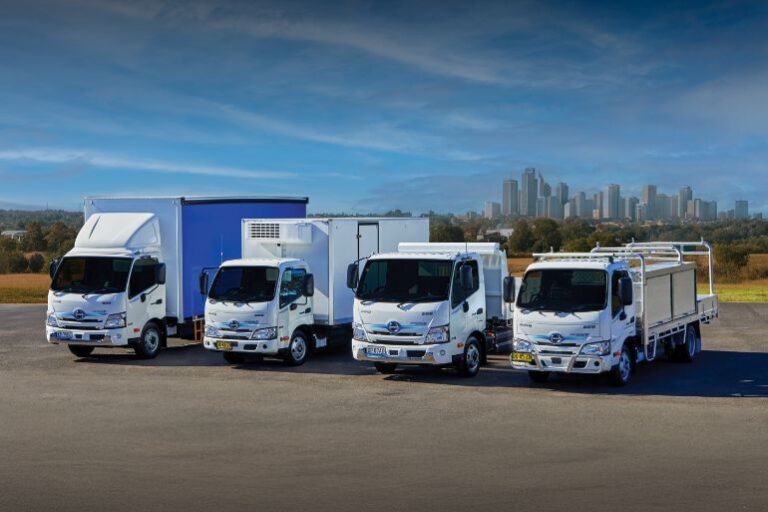
Hino says the purchase-price premium for its 300 Series Hybrid has narrowed to around 10% over an equivalent diesel, following a deliberate strategy to bring the two powertrains closer together.
The conventional diesel range’s transition to Euro 6 has helped close the gap, with Hino explaining that the hybrid already carried Euro 6 engine and emissions technology.
Speaking during the 300 Series media launch, Brian Wright, General Manager – Sales & Supply Chain at Hino Australia, said the company had worked over several years to improve the hybrid’s position in the market.
“It’s fair to say that probably five years ago it was too high,” Wright said of the premium. “We actively worked to reduce that.”
Different starting points for Euro 6
The updated conventional diesel incorporates additional exhaust after-treatment equipment, including selective catalytic reduction using AdBlue, alongside engine and transmission changes.
Those changes brought a price increase. The hybrid, however, had already used a Euro 6-compliant diesel engine since 2020.
Wright said the hybrid’s latest price increase principally covered the addition of Hino Connect, rather than the emissions transition affecting the conventional diesel.
The result is a closer purchase-price comparison between the two powertrains.
Hino executives put the hybrid premium at approximately 10% when talking to Fleet News Group. That provides an indication of the company’s positioning, with the actual dollar difference dependent on the variants and specifications being compared.
A deliberate shift in positioning
The narrowing gap reflects a longer-term pricing strategy.
Richard Emery, President and CEO at Hino Australia, said Hino had drawn on discussions with Toyota about its experience building demand for hybrid passenger vehicles, including the importance of bringing the premium within reach of more buyers.
Hino had subsequently applied smaller pricing adjustments to the hybrid than to the conventional diesel when reviewing the 300 Series range.
“We’ve always done a much less action on hybrid so that we could squeeze the price down,” Emery said.
For truck buyers, the significance is a lower additional investment to assess against potential operating savings over the vehicle’s working life.
Purchase price starts the comparison
A smaller premium strengthens the case for evaluating hybrid, but it does not establish the ownership-cost result for every application.
Operators need to compare equivalent trucks, including cab configuration, body, payload requirements and equipment. Annual distance, route conditions, fuel consumption and the planned replacement cycle then influence whether operating savings recover the additional purchase cost.
A truck working a busy urban delivery route may produce a different result from one spending much of its day travelling at a steady speed between regional centres.
The relevant question is how each powertrain performs on the intended task, supported by representative operating data.
Hybrid specification is also evolving
Hino is continuing to refine the hybrid alongside its pricing strategy.
The company has introduced a taller differential ratio for the Standard Cab Hybrid after Hino Connect data showed customers were undertaking more urban and regional travel than originally anticipated.
Hino says the change delivered a 5% fuel efficiency improvement in its assessment by reducing cruising engine speed.
That figure relates specifically to the gearing revision. It is not a measure of the hybrid’s fuel advantage over the updated conventional diesel.
For operators approaching a replacement decision, the narrower purchase premium makes a fresh comparison worthwhile. Obtaining matched diesel and hybrid quotations, then applying the fleet’s own workload and fuel data, will show whether the revised positioning translates into a stronger business case.