

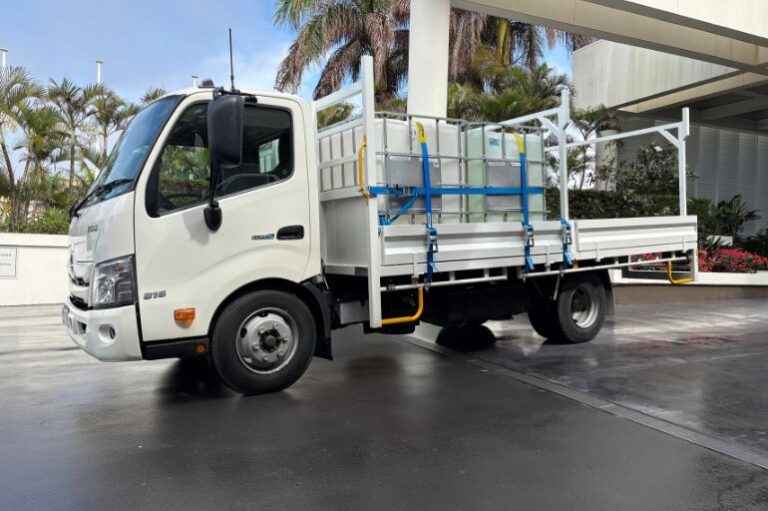
Hino has used the move to Euro 6 to introduce a broader package of changes to its 300 Series diesel truck, combining revised engine hardware, a next-generation automatic transmission and increased Gross Combination Mass ratings.
The four-litre N04C diesel now produces 440Nm of torque, while selected models offer a GCM of up to 11,500kg. A sequential shifter adds manual gear selection to the six-speed torque converter automatic.
Speaking with Fleet News Group, Daniel Petrovski, Department Manager of Product Strategy, emphasised that the changes extend beyond the emissions system.
“This is a Euro six update,” he said, describing the truck as an evolution of the existing 300 Series.
Engine revisions support broader capability
Torque rises from 420Nm to 440Nm, with maximum torque available from a lower engine speed than in the previous diesel model.
The engineering programme includes changes to the turbocharger, injectors, cooling components, pistons and cylinder liners, alongside the exhaust after-treatment required for Euro 6.
The diesel particulate reduction system is now complemented by selective catalytic reduction using AdBlue. Petrovski also outlined changes designed to help bring the exhaust system up to operating temperature.
Hino says the resulting engine and transmission combination improves driveability, particularly in hilly conditions and when operating under load.
The six-speed automatic retains a torque converter, with the next-generation transmission bringing revised control and lockup behaviour. Drivers can leave the truck in Drive or use the new sequential shifter to select gears.
Petrovski highlighted the additional gear control as useful for operators managing downhill descents with the exhaust brake.
Higher combination ratings
The updated powertrain supports increased GCM ratings across key diesel variants.
The 616 Standard and Wide Cab models, rated at 4,499kg GVM, offer a 7,999kg GCM and 3,500kg towing capacity.
The 716 combines a 6,500kg GVM with a 10,000kg GCM. The 816 models, rated at 8,000kg GVM, now offer an 11,500kg GCM.
Hino attributes the increased capability to the combined changes to engine torque and the automatic transmission.
“These are important steps to further increase the appeal of the 300 Series to our customers across all light-duty applications,” Petrovski said.
The revised ratings are particularly relevant to tipper, council and contractor applications where the truck must accommodate a payload as well as towing equipment. Final specification remains dependent on the complete truck and trailer combination.
Finding space for Euro 6
The emissions update has also required changes beneath and behind the cab.
An AdBlue tank and revised exhaust equipment place additional demands on available chassis space, prompting changes to fuel tank capacities and the location of components such as batteries.
Petrovski identified short-wheelbase models as a particular packaging challenge. The changes mean bodybuilders and operators need to assess the layout of the selected variant when planning bodies, storage and auxiliary equipment.
Fuel capacity changes vary across the range, making model-specific specifications important when comparing a replacement truck with an existing vehicle.
Cab and safety foundations retained
The update retains the established cab design and Hino SmartSafe equipment, while adding LED headlamps and fog lamps.
Standard safety features include a Pre-Collision System with Autonomous Emergency Braking and pedestrian detection, Lane Departure Warning, Vehicle Stability Control, a reverse camera and dual SRS airbags.
Four-wheel disc brakes and a cab certified to the UN ECE R29 strength standard also continue.
Inside, the truck retains its adjustable driving position, multi-information display and 10.1-inch multimedia unit with wireless Apple CarPlay and Android Auto compatibility.
Further range development ahead
Hino is preparing additional Built to Go configurations, including steel tray and van-body prototypes developed with Alltruck Bodies.
Further ready-bodied products are planned during 2027, with Petroski outlining crew-cab and higher-output variants as subsequent stages of the 300 Series programme.
The current Euro 6 diesel update gives operators increased torque and combination capability while retaining the familiar 300 Series platform. Its significance lies in how those changes work together—from engine response and transmission control to the practical task of fitting a body around the new emissions equipment.