
After spending a day driving Isuzu’s new AWD and 4×4 truck range off-road at Anglesea, one truck stood out for me.
The FTS 4×4 was my pick of the range.
We drove everything from the smaller NMS AWD Traypack through to the NPS and new NQS, and then up to the bigger F Series trucks. Each one had a clear role, but the FTS impressed me most because of the way it combined size, capability and control.
It is a serious truck, but it never felt difficult to manage.
Plenty of grunt without the drama
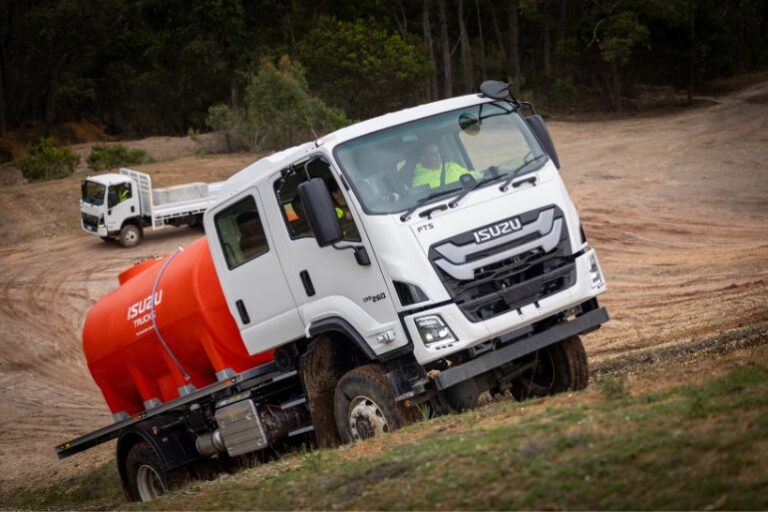
The FTS we drove was fitted with a water tank body, carrying around 3,000 litres, so it was not running around empty.
That gave us a good opportunity to see how the truck behaved with some meaningful weight on the back. We tackled a number of inclines during the day, including one of the steeper climbs on the course.
With low range selected and the drivetrain set up for the climb, the FTS simply crawled its way up. There was no sense that it was struggling for power or traction. It just kept moving.
That was probably the biggest thing that impressed me.
You expect a truck of this size to have plenty of torque, but being able to use that power in a controlled way off-road is what matters. The FTS did that very well.
The engine braking was just as impressive
Going uphill is only half the job when you are operating a heavy truck off-road. You also need confidence coming back down.
The FTS now has an engine compression brake, and that was one of the features that stood out during the drive.
On the steeper descents, the truck could work its way down at a controlled pace without the driver having to constantly rely on the service brakes. That is especially important in applications where these trucks are likely to be working.
Emergency services, mining, field support and remote operations can all involve steep terrain and heavy loads.
Being able to control speed on a descent without overheating or overworking the service brakes is a real operational advantage.
It feels like a truck designed for the job
The FTS is rated at 15-tonne GVM in the new range, and Isuzu has also made a number of changes around braking, chassis strength and driver support systems.
But what I noticed from behind the wheel was how easy everything was to use. The driving position was good, visibility was excellent and the controls were easy to understand.
There were no strange switches or functions that made you stop and think about what the truck was trying to do. That matters.
These vehicles can end up in fleets with a wide range of drivers, particularly in emergency services and specialist fleet environments.
A truck can be technically capable, but it still has to be straightforward for the person sitting behind the wheel.
Comfortable even when the track wasn’t
We were driving entirely off-road during the program, so there was plenty of movement through the cab.
The tracks included uneven ground, off-camber sections, rough surfaces and the sort of slow-speed terrain that constantly moves the truck around.
The suspension seat made a noticeable difference. Even when the cab was moving from side to side, I still felt like I had good control of the vehicle.
The new cabin also feels considerably more modern than older generations of off-road trucks. The dash is easy to read, there is a large infotainment display, and the general layout feels logical.
It is still a work truck, but it is a much better working environment.
FTS was my standout, but the NMS surprised me
The FTS was my favourite truck of the day, but the smaller NMS AWD probably delivered the biggest surprise.
It has much less ground clearance than the dedicated 4×4 trucks because it is designed more as an all-wheel-drive work vehicle.
I expected it to reach its limits fairly quickly. It didn’t. For the terrain we drove, it managed to keep up surprisingly well with the larger trucks.
It obviously has limitations compared with an NPS, NQS or FTS, and we did not take it through the water crossing used by the bigger 4×4 models, but for councils, tradies, service fleets and other operators that only need extra traction rather than serious off-road capability, I can see the appeal.
The NQS makes sense for multi-driver fleets
The new NQS was another interesting truck because of its nine-speed dual-clutch transmission. This is the model Isuzu is targeting strongly at emergency services, mining and other vocational fleets.
The two-pedal transmission makes it much easier for someone who is not driving trucks every day to get in and operate the vehicle.
That could be particularly important for emergency services, where a truck may have numerous drivers and some of them may only operate it occasionally.
The crew cab vehicle we drove also had rear air-conditioning vents, which sounds like a small feature until you consider how many people can be sitting in that cab on a hot day.
Those sorts of details matter in real fleet operation.
A 4×4 range built around different jobs
What became clear during the day was that Isuzu is not trying to make every truck do the same thing.
The NMS AWD suits fleets that need extra traction without requiring a serious 4×4.
The NPS remains the more traditional manual 4×4 platform with strong towing capability.
The NQS provides a higher-GVM, two-pedal option aimed at fleet applications such as fire services and mining.
And then there is the FTS. For me, that was the truck that brought everything together.
It had the power, the low-speed control, the engine braking and the overall capability you would expect from a serious off-road truck, but it was also comfortable and straightforward to drive.
After a full day across the Isuzu range, it was the one I would have happily taken back out for another lap.
That made the FTS 4×4 my pick of the day.