

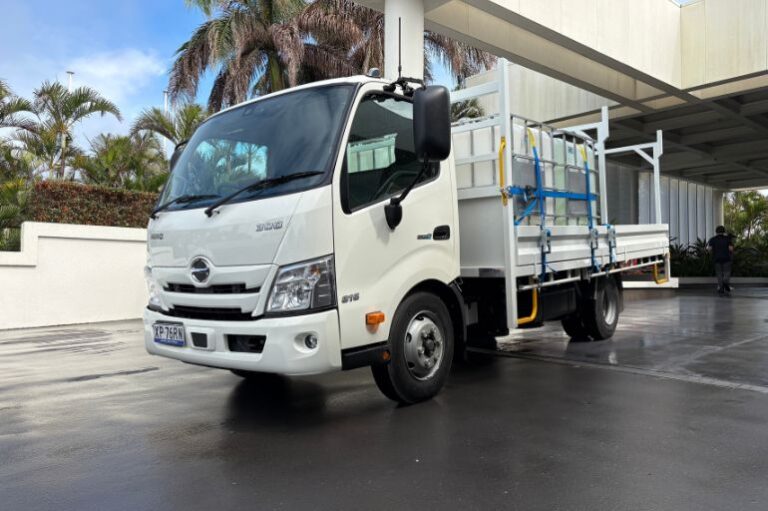
Hino’s Euro 6 300 Series looks familiar, but a drive through traffic, along the freeway and into winding mountain roads reveals a truck with a noticeably different character.
The combination of stronger torque delivery and an updated six-speed automatic makes the light-duty Hino an enjoyable working companion. Across several loaded models, the standout was how naturally the engine and transmission worked together.
Our final Best Value Analysis (BVA) score was 5.95/10, with Driving/On Road scoring 7.9/10. That difference matters: the broader assessment considers configuration choices, safety equipment, workspace features and manufacturer support as well as how the truck drives.
How it drives
A light-duty truck spends much of its life dealing with changing demands: traffic lights, hills, delivery stops and short freeway runs. The 300 Series handled that mix with an easygoing confidence.
The engine felt willing, while the automatic selected ratios without the hesitation or repeated gear changes that can make a working day frustrating. On winding climbs, it maintained momentum and responded naturally as the gradient changed.
There was no sense of the transmission constantly searching for the right gear. Shifts felt well timed, helping the truck feel spirited without requiring much intervention.
The narrow-cab models with independent front suspension were particularly enjoyable. Compact dimensions and low height make them appealing for urban duties, and the driving experience was more engaging than their workhorse appearance might suggest.
The on-road assessment awarded gearbox shifting 9/10, engine torque range 8/10 and visibility 9/10. Cabin noise scored 6/10, leaving room for improvement alongside the positive impressions of driveline behaviour.
More torque and a better partnership
The four-litre N04C Euro 6 diesel in the single-cab models produces 150 horsepower and 440Nm. Torque has increased from 420Nm, with maximum torque available from 1,300rpm rather than 1,400rpm.
Maximum power arrives at 2,700rpm instead of 2,500rpm. The broader operating spread helps explain the flexibility experienced on changing terrain.
The engine changes include a new turbocharger and injectors, revised pistons and cylinder liners, and cooling improvements. Selective catalytic reduction and AdBlue join the diesel particulate reduction system to achieve Euro 6 compliance.
The six-speed torque-converter automatic is also updated. It now operates on 12 volts, matching the engine, replacing the previous arrangement in which the transmission operated on 24 volts. Hino attributes quicker shifts and faster torque-converter lock-up to the improved communication.
There is also a sequential selector for manual gear selection. Drivers can choose a ratio ahead of a climb or descent, although leaving the transmission in Drive worked well for most of our route.
The Engine/Transmission BVA score of 4.6/10 needs context. This category assesses the number of engine, transmission, final-drive and PTO options. It measures choice across the offering; the separate on-road category captures how the driveline performs.
Familiar cab, improved lighting
The exterior is an evolution of the existing 300 Series. Cosmetic changes are subtle, and the Euro 6 badge is an easier identifier than the familiar cab shape.
LED headlamps provide an enlarged illuminated area, while LED fog lamps are standard across the range. Diesel models also receive LED daytime running lamps.
Inside, wireless Apple CarPlay makes a substantial difference to everyday convenience. The 10.1-inch multimedia unit also supports Android Auto, while the instruments include a 4.2-inch multi-information display.
Clear instrumentation and accessible controls contribute to the straightforward driving experience. Suspension seating in the wide-cab models adds another comfort consideration for buyers comparing applications.
Workspace Ergonomics scored 6.2/10. Personal storage scored well, while cabin power options were a weaker area in the assessment.
Check the chassis against the job
Euro 6 equipment takes space. The AdBlue tank and revised exhaust system have required changes to component locations and fuel tank packaging, with capacities varying by model.
That makes a detailed body and equipment discussion worthwhile before ordering, particularly for short-wheelbase applications.
Hino quotes a minimum 3,500kg towing capacity across the diesel range, with GCM reaching 11,500kg on selected models. The 4,499kg GVM 616 models have a quoted GCM of 7,999kg.
Buyers still need to check the specific truck, body, payload and trailer combination. Chassis/Suspension scored 3.6/10under criteria that assess axle, weight-rating and suspension choices.
Safety and support
Standard Hino SmartSafe equipment includes a pre-collision system with autonomous emergency braking and pedestrian detection, plus lane departure warning. Vehicle stability control, a reversing camera, dual airbags and four-wheel disc brakes also feature.
Safety/Sustainability scored 5.6/10, while Manufacturer Support was a stronger result at 7.6/10.
The support package includes a five-year/250,000km warranty, whichever comes first, five years of roadside assistance and capped-price servicing.
Final BVA scores
| Category | Weight | Score /10 | Weighted result |
|---|---|---|---|
| Driving/On Road | 20% | 7.9 | 1.58 |
| Engine/Transmission | 20% | 4.6 | 0.92 |
| Chassis/Suspension | 15% | 3.6 | 0.54 |
| Safety/Sustainability | 15% | 5.6 | 0.84 |
| Manufacturer Support | 15% | 7.6 | 1.14 |
| Workspace Ergonomics | 15% | 6.2 | 0.93 |
| Overall | 100% | 5.95/10 |
The verdict
The Euro 6 Hino 300 Series makes its strongest case from the driver’s seat. The engine and automatic transmission work together convincingly, delivering an approachable, enjoyable truck across varied conditions.
Its broader BVA result highlights the importance of matching configuration and equipment to the job. For buyers whose needs fit the available specification, the reward is a light-duty truck that gets on with the work while making the driving feel easy.