

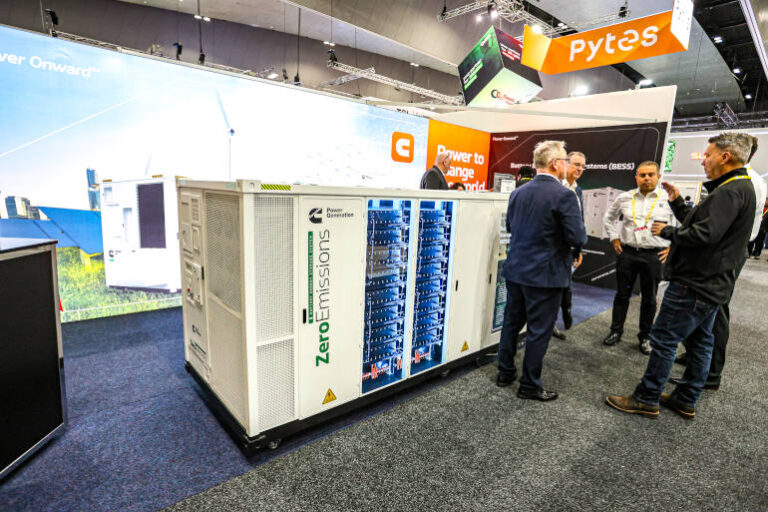
Cummins used All-Energy Australia 2025 to unveil its new Battery Energy Storage System (BESS)—a containerised, fully integrated storage solution designed for commercial, industrial and remote applications. While Cummins is well known in Australia for its diesel and gas generators, the introduction of BESS marks the next phase of its power generation strategy: supporting reliability and resilience while reducing emissions and integrating renewables.
At the launch, Sherif Ibrahim, New Energy Solutions BDM APAC at Cummins Power Generation, provided detailed insights into the technology, the architecture, and the practical customer applications.
A new addition to the Cummins Power Generation portfolio
Sharif said the BESS extends Cummins’ long-running power generation offering:
“Cummins have been known for more than a decade for diesel and gas generators, and now we are adding to our power gen portfolio battery energy storage systems, which can be integrated with our diesel or gas gensets or even renewables.”
This integration point is central to Cummins’ energy strategy. Rather than replacing existing infrastructure, the BESS works alongside it—supporting low-emission, hybrid power systems for customers who are transitioning at different speeds.
Two architectures, multiple configurations
Sharif outlined the technical structure of the new system:
“We are having two architectures for our battery energy storage systems, starting from 211 kilowatt hour and 422 kilowatt hour in 10-foot containers. And we’re having another architecture starting from 600 kilowatt hour up to two megawatt hour, which is scalable and can be interconnected.”
The larger 600 kWh–2 MWh units are designed for high-demand applications and can be combined to create multi-megawatt-hour installations. Sharif noted that some customers are already requesting 10 MWh and above, achieved by linking several units together.
All systems are designed as plug-and-play, simplifying installation for commercial and industrial sites, fleet depots, microgrids and mining operations.
Integrated AC-output design with smart controls
One of the key differentiators of the Cummins BESS is how much equipment is included inside a single enclosure.
Sharif described the integrated design:
“We are having in the same container… the batteries, the isolation transformer, the microgrid controller and the power conversion system. This is something very innovative and adds to our power gen portfolio.”
The integrated AC-output architecture means customers do not need to source separate components from multiple suppliers—reducing project complexity and risk while simplifying commissioning.
Sharif added:
“It’s a plug-and-play concept, so you can put it on site, just plug it and play with your distributed energy resources.”
This includes Cummins gensets, existing on-site PV, or other DER assets.
Lithium iron phosphate chemistry for safety and durability
Sharif confirmed that Cummins selected Lithium Iron Phosphate (LFP) as the battery chemistry:
“The chemistry is lithium ion phosphate.”
LFP is widely regarded for its thermal stability, long cycle life, and suitability for industrial environments—important considerations for Australian conditions, particularly mining, transport depots, and remote operations with high ambient heat.
Combined with liquid cooling, integrated fire suppression, and compliance with AS/NZS and IEC standards, the system is designed for safe operation across Australia’s temperature extremes.
Applications: from remote communities to commercial peak shaving
One of the key strengths of the BESS is its versatility across multiple use cases.
Sharif highlighted several examples:
“One of the main applications… is serving remote communities and critical sites. We add to the resiliency of those networks by integrating with other distributed energy resources.”
He also pointed to commercial and industrial benefits:
“We are lowering cost because we can utilise it during peak shaving and high demand by dispatching energy from the battery… and we can export energy to the network during demand response, which allows our customers to earn incentives.”
For fleet depots transitioning to EVs, the ability to manage peak demands, stabilise loads and integrate solar provides a pathway to reduce energy costs and improve operational reliability.
Supporting disaster response and operational continuity
Sharif confirmed the system also has clear resilience benefits:
“We are ensuring uninterrupted operations.”
This is relevant for councils, utilities, logistics operators and emergency services that need energy security during grid outages, natural disasters or high-demand periods.
Scalable and future-ready
Sharif emphasised the scalability as a key design requirement:
“It’s a product which is scalable and can be integrated… our highest energy node is two megawatt hour, but several customers are requiring 10 megawatt hour and more by integrating multiple units.”
This modular approach ensures the platform can evolve alongside customer requirements, particularly for organisations planning multi-stage decarbonisation programs or expanding renewable generation.
A technically robust solution backed by Cummins’ network
The BESS launch positions Cummins as a full-suite energy provider—offering diesel, gas, hydrogen, solar integration, microgrid controls and now storage under a single support framework.
For technically minded customers, the key message from Sharif was the combination of durability, integration and simplicity:
“It’s high-density energy in a very small footprint.”
With the new BESS platform, Cummins is building a hybrid approach to power generation that suits Australian conditions and helps organisations progress toward lower emissions without compromising reliability.