
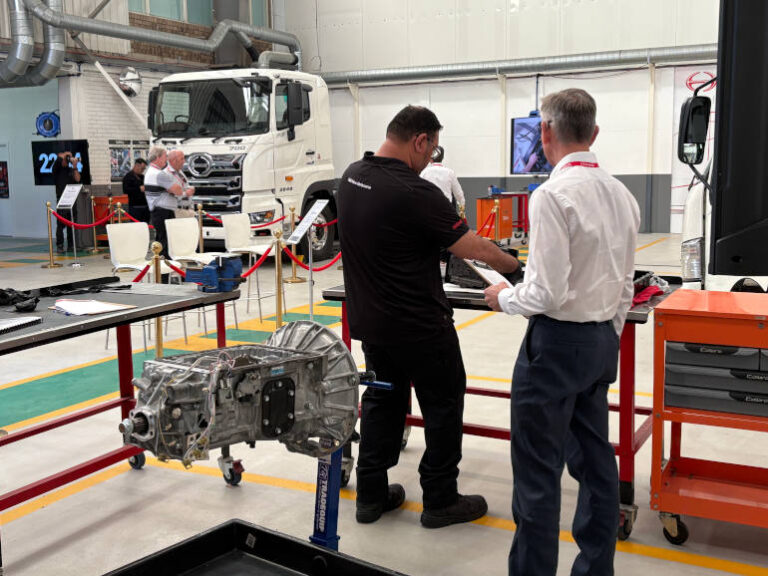
Hino Australia’s National Skills Contest has grown from a small internal trial in 2008 into a sophisticated capability-building platform that now underpins the brand’s approach to training, customer experience and after-sales support. The 2025 event, held at Hino’s Sydney headquarters, once again demonstrated why the contest is one of the longest-running programs of its kind in the Australian transport sector.
Hino President & CEO Richard Emery says the competition plays a critical role in continually strengthening the dealer network. He describes it simply: “We want to continually increase the skills of our people across the dealer network.” He adds that the purpose extends well beyond the event itself. It exists to support the part of the business that matters most for customers: “the bit that comes after the sale, which, particularly in the truck industry, is so critical.”
The contest is structured across three streams — Service, Parts and Sales — and finalists qualify only after completing extensive online learning, assessments and dealership-based training modules. When they arrive at the national final, they enter what Emery calls “a bit of a pressure cooker,” designed to bring out accurate, consistent and professional performance.
A training engine for a changing industry
Hino General Manager – Sales & Supply Chain Brian Wright says the contest tracks directly to what is happening in the market. “The market is continuing to evolve. Our customers’ needs are continuing to evolve, as well as truck product is continuing to evolve,” he says. “Staying in front of that curve is very, very important.”
Wright highlights one of the biggest challenges for sales teams today: translating increasingly complex technical specification into practical customer solutions. “Payload is God in the trucking industry,” he says. A salesperson’s ability to advise on weight distribution, axle layout and the differences between models can be “the difference between winning or losing a deal.”
This year’s sales assessments included TrailerWIN and TruckScience tasks to test how consultants adapt specifications between models such as the 500 Series and the 700 Series. Wright notes that moving a customer from one platform to another requires detailed product insight: “The weight distribution of how a body fitted on a 500 is different to a 700, so we’re seeing how they can adapt and still meet the customer’s needs.”
Technology reshaping skills
The contest also reflects broader shifts in operating conditions: Euro 6 engines, emissions systems, new digital platforms and hybrid powertrains are changing how trucks are sold, serviced and supported.
Hybrid technology has become a recurring theme. “Hybrid provides a good stepping position at this point in time,” Wright says. It offers fleets lower emissions without the payload compromises associated with early electric trucks. Parts and service teams must also be able to manage high-voltage systems with accuracy, confidence and appropriate safety processes.
Telematics is another area where capability matters. Wright says Hino-Connect has become a key part of customer conversations: “It also assists with customers managing the uptime of their truck through the 24/7 diagnostics.” With portal activation rate of around 96 percent across eligible models, understanding the platform is now part of the job.
After-sales excellence as a strategic focus
Emery emphasises that the contest is designed to showcase Hino’s commitment to after-sales support. “It’s important for us to show how committed we are to the after-sales experience that our customers have,” he says.
This aligns with significant investment in training and tools across the network. Virtual-reality diagnostic headsets, remote assist capability, warehouse efficiency programs and new service processes like the Service Efficiency Program (SEP) — initiated byGreg Bleasel, Vice President – Product Support — all point toward the same objective: reducing downtime.
Gus Belanszky, General Manager – Service & Customer Support, says the contest also helps technicians demonstrate their capability to customers, suppliers and dealers. “It’s that opportunity to show what they can do, their level of skill,” he says. “What they do keeps our customers on the road and keeps them happy.”
A cultural asset for the network
For Bleasel, who helped create the contest back in 2008, the evolution has been dramatic. “It started off with just service, about eight people,” he says. Today the contest draws finalists from across Australia, along with dealers, partners, suppliers and guests from Japan and New Zealand. He describes it as an event that “energises the brand.”
The growth of the Master Technician Program is another example. Bleasel says Hino is now enhancing the program with new privileges and responsibilities to recognise senior technical expertise. “We want to add more value to what the master technician is,” he says.
Looking ahead
As the transport sector moves into an era of low-emissions technology, data-driven service and evolving compliance obligations, training will be a competitive differentiator. Hino’s Skills Contest has become more than an annual event — it is a capability engine designed to ensure every dealership can support customers with consistent, modern and highly skilled service.
Emery says the contest demonstrates the values Hino wants customers to see: professionalism, commitment and a culture of continuous improvement. For fleets, those qualities show up in the places that matter most — at the workshop counter, at the parts desk, and on the service floor, keeping trucks on the road.