

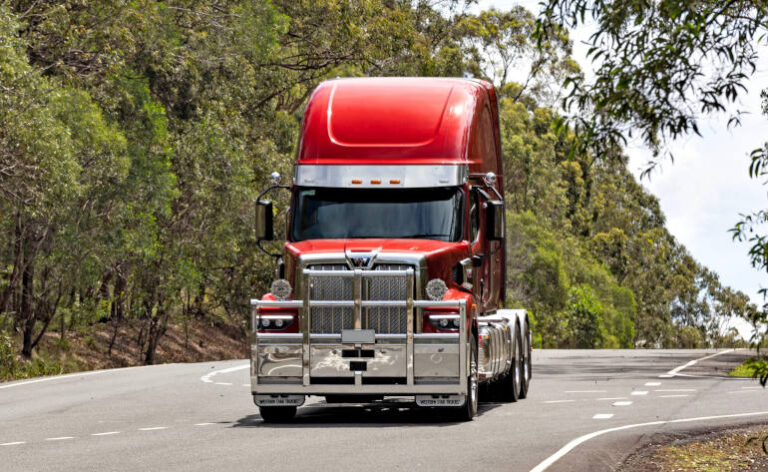
After nearly 15 years with Penske, Jono Wrightson, Business Manager – Detroit at Penske Australia and New Zealand, has seen the Detroit brand evolve alongside changing fleet priorities across Australia and New Zealand.
In a wide-ranging conversation with Fleet News Group, Wrightson unpacked what his role covers, how Detroit engines have quietly built a reputation for longevity and efficiency, and why “more power” isn’t always the answer fleets think it is.
A broad role across the Detroit portfolio
Wrightson’s role spans the full Detroit footprint across Australia and New Zealand, covering everything from technical support and warranty to parts and sales enablement.
“So the Business Manager role incorporates anything to do with Detroit across Australia and New Zealand for that matter. So there’s the technical aspect, there’s warranty, there’s parts… and helping sales within the truck brands being Western Star and Freightliner,” he said.
That support role is as much about education as it is about engineering, particularly helping fleets understand where Detroit fits across different applications.
Long-standing architecture, familiar to workshops
One of the recurring themes in the conversation was continuity. Detroit’s current engine platform traces its roots back to emissions requirements introduced in the US nearly two decades ago, and that consistency still matters to fleets today.
“It was designed for the 2007 emissions in the US, and we’re still using pretty much the same platform to this day… things aren’t being moved around,” he said. “So for stability and recognition of the product, that’s really good.”
For Fleet Managers and workshop teams, that stable architecture translates into familiarity, simpler servicing, and fewer surprises over time.
Small design details that add up
Wrightson pointed to practical engine design choices that often go unnoticed but make a difference day-to-day.
“With our fuel filters and oil filters on the engine are above the chassis rail… they’re dry filled,” he explained. “You don’t have to worry about tipping oil into the wrong hole or contaminants going in.”
There are environmental benefits too.
“Because they’re a canister filter, they are a bit more environmentally friendly, because you don’t have that metal sleeve around the outside you’re throwing away all the time.”
Cooling, emissions and longevity
Cooling and emissions management has been a major focus of Detroit’s engineering approach, particularly around EGR design.
“If you put your EGR cooler at the top of the engine… air always tries to get to the top, so the air can get out,” Wrightson said. “It’s more to do with longevity of the engine.”
Detroit’s approach has also delivered lower AdBlue consumption.
“The AdBlue usage of our engine being around three to four per cent… because we’ve got a proven and successful EGR system,” he said. “That’s reducing costs.”
The quiet achiever: DD13
While headline power figures often dominate conversations, Wrightson believes the 13-litre engine deserves more attention.
“They’ve been the quiet little achiever. You don’t hear much from the engines whatsoever… the little 13 does a good job in all sorts of roles, B-doubles, around-town vocational work.”
Improved road infrastructure has also shifted the equation.
“If you look at the old Pacific Highway versus the new Pacific Highway now… the 13-litre can quite easily do the job of what the 15 or 16-litre people look for these days.”
Power versus productivity in a PBS world
With more fleets pursuing PBS combinations, Wrightson acknowledged the tension between productivity and efficiency.
“If you are going to cart more, you’re going to end up burning more fuel,” he said. “If we wanted to be a balance between efficiency and power, yeah, we probably realistically need to stay where we are.”
He also suggested some buying decisions are still influenced by perception.
“It comes down to the driver… if they think they can get to the other end quicker. More power sounds like it’s more better.”
Safety, automation and the modern cab
Safety technology and automated drivetrains are increasingly part of fleet discussions, particularly for larger operators.
“Safety does come up… stopping, roll stability, and trying to prevent the nose-to-tail accidents,” Wrightson said.
Automated transmissions are also changing the driving experience.
“There’s a lot of people going for the automated gearboxes these days,” he said. “There’s efficiencies by having a proprietary driveline.”
The result is a markedly different in-cab environment.
“The in-cabin noise these days… it’s a really calm driving environment. It’s not like it used to be.”
Looking ahead
While Detroit is active in electric and zero-emission truck programs in parts of the US, Wrightson was measured about local timelines.
“That’s probably a little bit away for us at this point, purely because of the weights that we carry,” he said. “It’s about fit for purpose.”
For now, the focus remains on proven platforms, incremental efficiency gains, and matching the right engine to the job — rather than chasing the biggest number on the spec sheet.
For fleet buyers weighing productivity, whole-of-life cost and reliability, Wrightson’s message was clear: sometimes the most effective solutions are already quietly doing the work.