
In an exclusive interview at Geotab Connect 2025 in Orlando, Florida, Sean Killen, Vice President of Global Markets at Geotab, shared his observations on the Australian trucking industry, highlighting its unique challenges, technological adoption, and where he sees it heading in the coming years.
Regulations and Technology Lag
Australia’s trucking industry operates under some of the most stringent compliance requirements in the world, which has shaped the slow adoption of global telematics solutions.
“Australia doesn’t care if what the US does. I’m Australia. I want what Australia wants. Because I’m Australia, I can do what I want,’” Killen said, highlighting the country’s independent regulatory stance.
This insistence on unique national regulations has made it difficult for international telematics providers to enter the Australian heavy-vehicle market.
“It’s hard to make sure you comply with everything that Australia requires, because it’s a very advanced country… a lot of companies haven’t gone in because of that. Because it’s hard, it’s hard to learn everything you have to know about Australian compliance.”
Geotab, however, has invested heavily in developing a compliant heavy-truck solution for Australia, a process that took 18 months of dedicated R&D.
“We finally, in the next month, should have a big announcement that we’re fully compliant in Australian heavy truck,” he revealed.
A Traditional Industry Facing Modern Pressures
Unlike other markets, Australian trucking remains heavily owner-operated, with many businesses passed down through generations.
“The Australian trucking industry will very much have to modernise in the next 10 years to more of a digital platform, because the margins are so tight. The big groups have already done it. The small, local, entrepreneurial guys will have to do it too.”
Killen noted that at truck events like the Brisbane Truck Show, the industry’s traditional nature is on full display.
“If you go to the Brisbane Truck Show right now and you walk around, it is like old school. And those guys got into that lifestyle because they wanted the freedom of that life. And they love it.”
Introducing new technology into this deeply traditional sector has been a challenge.
“To introduce technology is a little scary. But the progressive companies—like your Toll and Linfox and some of the smaller transport companies that are running at very tight margins—they must innovate and be advanced.”
The Generational Shift Will Drive Change
Killen believes that change is inevitable, as younger generations inherit trucking businesses.
“One of my favorite things about the Australian trucking market is they are super proud to own those companies… but the margins are tight, and the kids know that they’re gonna have to innovate.”
He described the generational dynamic at industry events, where families attend together.
“You’ll see dad, son, and teenager walking around together, and dad’s still driving. Grandpa owns the company, and he’s the CEO, and then the kid is just waiting till he’s allowed to drive.”
Unlike in the United States, where many families encourage their children to leave trucking, Australians tend to keep their businesses within the family.
“In the US, a lot of them have been absorbed into big companies, so there’s no ownership anymore. In Australia, it’s like, ‘Grandpa owns the company, dad’s the CEO, and I’m the next CEO.’ And they’re going to keep it in the family.”
Heavy Reliance on Trucks vs. Rail
Another defining feature of Australia’s transport industry is the lack of rail infrastructure, which makes long-haul trucking essential.
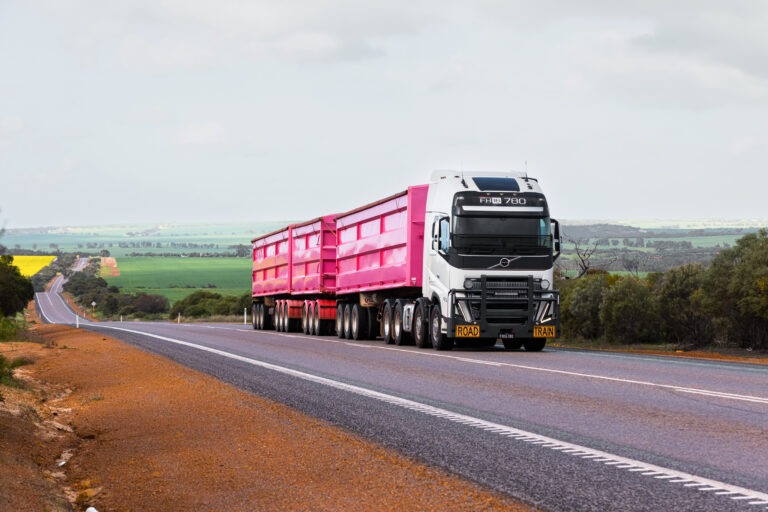
“In Australia, that’s done by a truck, right? You got those four trailer big, crazy ones,” Killen said, referring to road trains used for freight transport across vast distances.
“I think those are the most fascinating vehicles I’ve ever seen, that somebody can drive that and make a turn with that… it’s insane.”
Unlike in North America, where freight rail networks reduce truck reliance, Australia’s trucking industry carries much of the country’s supply chain burden.
“You don’t see it anywhere else… I don’t see that in Brazil or Mexico. There’s no quads anywhere else.”
The Road Ahead: Digital Innovation
Killen is confident that, while change will take time, Australia’s trucking industry will eventually shift towards digital platforms and AI-driven telematics.
“The small, local, entrepreneurial guys will have to do it too… but 80% of the Australian trucking industry is owner-operated with like, five vehicles, 10 vehicles at the most.”
As the next generation of trucking entrepreneurs takes over, digital transformation will become essential for survival.
Killen’s insights paint a picture of an industry rooted in tradition but facing undeniable change. With growing regulatory pressures, increasing safety demands, and the need for efficiency, Australian trucking is on the verge of a telematics revolution.
- Hino 500 Series Means Business
 Hino is putting Australian operating experience at the centre of its 2027 medium-duty 500 Series, highlighting an established driveline alongside standard safety technology and connected fleet support. Since the platform’s introduction in 2019, the 500 Series has worked across applications ranging from freight and construction to council services and towing. For fleet managers assessing replacement
 - Three risks behind more than a third of major truck incidentsInattention, inappropriate speed and inadequate following distance accounted for 38% of major heavy vehicle incidents in 2025, according to new research that gives fleet managers a clear starting point for reviewing their safety priorities. The 2026 National Truck Accident Research Centre (NTARC) Major Incident Investigation Report found human factors contributed to 54.7% of all major incidents analysed.
- MAN TGS wins 2026 Fleet Truck of the Year – Heavy DutyThe MAN TGS has been named the 2026 Fleet Truck of the Year – Heavy Duty, taking the top spot in the Fleet News Group Best Value Analysis with an overall score of 7.730 out of 10. The MAN finished ahead of the Hino 700 Series, which scored 7.600, and the Volvo FH16, which recorded 7.495, making the Heavy Duty category one of
- IVECO Daily wins 2026 Fleet Truck of the Year – Light DutyThe IVECO Daily Cab Chassis 50C has been named the 2026 Fleet Truck of the Year – Light Duty, finishing on top of the Fleet News Group Best Value Analysis with an overall score of 6.010 out of 10. The Daily finished ahead of the Isuzu NPR , which scored 5.741, and the Hino 300 Series, which recorded 5.030. While all three finalists
- Modern trucks could help the industry tackle its driver challengeThe heavy vehicle industry’s driver shortage is not only a recruitment problem. It is also forcing truck manufacturers and fleet operators to reconsider the working environment they provide drivers. Hino Australia President and CEO Richard Emery believes the industry needs to do more over the coming years to encourage people to consider truck driving as