

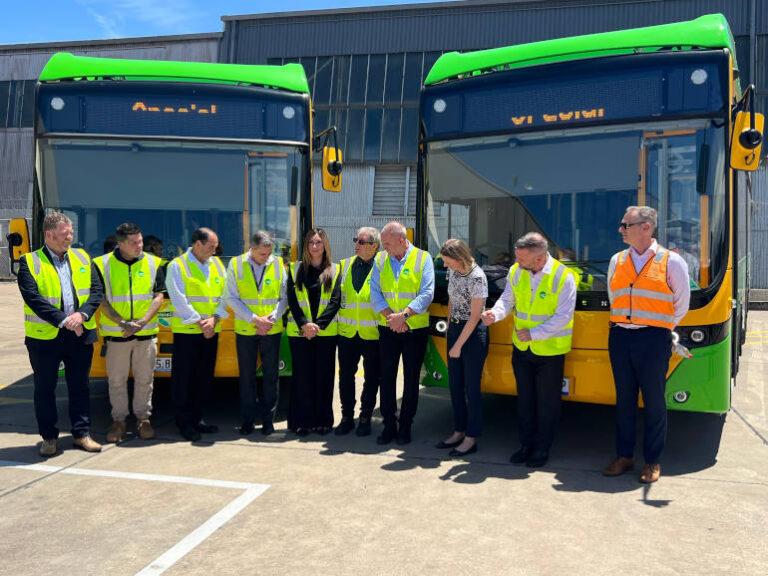
South Australia has taken a substantial step toward a zero-emission public transport network, with the State Government confirming the arrival of the first 60 new battery-electric buses that will replace ageing diesel units across Adelaide Metro. The initial two Scania-supplied buses will enter service next week, with the full rollout scheduled for completion by mid-2026.
For heavy-vehicle operators, the move signals a shift in procurement, infrastructure planning, and safety standards that will increasingly influence future fleet decisions—particularly as jurisdictions move toward similar emissions targets.
Decarbonisation at Scale
The introduction of the electric fleet is part of a broader strategy to decarbonise the state’s transport operations, with significant reductions in operational emissions expected immediately.
According to the State Government, replacing older diesel buses with the new BEVs will remove more than 4,500 tonnes of carbon from the atmosphere each year—roughly equivalent to powering 1,500 homes.
Minister for Infrastructure and Transport Emily Bourke said the arrival of the first units marks a turning point.
“This is an exciting milestone for our public transport network with the first two electric buses now handed over to the State Government and ready to hit the road.”
“Not only will this remove tonnes of unwanted carbon from our atmosphere each year, but it will also provide a cleaner and smoother ride for passengers.”
She noted that the rollout forms part of the state’s broader commitment to net zero.
“This is a major step forward to achieve our target of net zero by 2050, positioning us as a leader in zero-emission public transport.”
Infrastructure and Operational Readiness
The electrification program includes substantial depot upgrades. At Morphettville, new charging bays are being installed to support the incoming BEV fleet, enabling full-day route coverage with vehicles capable of travelling more than 200 km on a single charge.
In parallel, global engineering firms Mott MacDonald and WSP are developing detailed business cases to support the wider transition across both rail and bus networks, giving transport operators clearer pathways for future infrastructure needs.
For heavy-vehicle fleets, the state’s direction reinforces several trends already emerging nationally:
- diesel-only procurement has ceased,
- hybrid and BEV models are becoming the default option,
- depot-based charging and power-supply planning is now business-critical.
Technology and Safety Improvements
Beyond emissions reduction, South Australia is using the fleet upgrade to lift network-wide safety standards. All 60 electric buses will be fitted with full protective driver security screens, with the State Government now halfway through retrofitting its entire 940-bus fleet.
Minister Bourke emphasised the focus on driver safety:
“These buses come with the latest technology and have been fitted with the full driver security screens to better protect our bus drivers.”
The electric buses also introduce Advanced Driver Assistance Systems (ADAS), including lane-keeping support, speed management, and detection technology for pedestrians and cyclists.
From a heavy-vehicle management perspective, this aligns with ongoing national efforts to reduce risks for drivers and vulnerable road users while preparing fleets for connected and autonomous safety systems.
A Long-Term Partnership Driving the Transition
Scania Australia has been supplying Euro 6 compliant buses to South Australia since 2015 and more recently provided hybrid and battery-electric models. The company says this next stage brings long-planned sustainability goals to life.
Jamie Atkinson, Scania Manager, said:
“The Department for Infrastructure and Transport and Scania have long been committed to driving the shift towards a sustainable transport solution for route buses in South Australia.”
He highlighted the practical benefits operators and commuters will see immediately.
“When in service, fully electric buses are all but silent in operation 100% of the time, with no tailpipe emissions at all. When powered by electricity produced from renewable sources in South Australia, they deliver public transport that is cleaner and greener than ever.”
“This technology is a win for commuters and the environment.”
What It Means for Heavy-Vehicle Fleet Operators
For HV News readers—Fleet Managers, Workshop Managers, and Procurement teams—the announcement reinforces several market signals:
- Diesel-only fleets are entering sunset phase, with state contracts leaning heavily toward BEV and hybrid.
- Safety technology is not optional; it is becoming standard across government procurement.
- Infrastructure planning must start early, as depots need power, charging, and layout changes long before the first vehicles arrive.
- OEM partnerships matter, as long-term technology roadmaps increasingly influence whole-of-life performance and asset replacement planning.
South Australia’s adoption of electric buses at scale provides a strong case study for other jurisdictions and private heavy-vehicle fleets preparing their own decarbonisation strategies.