
After several years of building capability, infrastructure partnerships and customer confidence, Australian fleet operators are now starting to adopt electric light trucks in meaningful volumes.
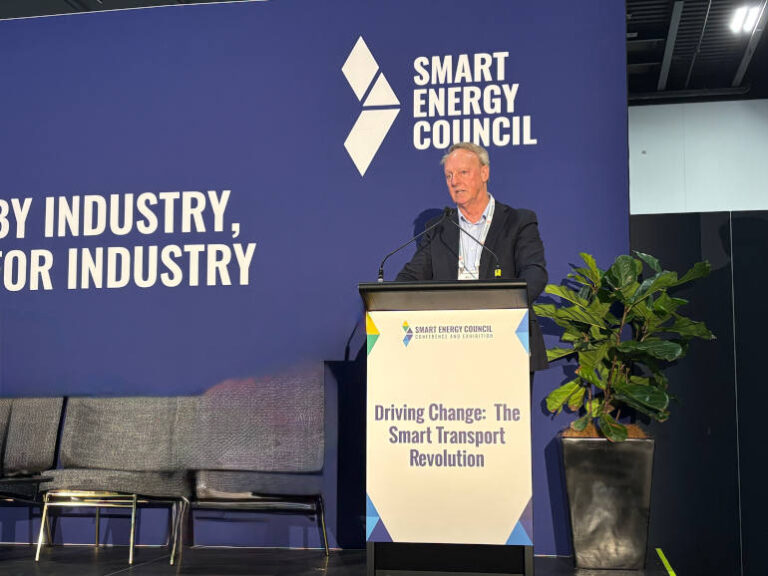
Speaking at the Smart Energy Conference and Exhibition in Sydney, Bill Gillespie, General Manager at Foton Mobility Distribution Pty Ltd, outlined the scale of deployment now occurring across major retail, logistics and local government fleets using Foton electric trucks.
“Our business, we are unashamedly Australia’s number one EV truck distributor in Australia,” Gillespie said. “We can now boast customers like Bunnings who have six of our trucks in their stores around Australia. Woolworths, by July, they’ll have 280 of our last mile trucks.”

The Woolworths deployment represents one of the largest operational electric truck fleets currently running in Australia and demonstrates how rapidly the rollout has accelerated since the first vehicle entered service.
“Since they took the first delivery of that Woolworths truck in July 2023, they’ve gone from one and now in July this year, so three years later, they will deliver their 280th truck,” said Gillespie.
“They’re operating from Cairns all the way around to Adelaide. We haven’t done any in Tasmania yet or WA but they are going to be next.”
According to Gillespie, the trucks are no longer operating as isolated demonstrations or sustainability pilot programs. Instead, they are now functioning as part of normal fleet operations.
“If people say, well, it must be some sort of special use case, it’s not,” says Gillespie.
“They run them from their normal depots, albeit they have put charging into those depots. They run on AC charging. They do DC top ups occasionally, but largely speaking, they charge them overnight. They use them during the day.”
The operational data emerging from those fleets is becoming increasingly significant. Gillespie said the Woolworths electric truck fleet has already travelled more than five million kilometres in normal delivery duties.
“Since they’ve started running those Woolworths trucks, they’ve covered five million kilometres of EV last mile driving,” states Gillespie.
The growth is also spreading into other commercial fleet sectors. Foton recently supplied electric trucks to Winning Appliances as part of a broader industry push supported by ARENA and financing partner Zenobē.
“We’re growing the fleet,” explained Gillespie. “Winning Appliances are taking on more trucks on.”
Local government fleets are also beginning to emerge as a major opportunity for electric truck adoption, particularly in tipper truck applications where many vehicles operate on predictable metropolitan routes.
“We’re selling a lot of trucks into Melbourne,” claims Gillespie. “Brimbank Council, Casey, Monash, Dandenong, Merri-bek — all are buying four-and-a-half-ton tipper or six-ton tipper trucks, and now moving into eight-and-a-half-ton tipper trucks.”
Gillespie said the transition within councils is happening gradually as operational teams gain confidence in the technology rather than attempting wholesale fleet replacement.
“A lot of councils talk green. This is an opportunity. I’m not for a minute saying that councils should just change the whole fleet. That’s not going to happen, but there is an opportunity to change them over.”
One of the strongest indicators of market acceptance has been driver feedback. Gillespie said operators who initially preferred diesel vehicles often quickly change their opinion after driving electric trucks.
“I’ve never had one driver come to me and say, I really want to just go back to driving a diesel,” explains Gillespie. “Woolworths have got 3,500 drivers. I’ve never had one say to me, we just really love driving our diesels. Once they drive the EV trucks, they love them.”
Noise reduction has also become an unexpected operational benefit, particularly for urban and residential deliveries.
“We know anecdotally from customers who take deliveries from Woolworths zero-emission trucks — cafes, homeowners — they like this,” said Gillespie. “They respond pretty well to the Woolworths brand doing it. They like the fact that the trucks are quiet so they can run later in the day.”
Despite the growing momentum, Gillespie acknowledged that electric trucks still represent a small percentage of the broader Australian light truck market. However, he believes even partial adoption could have a major impact on emissions reduction.
“The reality is, if you just tackle the light duty trucks of Australia and said by 2030 half of them we sell each year will be zero emission, you’d make an enormous difference.”
According to Gillespie, approximately 15,000 diesel light trucks are sold in Australia every year, with each diesel truck producing around 21.5 tonnes of carbon emissions annually.
“So if you extrapolate the Woolworths and Coles fleets, 2,600 trucks, and they all became zero overnight, it would be 2,600 by 21 and a half tonnes every year eliminated.”
For Gillespie, the most important development is that the market conversation has shifted from whether electric trucks can work to how quickly fleets can operationalise them.
“What came from an idea five years ago when I started in this — I came from Hino trucks into this zero-emission world of trucks — it’s really taken three or four years for an overnight sensation.”