


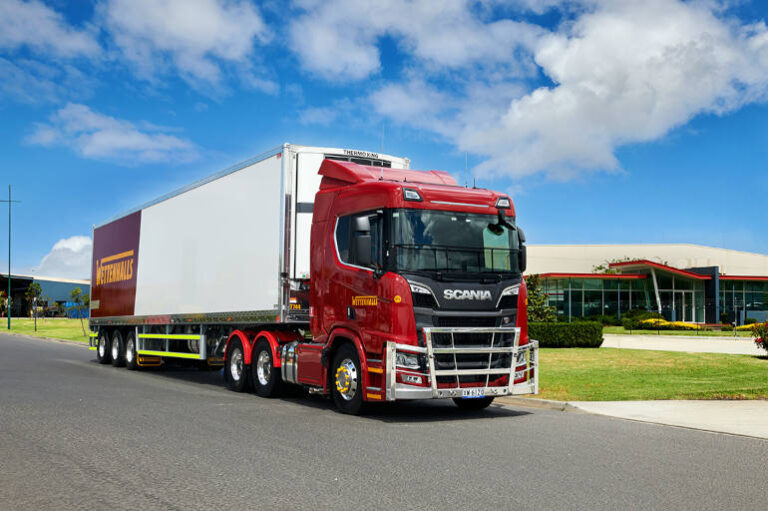
Melbourne-based transport company Wettenhalls has taken delivery of its 100th Scania truck, marking a significant milestone in the company’s long-term shift towards safer, more efficient and lower-emission fleet operations.
The milestone vehicle forms part of a broader order of 15 new trucks being delivered in early 2026, continuing a relationship that has developed over the past decade as the company modernises its fleet to meet evolving operational and customer requirements.
Founded in 1925 in Colac, Victoria, Wettenhalls has grown from servicing the dairy industry into a national logistics provider operating approximately 200 trucks and trailers. Today, its operations span bulk dry, chilled and frozen logistics, as well as services across construction, waste, recycling, retail and import/export sectors.
Focus on safety, sustainability and operating efficiency
The company’s fleet strategy is increasingly shaped by the need to balance safety performance, environmental expectations and whole-of-life operating costs.
Marcus Prato, Head of Fleet at Wettenhalls, said the decision to continue investing in Scania vehicles reflects a combination of operational factors rather than a single consideration.
“We’re buying Scania because they’re a good truck,” said Prato. “If you look at a Scania today, it ticks the boxes for many reasons: It’s safety, it’s Euro 6, it’s driver comfort, it’s fuel consumption, after sales locations that are suitable for our business, and our relationship with Scania is fantastic.”
The newest addition to the fleet is a V8 590 hp prime mover that will operate in A-double and B-double configurations on interstate and intrastate routes, transporting general freight, refrigerated goods and specialised logistics loads.
Wettenhalls noted that flexibility remains essential for its operations, with trucks often moving between long-distance freight tasks and urban delivery environments where stop-start driving conditions can affect fuel consumption and productivity.
Data and monitoring supporting fleet performance
Technology and data analytics are playing a growing role in how the fleet manages performance, safety and efficiency.
Wettenhalls uses the Scania Fleet Monitoring program to track key operational metrics such as fuel consumption and driving behaviour, alongside additional third-party systems and in-cab camera technology designed to improve driver safety and operational visibility.
“The value of the monitoring is that unexpected performance is immediately identified and can be rectified,” Prato said, adding that benchmarking fuel performance remains a consistent focus for the fleet team.
Driver training and familiarisation have also been identified as important elements in supporting productivity, particularly as newer vehicles introduce digital dashboards and advanced safety features.
Responding to evolving customer and regulatory expectations
Environmental, Social and Governance (ESG) requirements and emissions standards are increasingly influencing fleet procurement decisions across the transport sector.
According to Wettenhalls, these expectations are now commonly reflected in customer procurement processes.
“The specialised divisions are growing particularly well, and there’s associated requirements for Environmental, Social, and Governance measurement, Euro 6 emissions compliance, and high levels of safety features,” Prato said. “These sorts of things are on just about every ‘request for quotation’ documents these days.”
The company reported that well over two-thirds of its fleet already meets Euro 6 emissions standards, aligning with broader industry trends toward cleaner and more efficient heavy vehicles.
Long-term partnership approach
From the supplier perspective, Scania highlighted the role of fuel efficiency and performance monitoring in supporting fleet cost management, particularly in an environment where operating expenses remain under pressure.
Scania National Fleet Sales Manager Phillip Mayfield said ongoing performance improvements have been a key part of the relationship.
“In Australia we have over-delivered on our 8% fuel saving promise since launch here in 2022,” Mayfield said.
For Wettenhalls, the delivery of the 100th Scania represents less a one-off achievement and more a continuation of a fleet strategy built around reliability, compliance and operational efficiency—factors that are becoming increasingly central to transport operators managing complex logistics networks across Australia.