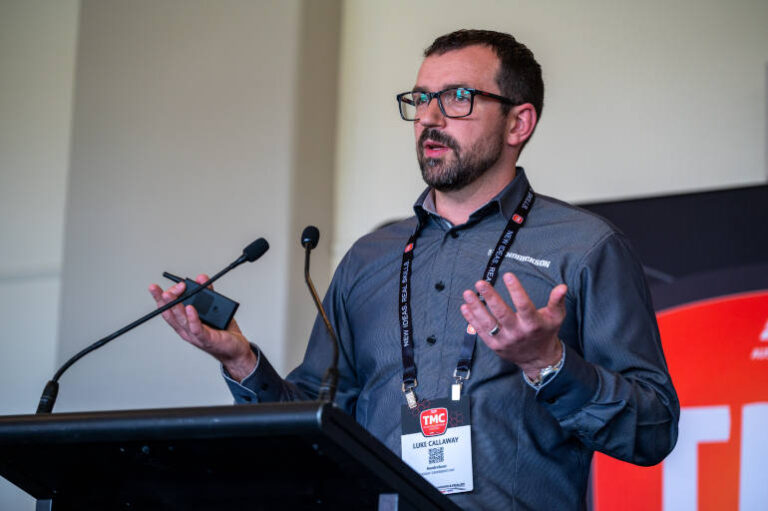
At the 2025 Australian Trucking Association’s Technology and Maintenance Conference (TMC), Hendrickson’s Luke Callaway delivered a technical deep dive into suspension systems — explaining how they impact safety, productivity, tyre wear, and even fuel efficiency. His presentation, Smart Suspension Choices for Safer, More Productive Fleets, challenged operators to look beyond capacity ratings and consider how suspension design affects total cost of ownership and long-term vehicle performance.
Understanding Suspension’s Role
“Suspension is more than just a set of springs and dampers,” Callaway explained. “It’s a complete system that connects the vehicle to the road — supporting weight, maintaining tyre contact, and absorbing shocks and vibrations.”
Every component — from the springs and bushes to the air in the tyres — plays a role in ride comfort, stability, and handling. Poorly matched suspension can compromise safety, damage freight, and increase operating costs through accelerated wear on tyres and other components.
Choosing the Right Capacity
Suspension capacity might seem straightforward, but Callaway noted it’s “about more than just maximum load.” Manufacturers determine capacity through extensive testing to ensure products can handle the dynamic loads experienced over the life of a truck or trailer — not just static weight.
He explained that a suspension’s rating reflects both its strength and its durability: “A 10-tonne suspension may be optimised for weight and maintenance in highway use, while a 12- or 13-tonne suspension is better suited to off-highway or more arduous conditions.”
Selecting the right suspension requires matching it to the operating environment — whether long-distance highway work or off-road quarry operations — to balance durability, maintenance, and payload.
How Technology Improves Performance
Suspension technology has evolved to meet the diverse demands of the heavy vehicle industry. Air suspensions now dominate because they adapt to changing loads and maintain consistent ride height. “They allow you to vary the spring rate elegantly, simply by adding or releasing air,” said Callaway. “That means consistent handling and reduced stress on both the vehicle and the road.”
Newer damping technologies are also emerging. Air spring damping, for example, uses controlled air movement within the suspension to dissipate energy instead of relying on hydraulic shock absorbers. The result is consistent damping throughout the life of the air spring and reduced maintenance costs.
Callaway also discussed the role of viscoelastic rubber elements and composite materials in modern suspensions — both reducing unsprung mass and providing natural damping. “Reducing unsprung weight helps with ride quality and braking performance,” he said. “It also contributes to lower fuel use and tyre wear.”
Tyre Life and Fuel Efficiency
Tyres are an integral part of the suspension system, and their interaction with the road affects both fuel economy and safety. Maintaining even tyre contact is essential. Uneven load sharing between axles can reduce braking performance and cause premature tyre wear.
“Load sharing and correct tyre pressure go hand in hand,” Callaway said. “If you’re running the wrong pressure for the load, you’re compromising grip, stability, and tyre life.”
He highlighted the growing importance of central tyre inflation systems (CTIS), which automatically adjust tyre pressures based on vehicle load and conditions. This technology not only extends tyre life but also improves rolling resistance and fuel efficiency. Callaway shared modelling that showed how even a modest 0.5% fuel saving and 25% tyre life improvement could save a five-vehicle B-double fleet more than $100,000 over five years.
Dual tyre setups can also affect rolling resistance. “If there’s a 5% pressure mismatch between tyres, one tyre drags against the other,” he explained. “That’s wasted energy — and it adds up over long distances.”
Productivity and Lift Axles
Lift axles are another area where technology contributes directly to productivity and cost savings. Raising an axle when running light loads reduces tyre wear and rolling resistance. Callaway pointed to recent testing in the US showing a 3% fuel saving from using non-driven axles and an additional 2% from lifting an axle when it wasn’t needed. “That’s up to 5% in fuel efficiency gains depending on the operation,” he said.
Safety, Stability, and Ride Comfort
Ride stability depends heavily on roll stiffness — the suspension’s resistance to body roll when cornering. “High roll stiffness reduces the likelihood of rollover and improves driver confidence,” Callaway noted. Air suspensions typically use auxiliary mechanisms such as anti-roll bars to achieve this without sacrificing ride comfort.
Suspension tuning also affects fatigue. “Generally, a softer suspension with a lower natural frequency offers better comfort and less driver fatigue,” he explained. “But there’s always a trade-off — stiffer systems can offer better handling and durability.”
Balancing Cost and Capability
With so many suspension options available — air, mechanical, rubber, composite — Callaway encouraged operators to take a total cost-of-ownership approach rather than choosing on price alone. “Different applications demand different attributes,” he said. “Long-distance fleets may prioritise low maintenance and durability, while tipper operators might value strength and roll stability.”
He advised fleets to analyse lifecycle costs, including maintenance, downtime, fuel use, and tyre wear, to calculate payback periods when comparing systems. “A more expensive suspension can pay for itself quickly through reduced maintenance or improved tyre performance,” he said.
Adapting to Electric Vehicles
During the Q&A, delegates asked whether the transition to battery-electric trucks is influencing suspension design. Callaway said the most significant impact so far relates to increased vehicle mass and packaging.
“Electric drivetrains often mean higher axle loads and bulkier e-axle assemblies, so suspensions need to accommodate that extra weight and space,” he said. “There are also allowances in some jurisdictions to carry higher loads for zero-emission vehicles, so suspension capacity becomes an even more important design factor.”
The TMC 2025 session made clear that smart suspension choices are not just about comfort — they’re a key driver of safety, fuel efficiency, tyre life, and overall fleet productivity.
As Callaway concluded:
“There’s no one-size-fits-all suspension. The best choice is the one that’s optimised for how and where your trucks actually work.”
- From 18 months to minutes: Geosecure brings AI route optimisation to street sweeping
 For many councils, developing a street-sweeping schedule is still a highly manual process. As road networks grow, new suburbs are added and community expectations change, existing schedules can become increasingly difficult to manage. In some cases, the original program is simply expanded over time rather than rebuilt around the current road network and service requirements.
 - Geotab adds mass management to heavy vehicle telematicsGeotab has expanded its Australian heavy vehicle compliance offering by adding Smart On-Board Mass capability through a certified integration with Airtec Corporation, allowing heavy haulage operators to manage telematics and mass data through a single platform. The certification means Geotab can now support Telematics Monitoring Application schemes both with and without Smart OBM requirements, as
- Daimler Truck Crowns Top TechniciansDaimler Truck Australia Pacific has named its 2026 Freightliner and Mercedes-Benz Trucks Technicians of the Year, putting a spotlight on the technical capability required to keep increasingly complex heavy vehicles operating reliably. The national finals were held at the Daimler Truck Training Academy in Mulgrave, Victoria, where leading technicians completed technical theory assessments, real-world diagnostic
- Why Isuzu kept the NPS when the NQS arrivedWhen Isuzu unveiled the new NQS 4×4 as part of its MY25 N Series range, it would have been easy to assume it was simply the replacement for the familiar NPS. It isn’t. Instead, Isuzu has retained the NPS alongside the new NQS, creating two distinctly different 4×4 propositions for customers whose vehicles may look
- LinCon Builds its Heavy Fleet Around ScaniaLinCon Hire and Sales is expanding its Scania fleet as the specialist access equipment operator looks for all-wheel drive capability, fuel efficiency and reliability across some of Australia’s most demanding worksites. Brisbane-based LinCon Hire and Sales has committed to a significant expansion of its Scania fleet, with the specialist elevating work platform operator taking delivery