

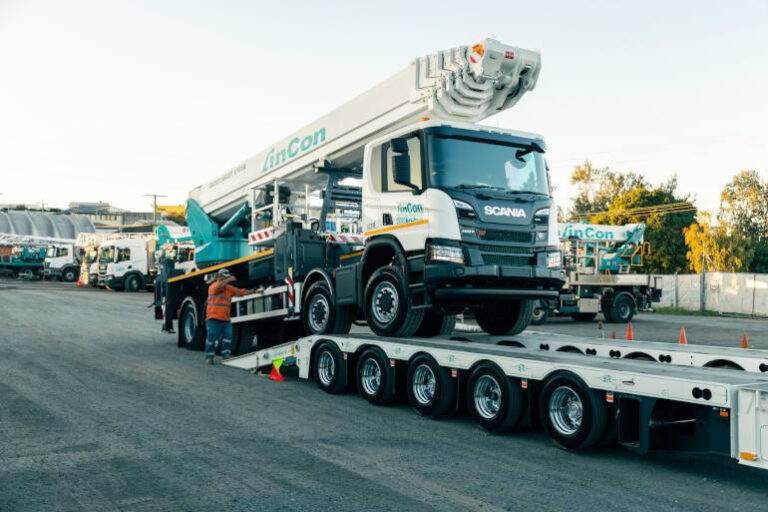
LinCon Hire and Sales is expanding its Scania fleet as the specialist access equipment operator looks for all-wheel drive capability, fuel efficiency and reliability across some of Australia’s most demanding worksites.
Brisbane-based LinCon Hire and Sales has committed to a significant expansion of its Scania fleet, with the specialist elevating work platform operator taking delivery of five new trucks and ordering a further 15 during 2026.
The company operates around 140 vehicles nationally, ranging from ute-based 13-metre elevating work platforms (EWPs) through to a 103-metre Palfinger platform mounted on a five-axle Tadano crane carrier.
For LinCon, which services customers across power, renewables, telecommunications, infrastructure and mining, getting equipment to remote and difficult locations is a fundamental fleet requirement. That has driven its preference for Scania P-series trucks in 4×4, 6×6 and 8×8 configurations.
Technical Sales Manager Tony Fish said power, torque and cooling performance were particularly important because the vehicles often travel long distances before spending significant periods operating their power take-off systems.
“We’ve always gone for higher horsepower engines because we do a lot of travelling and we need to get up hills easily,” Fish said.
The latest deliveries include five Scania 6×6 chassis fitted with 64-metre EWPs. LinCon also has 10 Scania 8×8 trucks ordered with 75-metre lifts and another five 8x8s destined to carry 64-metre Palfinger units.
Heavy equipment demands specialist fleet thinking
Once fitted with their Palfinger equipment, the trucks weigh around 36 tonnes. LinCon specifies Scania’s 13-litre six-cylinder Super engine, with the 8×8 vehicles using the 500hp version and the 6×6 models fitted with the 460hp unit.
The build process itself reflects the specialised nature of the fleet. Trucks are built by Scania in Europe before travelling to Palfinger in Germany for installation of the EWP. Once in Australia, load-sharing suspension is fitted to increase the front axle limit to 16 tonnes.
LinCon also uses Scania chassis with full air suspension for its Barin under-bridge inspection vehicles. The air can be released when the inspection arm is extended, helping create a more rigid working platform.
It highlights a broader issue for heavy vehicle fleet managers: the truck cannot be considered independently from the equipment it carries. Chassis configuration, suspension, engine output and operating environment all need to be assessed as part of the complete asset.
Fuel consumption matters even with low kilometres
LinCon’s fleet also demonstrates why kilometres travelled are not always an adequate measure of heavy vehicle utilisation.
Many of its EWP trucks accumulate comparatively low distances but spend long periods with their engines running to power the elevated platform. Fish said this operating profile influenced the company’s servicing approach.
Oil sampling showed the engine oil remained in good condition at 250 hours, prompting LinCon to move to 400-hour oil changes.
“We’re still probably way over-servicing, but oil is cheaper than a breakdown or sending another driver and a truck down to relieve a broken-down truck,” Fish said.
That approach is particularly relevant when vehicles are deployed remotely. LinCon currently has 10 trucks working on a power transmission project around 200km from Newman in Western Australia, supported by 14 to 15 drivers on rotation.
With the project expected to run for approximately two years, LinCon has established a mobile servicing setup carrying parts and equipment so maintenance can be completed on site.
New V8 takes on 95-tonne combination
The company has also added its first Scania V8, an R 660 prime mover rated to 130 tonnes.
It will haul a Drake widening low-loader carrying LinCon’s 103-metre Palfinger platforms, which are mounted on five-axle Tadano crane carriers and cannot be driven on public roads.
With an 8×8 loaded onto the float, the dolly, trailer and prime mover combination is expected to weigh around 95 tonnes.
Fish said fuel performance was therefore an important consideration, particularly given the poor aerodynamic profile of the large access equipment.
“Aerodynamically the EWPs are a heavy brick on wheels so the fuel savings will be valuable to us,” he said.
For LinCon, the investment in specialised heavy vehicles is ultimately about ensuring its fleet can reach the work rather than expecting the work to suit the fleet.
The company has previously deployed trucks across the Great Dividing Range and continues to support transmission, renewable energy, mining and infrastructure projects around Australia.
“That’s why we buy all-wheel drive trucks, because we need to be able to access any terrain,” Fish said.
For heavy vehicle fleets working in similar environments, LinCon’s approach reinforces the importance of matching specification, maintenance strategy and support arrangements to the actual duty cycle — particularly when downtime can leave specialist equipment stranded hundreds of kilometres from the nearest workshop.