

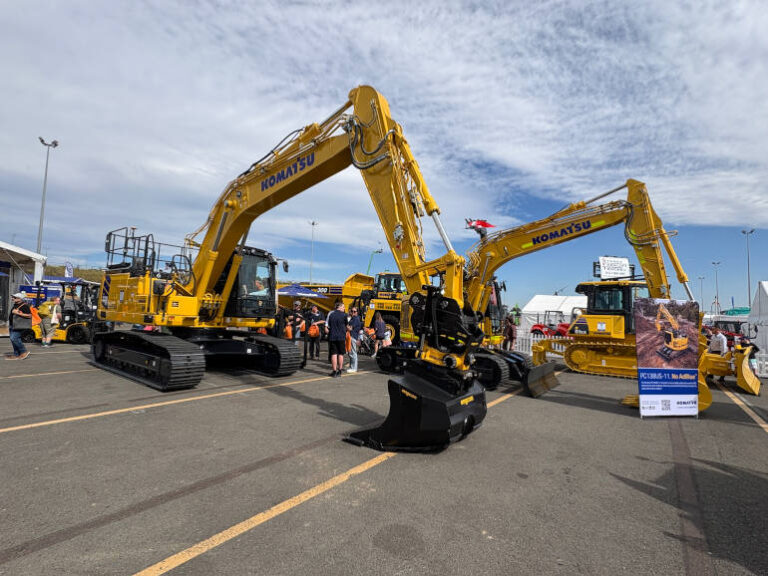
The 20–25 tonne excavator has long been the backbone of civil construction, infrastructure and local government fleets. It is the size class that delivers reliable production across a wide range of applications — from subdivision works and drainage projects to road maintenance and general earthmoving.
What is changing is not the importance of the machine, but the role it plays in improving productivity, safety and consistency across fleet operations.
The Komatsu PC220LCi-12, soft launched into the Australian market in 2025 and showcased at the 2026 National Diesel Dirt and Turf Expo, represents the next step in the evolution of this popular size class. It combines proven excavator performance with factory-integrated technology designed to support safer, more efficient operations across the life of the asset.

A proven size class for high-utilisation fleets
For many Fleet Managers, the 20–25 tonne excavator is one of the most heavily utilised assets in the fleet. It is large enough to handle bulk earthworks and infrastructure tasks, yet compact enough to work in urban environments where access can be restricted.
Operating at approximately 24 to 25 tonnes in Australian specification, the PC220LCi-12 sits squarely in the category used for the majority of day-to-day civil and infrastructure work. Machines in this class often record high annual operating hours, which means reliability and uptime have a direct impact on productivity and service delivery.
This is why the replacement decision for a mid-size excavator is rarely just about purchase price. Fleet teams are increasingly focused on whole-of-life performance — including utilisation, maintenance costs and the ability to complete jobs safely and efficiently.
intelligent machine control improves accuracy and productivity
One of the defining features of the PC220LCi-12 is its integrated intelligent machine control system.
Rather than relying on add-on technology, the system is built into the machine from the factory, allowing operators to maintain accurate grade control and work within defined design parameters. This helps reduce the risk of overcutting, minimise rework and improve productivity across the project.
For organisations managing multiple crews and job sites, this type of technology supports consistent performance across the fleet. It reduces variability between operators and helps maintain output even when workforce experience levels vary.
In practical terms, the benefit is not just faster excavation. It is more predictable results, better resource planning and improved confidence that projects will be delivered on time and within budget.
Safety features designed for complex work environments
Safety remains a critical consideration for any organisation operating heavy equipment, particularly in urban or high-risk environments.
The PC220LCi-12 includes a range of integrated safety features designed to improve operator awareness and reduce the likelihood of incidents. These include 360-degree camera visibility and automated detection of people and objects around the machine.
Boundary control functionality allows operators to define working limits, helping prevent the boom or bucket from entering restricted areas such as underground services, nearby structures or traffic zones.
For fleet operators working in local government or civil construction, these features provide an additional layer of protection when operating in busy environments where the margin for error is small.
Supporting maintenance planning and uptime
High utilisation means maintenance planning becomes a critical part of fleet management.
Downtime can quickly disrupt project schedules and increase operating costs, particularly when equipment is supporting essential services or infrastructure delivery. That is why modern excavators are increasingly designed to make servicing easier and more predictable.
The PC220LCi-12 includes improved access to service points, extended maintenance intervals and automated system functions that simplify routine servicing tasks. These design improvements help reduce downtime and support better planning of maintenance activities.
For Fleet Managers, predictable maintenance schedules and reliable machine performance are often the factors that have the greatest impact on whole-of-life costs.
A practical tool for improving fleet performance
The introduction of machines like the Komatsu PC220LCi-12 reflects a broader shift across the fleet industry.
Organisations are focusing more closely on productivity, risk management and asset utilisation. Equipment is no longer viewed simply as a tool to complete a task. It is part of a system that supports service delivery, safety outcomes and financial performance.
For fleets responsible for maintaining roads, building infrastructure or supporting construction projects, the mid-size excavator remains a critical asset. The difference today is that technology, safety systems and maintenance design are playing a bigger role in helping fleets deliver reliable results with fewer resources.
In that context, the Komatsu PC220LCi-12 is less about a new machine and more about a practical step toward smarter, more efficient fleet operations.