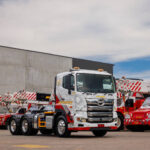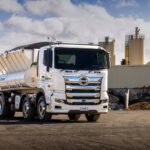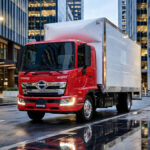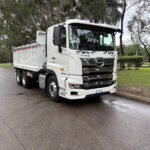
Spending a full day in the Hino 700 Series was a reminder that a truck is never just a truck. The badge might be the same, and both vehicles shared the same broad 700 Series DNA, but the two models I drove had very different roles, engine characteristics, handling traits and body applications.
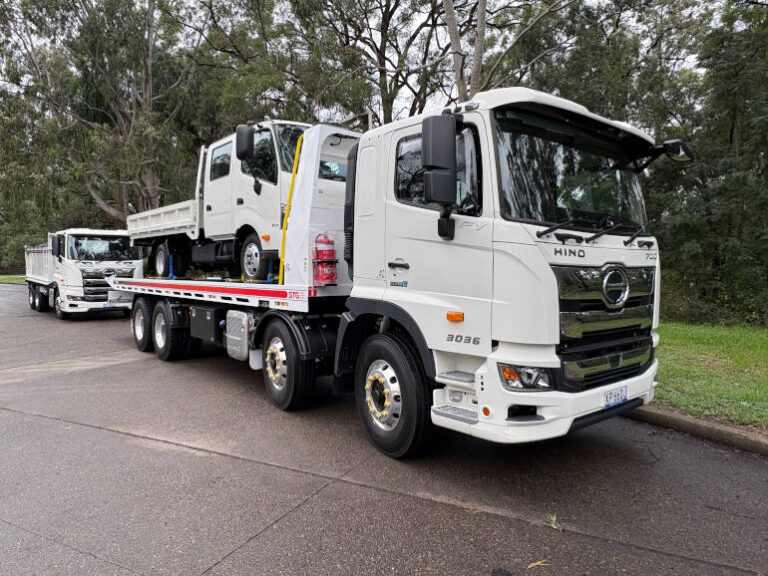
The first was the Hino 700 Series FS 2845 AMT Air tipper, fitted with a Chris’s Body Builders 4.5-metre Hardox tipper body. The second was the Hino 700 Series FY 3036 AMT Air tilt tray, fitted with an STG 9200mm tilt slide tray.
On paper, they both sit in Hino’s heavy-duty 700 Series range. On the road, they felt like two different tools built for two different jobs.

Hino 700 Series FS 2845 AMT Air tipper
The FS 2845 was the truck I spent most of the day driving, and it felt well suited to the kind of work many councils, civil contractors and construction fleets would recognise: urban traffic, suburban arterials, freeways, hills, rain and stop-start movement.
This model was powered by Hino’s E13C-BL 13-litre engine producing 450hp and 2,157Nm of torque. It was matched to the Hino M112 12-speed automated manual transmission, with a 6×4 axle layout, 28,000kg manufacturer GVM and 50,000kg GCM.
The body was a 4.5-metre Hardox tipper from Chris’s Body Builders, with 1150mm high sides, 5mm Hardox tailgate, sides and front walls, and a 6mm Hardox floor. It was also fitted with a 50mm 35-tonne rated Rockinger RO500B coupling.
That combination gave the truck a clear sense of purpose. The 13-litre engine had plenty in reserve, particularly when climbing or joining faster traffic. The 12-speed AMT also became more impressive the more time I spent with it. Like many heavy vehicles, it rewards the driver who learns how the gearbox wants to be treated. Once I started being smoother and more deliberate with throttle inputs, the truck felt more settled and predictable.
The drive route included Sydney traffic, the M5, M7, Richmond and the Bells Line of Road through the Blue Mountains. That variety showed the tipper’s strength. It was easy enough to manage in traffic, but still had the muscle and engine braking support needed when the road opened up or started climbing.
Hino 700 Series FY 3036 AMT Air tilt tray
The second truck was the FY 3036 AMT Air tilt tray, and it immediately felt different.
This model used Hino’s A09C 9-litre engine producing 360hp and 1,569Nm, again matched to the 12-speed Hino M112 AMT. It had an 8×4 axle layout, 30,000kg GVM, 42,500kg GCM and a longer 6738mm wheelbase.
The body was an STG 9200mm tilt slide tray with a 6mm Hardox chequer plate floor and a 13.6-tonne single-line pull winch. It was configured for rigid metro and regional operation, making it the sort of vehicle suited to equipment transport, recovery-style work and specialist fleet applications where payload length and body capability matter as much as engine output.
Compared with the tipper, the tilt tray had a different driving character. The smaller 9-litre engine did not have the same effortless shove as the 13-litre tipper, but the truck still felt capable and refined. The twin-steer layout and longer body changed the way it moved through corners and traffic, and it required a slightly different mindset from the driver.
That was one of the key lessons from driving the two trucks back-to-back. Even within the same range, different bodies and configurations create different personalities.
Safety systems that matter in real fleet use
Both trucks were fitted with Hino SmartSafe features as standard, including Driver Monitor, EBS braking, Vehicle Stability Control, ABS, Pre-Collision System with Autonomous Emergency Braking and Pedestrian Detection, Lane Departure Warning System and Safety Eye distance warning.
On narrow roads and in wet conditions, those systems were useful rather than theoretical. The lane warning system could be noticeable, but it also acted as a valuable reminder when concentrating on mirrors, road position, traffic and changing conditions. The distance warning system was also helpful in keeping attention on the gap to vehicles ahead.
For fleets, this is where the 700 Series makes sense beyond the spec sheet. These trucks may be driven by professional drivers, but in local government, construction, infrastructure and support operations, heavy vehicles are often driven by people for whom driving is only part of the job. Predictability, visibility, comfort and safety support all become important.
Comfort and technology
Both trucks featured an air-suspended cab, next-generation ISRI NTS2 driver seat, steering wheel controls, a 7-inch TFT driver instrument panel and a 10.1-inch smart multimedia unit with Wi-Fi connectivity.
The cabin was quiet and comfortable over a long day, and wireless Apple CarPlay made it easy to stay connected and listen to podcasts between stops. There were small differences in cabin storage between the two vehicles, including cup holder arrangements, which is a reminder for fleet buyers to pay attention to cab configuration details when specifying trucks with dealers.
These details matter because they affect the working day. A driver might forgive a missing convenience feature on a short test drive, but after months in service, storage, seating, visibility and connectivity all contribute to fatigue, acceptance and productivity.
Learning the truck, not just driving it
The biggest takeaway from the drive was how much the 700 Series rewards familiarity.
Modern heavy vehicles are much easier to drive than older trucks, and the 12-speed AMT removes much of the physical workload. But they are not passenger cars. Each truck still has its own personality, and the driver still plays a major role in fuel use, brake wear, smoothness and safety.
That was especially obvious when using cruise control. In a car, adaptive cruise can feel almost semi-autonomous. In a truck, it needs to be used more selectively. The driver still needs to read the road ahead, anticipate traffic, manage hills and avoid unnecessary braking or acceleration. In heavy vehicles, poor anticipation has a much bigger impact on fuel consumption and wear.
Which one suits which fleet?
The FS 2845 tipper is the more muscular, construction-ready option. With the 13-litre engine, 6×4 layout, 50,000kg GCM and Hardox tipper body, it suits councils, contractors and civil fleets needing a robust heavy-duty tipper with strong performance and towing capability.
The FY 3036 tilt tray is a more specialised platform. Its 8×4 layout, long wheelbase, 9200mm tray and 13.6-tonne winch make it better suited to metro and regional transport tasks where body length, stability and equipment handling are central to the job.
Both showed why model selection in heavy vehicles needs to be driven by application, not just badge, price or power output. The right truck is the one that matches the body, route, payload, driver profile and operational risk.
After driving both, the Hino 700 Series left the impression of a heavy-duty range that is becoming easier to operate without losing the distinct character that makes trucks so application-specific. For fleet buyers, that is the key point: the 700 Series is not one truck. It is a platform that needs to be specified carefully for the job it will do every day.
- Borger Hits a Century with Hino
 Borger Cranes has taken delivery of its 100th Hino truck, adding a distinctive Indigenous-liveried Hino 700 Series SS 2848 prime mover to its national fleet. The truck will transport auxiliary crane equipment, including counterweights, supporting a business that employs more than 1,100 people and operates 320 cranes and over 270 vehicles. For the Indigenous-owned family
 - Downer’s Hino Choice Starts with the DriverDowner Group has added another Hino 700 Series to its fleet, selecting an FY 3248 8×4 chassis for a specialised Bergkamp feeder unit used in road preservation and microsurfacing. The purchase followed an extensive evaluation of different truck manufacturers, with Downer assessing how each chassis would meet the demands of the application. Driver comfort, low
- Hino 500 Series Means BusinessHino is putting Australian operating experience at the centre of its 2027 medium-duty 500 Series, highlighting an established driveline alongside standard safety technology and connected fleet support. Since the platform’s introduction in 2019, the 500 Series has worked across applications ranging from freight and construction to council services and towing. For fleet managers assessing replacement
- Modern trucks could help the industry tackle its driver challengeThe heavy vehicle industry’s driver shortage is not only a recruitment problem. It is also forcing truck manufacturers and fleet operators to reconsider the working environment they provide drivers. Hino Australia President and CEO Richard Emery believes the industry needs to do more over the coming years to encourage people to consider truck driving as
- Expanded Hino 700 Series range drives surge in heavy-duty ordersHino Australia says an expanded 700 Series range has helped deliver a significant lift in heavy-duty orders as the company works to convince traditional light and medium-duty customers to consider Hino for more demanding applications. Hino Australia President and CEO Richard Emery acknowledged that the 700 Series had not previously achieved the market penetration the