
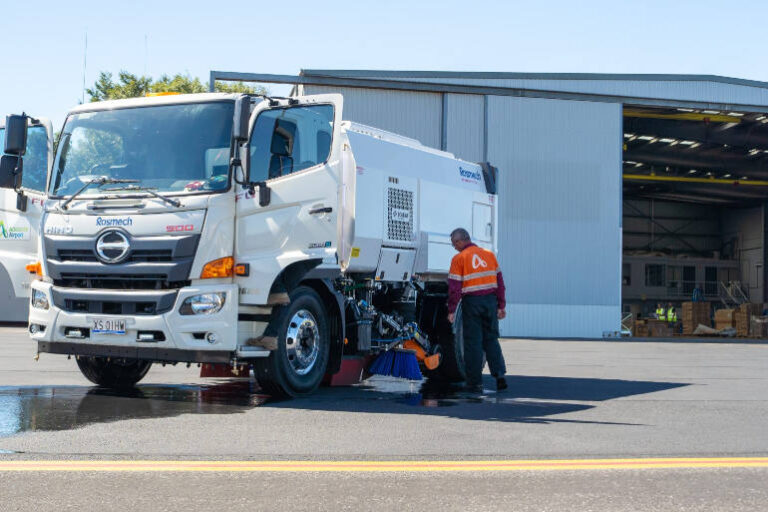
Street sweepers are highly specialised fleet assets, but knowing whether they are being used efficiently can be surprisingly difficult.
A vehicle can be operating for an entire shift, kilometres can accumulate and the operator can report that the scheduled work has been completed. But how much of that time was actually spent sweeping?
It is a question Geosecure National Fleet Consultant Travis Weir has been examining while working with councils on the development of Optimize, a new AI-powered route optimisation solution.
The work has exposed a challenge that may be familiar to many local government Fleet Managers and operations teams: street-sweeping schedules that have developed over many years but have never been fundamentally redesigned.
According to Weir, some councils told Geosecure that their schedules had simply grown as new streets and subdivisions were added.
“Some of them come back and said, ‘Look, these are historically done. We just try and add to them as new suburbs come on or new subdivisions come on.’”
Other councils indicated creating a completely new schedule could take many months because planners need to account for the size of the road network, kerb and gutter lengths, service frequencies and other operating considerations.
Lots of movement doesn’t always mean lots of sweeping
The problem becomes more apparent when planned routes are compared with what vehicles actually do.
Weir said one pattern identified during the work was street sweepers moving between different parts of an LGA rather than completing geographically grouped areas.
“What we typically see for a schedule for an operator is, say you’ve got a large LGA, they’ll go and sweep two roads or three streets on the eastern side of the LGA, and then the very next one will be over the far western side, and then they’ll go and do a customer request in the northern suburbs.”
Every kilometre travelled between sweeping locations consumes operator time and fuel without necessarily contributing to the council’s street-sweeping service level.
Historical telematics data can make that difference visible.
During a demonstration, Weir showed an example where the relationship between travelling and sweeping raised questions about asset efficiency.
“No, well 30% broom down is not very good, and it’s purely because, like we said, they’re driving to one side of the LGA to the other instead of.”
For a Fleet Manager, that measure is potentially more useful than looking at kilometres or operating hours alone. A street sweeper with high utilisation can still be poorly productive if much of its operating time is spent travelling rather than sweeping.
Are service levels actually being achieved?
There is another issue: proving that the organisation has delivered the service promised to the community.
Street-sweeping service levels vary considerably between councils. Weir used Blacktown and Forbes as examples, explaining that some streets might only require an annual service while smaller councils may aim to sweep their entire network every four weeks.
That means simply knowing a sweeper was operating isn’t enough.
Councils need to know which streets were completed, which were missed and whether the required service frequency was achieved.
During the development work, Geosecure analysed historical data for Forbes. Weir said the council’s expectation was that the full network was being swept within its four-week target.
The data suggested otherwise.
“We can backdate their data to show them they’re only 74% compliant to that contract or that SLA, and then we can show what streets they’ve missed very quickly and highlight it.”
That distinction is important. A council may be overservicing some streets while simultaneously missing others.
More operating hours or another street sweeper will not necessarily solve that problem.
Turning operational data into useful information
The approach being developed for Optimize combines several datasets.
These can include the council’s GIS road information, sealed and unsealed roads, kerb and gutter networks, medians, islands and roundabouts, together with the existing street-sweeping program.
The system can also account for whether streets need to be serviced daily, weekly, fortnightly, monthly or annually.
Telematics adds another layer.
Where the required PTO information is available, the system can distinguish between a sweeper travelling and a sweeper actually operating its brooms.
That gives managers the opportunity to compare plan versus actual performance rather than relying solely on vehicle utilisation or operator reporting.
A different question for Fleet Managers
For Fleet Managers, the important question may therefore be less about whether the street sweeper is being used and more about what it is achieving when it is used.
Before adding another machine, extending shifts or approving additional overtime, understanding broom-down time, dead running and service-level compliance could reveal whether the real constraint is fleet capacity or operational planning.
Street sweepers are only one example, but they demonstrate a wider principle for fleet management.
High utilisation isn’t necessarily the same thing as high productivity.
And sometimes the biggest opportunity isn’t buying another asset. It’s getting better information about how the existing assets are being used.
- Anric Takes Control of Fuel with Isuzu
 Keeping heavy machinery working across multiple construction sites is a logistical challenge, particularly when equipment needs hundreds of litres of diesel every shift. Rail and civil construction specialist Anric Group has invested in a purpose-built Isuzu refuelling truck to improve equipment uptime and reduce its reliance on external fuel suppliers. The Sydney-based business operates an
- Adelaide operator rolls into Brisbane with FAWAdelaide Trucks and Vans has expanded into Queensland, launching Brisbane Trucks and Vans and adding a FAW J7 prime mover to its growing fleet. The company has invested $3 million in its Wacol operation, which opened in May and has built a 19-vehicle fleet to support existing national clients and new customers across the steel,
- Purtill Group backs ProCabin for regional fuel runsDeniliquin’s Purtill Group has added two Mercedes-Benz Actros ProCabin 2663 prime movers to its fuel delivery fleet, with safety technology, driver feedback and regional service support influencing the purchase. The family-owned business, celebrating its 75th anniversary in 2026, is using the new trucks to haul 30-metre A-double fuel tankers between Melbourne and the NSW centres
- 15 new fire trucks boost emergency response capability across NSWFire and Rescue NSW (FRNSW) is expanding its frontline fleet with 15 new fire trucks being deployed to stations across Sydney, Wollongong and the Blue Mountains. Announced in October, the new vehicles feature enhanced safety systems, improved communications and satellite connectivity, providing firefighters with modern equipment to support emergency response operations. Minister for Emergency Services
- Isuzu crew cab goes the distance for remote maintenance workA Wodonga-based maintenance company has added an Isuzu NNR crew cab to its fleet to help transport workers, tools and materials to infrastructure projects, including remote sites in Australia’s alpine country. Global Factory Maintenance (GFM) supports hydroelectricity, gas, manufacturing and civil projects, with some crews travelling around 250 kilometres a day to and from work