

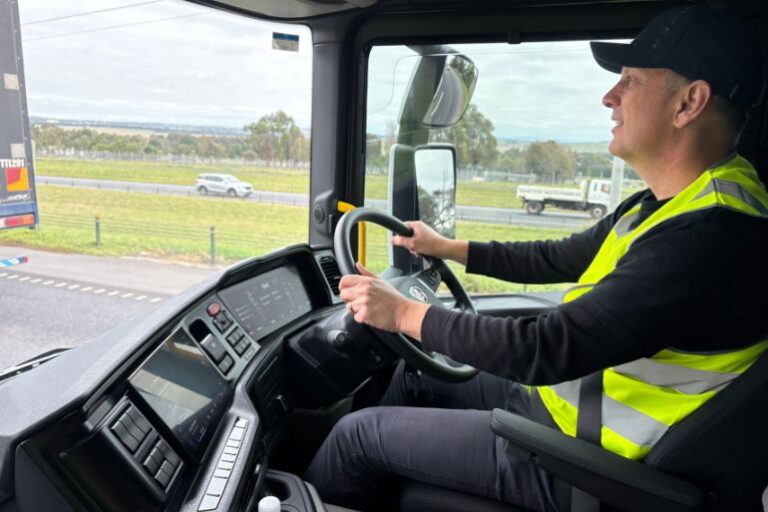
The launch of Scania’s new Super 11-litre engine in Australia is not just about adding another engine size to the range. It is also a reminder that truck performance is changing.
For many years, performance was measured in simple terms: horsepower, torque, displacement and how quickly a truck could pull a load up a hill. Those numbers still matter, but a first drive of the new Scania Super 11 shows that modern fleet performance is much broader.
It is about how smoothly the power is delivered. It is about how efficiently the driver uses the truck. It is about how the engine, gearbox, braking systems and driver assistance technology work together. And, increasingly, it is about how much cost can be removed from the operation without making the job harder for the driver.
That is where the Super 11 starts to make sense.

Smaller engine, serious torque
Scania’s new Super 11 is a 10.62-litre five-cylinder engine positioned between the existing 9-litre and 13-litre engine families.
In Australia, it is available in three ratings: 350 hp with 1,800 Nm, 390 hp with 2,000 Nm, and 430 hp with 2,200 Nm. The torque is available from 950 rpm to 1,360 rpm, which is important because it means the engine is designed to work low in the rev range rather than relying on drivers to push it hard.
That was one of the most noticeable points from the drive. The Super 11 does not need to be worked aggressively to do the job. It feels more comfortable when the driver lets the torque do the work and allows the G25 Opticruise gearbox to manage the shifts.
The Scania driver trainer summed it up clearly during the drive: with a Scania, the accelerator does not need to be pushed to the floor to access performance. In most situations, a measured throttle input is enough, because the truck is designed to use torque rather than chase revs.
That is an important message for fleets. The Super 11 is not trying to impress drivers by feeling busy. It is trying to make the job feel controlled.
Smooth is not slow
One of the best lines from the drive had nothing to do with horsepower. It came during a discussion about efficient driving.
The trainer explained that some drivers mistake smooth driving for slow driving. But the point is not to hold up traffic or reduce productivity. The point is to remove unnecessary acceleration, unnecessary braking and unnecessary stress from the vehicle.
“It’s not slow, it’s smooth,” was the message.
That sentence captures the Super 11 driving experience well. The engine does not feel like it needs to be forced. The truck rewards a more relaxed driving style where the driver looks further ahead, anticipates traffic, and avoids driving hard towards a situation that is already changing.
In urban and regional distribution work, that matters. A truck that accelerates hard towards a red light and then brakes heavily is not getting the job done better. It is using more fuel, adding wear and increasing risk.
The Super 11 performs best when the driver works with the truck rather than against it.
Coasting becomes part of the performance story
Scania’s approach to efficiency places a lot of emphasis on coasting. During the drive, the trainer described coasting as a way of creating “free kilometres”.
The logic is simple. Every time the driver takes their foot off the accelerator early and allows the truck to cover distance without adding fuel, those metres add up. A few hundred metres here and there can become kilometres across a day, a week and a year.
For fleet operators, this is where the performance discussion becomes more interesting. The Super 11 can deliver up to seven per cent improved fuel efficiency compared with Scania’s 9-litre five-cylinder engine, but the final result in the real world will also depend on driver behaviour.
The truck gives the driver the tools. The driver still has to use them.
On the road, the coasting message was easy to understand. Instead of accelerating towards traffic lights, roundabouts or slower vehicles, the driver can back off earlier, keep the truck rolling and reduce the need for heavy braking. When the traffic light changes or the road opens again, the truck is already moving and the engine can use torque to build speed smoothly.
It sounds simple, but in fleet operations small habits scale quickly.
Braking systems need to be used properly
The first drive also highlighted how important braking behaviour is to fuel efficiency.
Many drivers are used to leaving auxiliary braking systems active, expecting them to engage whenever they lift off the accelerator. The Scania trainer explained why that is not the most efficient way to drive.
If the retarder or auxiliary brake is left on all the time, the truck cannot coast properly. Every lift off the accelerator becomes a braking event, even when braking is not needed.
That has two consequences. It reduces efficiency and it can add unnecessary wear.
The better approach is to look ahead, decide when braking is actually required, and use the right braking system at the right time. In that sense, the Super 11’s performance is not only about the engine. It is about the complete powertrain and the driver’s ability to manage energy.
The new engine also includes Scania’s Variable Valve Brake, which provides up to 344 kW of engine braking power. That gives drivers strong braking support when needed, but the lesson from the drive was clear: the best drivers do not use braking systems constantly. They use them deliberately.
Driver behaviour is the multiplier
A modern truck can have the best engine, gearbox and safety systems available, but the driver still has a major influence on the operating result.
That was a recurring theme during the drive. The Scania driver trainer said the goal is not to teach people how to drive from scratch. It is to show experienced drivers that there may be a safer and more efficient way to operate the vehicle.
A good driver, in this context, is not just someone who can control the truck. It is someone who is still willing to learn.
The Scania driver score supports that approach by giving drivers feedback on efficient and safe behaviours. It looks at areas such as anticipation, braking, coasting and how the vehicle is driven on hills.
According to the trainer, improving the driver support score can translate into fuel savings. A 20 per cent improvement in driver score can produce fuel savings of up to five per cent.
That is significant because it sits on top of the engineering gains already built into the truck. The engine can be efficient, but driver behaviour can either protect that advantage or erode it.
Comfort changes the way the truck is driven
The Super 11 also benefits from the broader Scania driving environment.
During the drive, the cab felt quiet, comfortable and easy to operate. It is tempting to describe modern trucks as car-like, but that can understate the skill still required to drive them properly. A truck remains a heavy vehicle, and the consequences of poor decisions are much greater than in a passenger car.
However, the comfort level does matter. A quieter cab, good visibility, effective driver assistance systems and a predictable powertrain can reduce fatigue and make it easier for drivers to focus on the road.
The trainer made the point that Scania trucks feel comfortable, familiar and safe from behind the wheel. The retarder, driver score, visibility and quietness all contribute to the overall experience.
That matters for fleets because driver acceptance is now part of the buying decision. If a truck is easier to drive well, operators have a better chance of getting the fuel, safety and maintenance outcomes they are paying for.
Visibility and safety are part of productivity
Another part of the first-drive impression was visibility.
In urban and vocational applications, forward vision and awareness around the vehicle are critical. The Super 11 launch vehicles were aimed at applications such as waste, hook lift, distribution, agitators and prime mover work, where the truck may spend a lot of time in tight operating environments.
The P-series cab gives the driver a strong view of the road and surrounding traffic, while the safety systems provide another layer of support.
Depending on the application, the Super 11 trucks shown at launch included features such as Advanced Emergency Braking, Adaptive Cruise Control, Lane Departure Warning with Active Steering, Lane Keep Assist, Lane Change Collision Prevention, Blind Spot Warning and Vulnerable Road User Collision Warning.
These systems do not replace driver responsibility, but they help create a safer working environment. In fleet terms, safety is performance. A truck that avoids incidents, reduces driver stress and supports better decision-making is contributing to uptime and productivity.
The G25 Opticruise suits the engine
The Super 11 is matched with Scania’s G25 Opticruise gearbox, which provides 14 forward gears including a super-crawler and overdrive, plus up to eight reverse gears.
The gearbox is an important part of the driving experience because it allows the engine to stay in its efficient operating range. The shifts are designed to be smooth, and the system supports Scania’s low-rev driving philosophy.
In the real world, that means the driver does not need to fight the truck. The best approach is to give the vehicle clear inputs, avoid unnecessary throttle use, and let the engine and transmission do their job.
For operators coming from older trucks or more traditional driving styles, that may require a mindset shift. Performance is not always about keeping the engine busy. Sometimes it is about letting the driveline stay calm.
A first-drive verdict
This was not a controlled fuel test, and it was not a full back-to-back comparison with Scania’s 9-litre or 13-litre engines. There were no measured acceleration figures, payload comparisons, noise readings or long-term fuel results.
So it would be wrong to call this a definitive performance test.
But as a first drive, the Super 11 made its point.
The engine feels smooth, flexible and well matched to the G25 Opticruise gearbox. The torque delivery encourages low-rev driving, the cab supports a calm working environment, and the broader Scania systems make it clear that efficiency depends on more than the engine alone.
The Super 11’s real strength may be that it makes performance feel less dramatic. It does not ask the driver to chase horsepower. It asks the driver to be smoother, more proactive and more efficient.
For fleet operators, that may be the most important part of the launch. The Super 11 is not just a smaller engine with strong torque. It is part of a complete operating philosophy built around fuel efficiency, uptime, safety and driver behaviour.
In a market where operating costs are under pressure and every litre of fuel matters, that could be the performance measure that counts most.




