




In a market flooded with hype around electrification, Ford’s new E-Transit Custom and Transit Custom PHEV offer something refreshingly grounded: a practical path to lower emissions for transport and logistics operators — without asking fleets to compromise on payload, uptime, or performance.
Unveiled as part of Ford’s growing multi-energy commercial-vehicle strategy, the new range proves there’s no single road to decarbonisation. For some, full battery-electric makes sense today. For others, a plug-in hybrid bridge is the right step. Either way, Ford has built the Transit Custom to handle both — on one shared platform.
Built for the real world, not the brochure
Ford’s Australian Marketing Director Ambrose Henderson said the company’s focus is on giving fleets choice, not forcing them into one drivetrain.
“We’re providing choice to customers,” Henderson said. “You can’t bring a car into the country for NVES and not sell it — it just doesn’t make sense. The customer has to buy it for it to have any impact.”
That customer-first approach led to the development of two distinct options:
- E-Transit Custom (BEV): 160 kW motor, 415 Nm torque, 64 kWh battery, 307 km WLTP range, rear-wheel drive.
- Transit Custom PHEV: 2.5 L Duratec petrol engine with 111 kW e-motor, 11.8 kWh battery, 54 km electric-only range, 1.7 L/100 km combined fuel use.
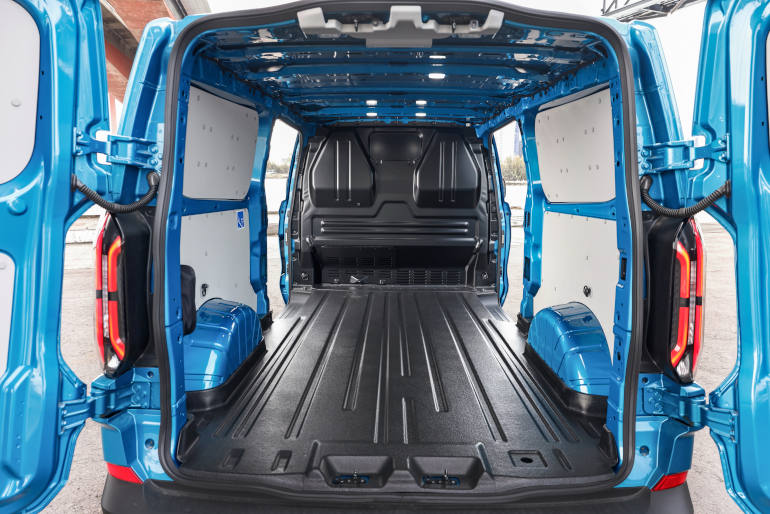
Each shares the same 30,000 km / 12-month service interval, 2,300 kg (BEV/PHEV) braked towing, and up to 6.8 m³ load space — making the electrified versions viable replacements in mixed-duty fleets.
Operational savings and uptime advantages
The running-cost difference between the PHEV and BEV is stark. Ford’s official five-year service pricing shows the E-Transit Custom at $1,200 total, compared to $2,471 for the PHEV. That’s roughly 50 per cent lower maintenance cost for the BEV — a major lever for fleets managing tight margins and high utilisation.
| Model | 5-Year / 150,000 km Total | Cost per 10,000 km |
|---|---|---|
| E-Transit Custom (BEV) | $1,200 | $80 |
| Transit Custom PHEV | $2,471 | $165 |
| Transit Custom Trail (Diesel) | $2,531 | $169 |
With no engine oil, exhaust system, or transmission service requirements, BEV downtime drops dramatically. The eight-year / 160,000 km battery warranty and five-year unlimited-kilometre vehicle warranty further reinforce whole-of-life cost confidence for fleet buyers.
A platform built for mixed duty cycles
Ford’s Product Development Director – Commercial Vehicles, Ian Foston, said the flexibility built into the new Transit Custom platform means fleets can match powertrains to task.
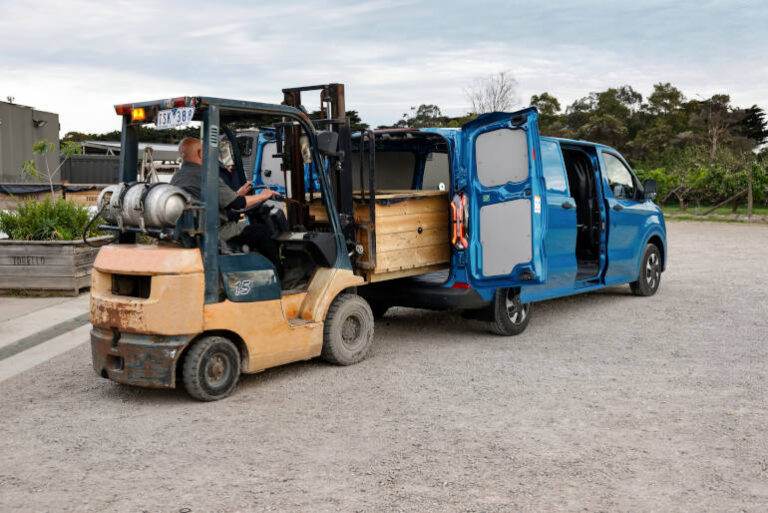
“It’s horses for courses,” Foston said. “If I was carrying a lot of things and wanted them secure, I’d choose a Transit Custom — it’s exactly the right tool for the job.”
The shared chassis accommodates all three drivetrains without sacrificing payload or cargo space. The independent rear suspension and electric power steering deliver a smoother, more car-like drive, while one-pedal operation on the E-Transit Custom enhances urban efficiency.
For transport and logistics operators running depot-based or metro-delivery routes, the 307 km electric range is more than enough for a full day’s work.
Meanwhile, regional contractors and mixed-route businesses can start cutting emissions immediately with the PHEV’s petrol-electric flexibility — charging at base each night and running zero-emission kilometres in city zones.
Data-driven electrification
Ford’s decision to size the PHEV battery at 11.8 kWh wasn’t arbitrary. Henderson said it was informed by real-world connected-vehicle data from Transit customers.
“Our average Transit Custom customer in Australia drives around 24,000 kilometres a year,” he said. “That’s roughly 100 kilometres a day, and a big proportion of that is done in short urban routes or between jobs.”
For those trips, a 54 km electric-only range covers the majority of daily travel, cutting fuel use and CO₂ output without affecting payload or price.
Decarbonising where it makes sense
For transport operators watching emission targets tighten, Ford’s approach demonstrates that decarbonisation can be phased and practical. NVES may apply to manufacturers, but the effect on fleets will be felt through greater model variety and lower-emission technology options.
Fleets can now electrify selected operations — urban delivery, service fleets, or council applications — while maintaining diesel capability for long-haul or high-load work.
“The commercial electrified space will grow, but it’s going to take time,” Henderson said. “As infrastructure grows and more fleets make choices around their carbon emissions, we’ll be ready.”
A balanced path forward
For transport and logistics businesses evaluating their next vehicle replacement cycle, Ford’s dual-power Transit Custom range delivers something rare: options that make financial and operational sense today.
The E-Transit Custom offers genuine zero-emission operation with the lowest maintenance cost in its class, while the PHEV provides a lower-risk transition path using familiar fuel and charging infrastructure.
In short, Ford’s latest vans don’t just help fleets tick sustainability boxes — they make the business case for decarbonisation a lot easier to drive.