
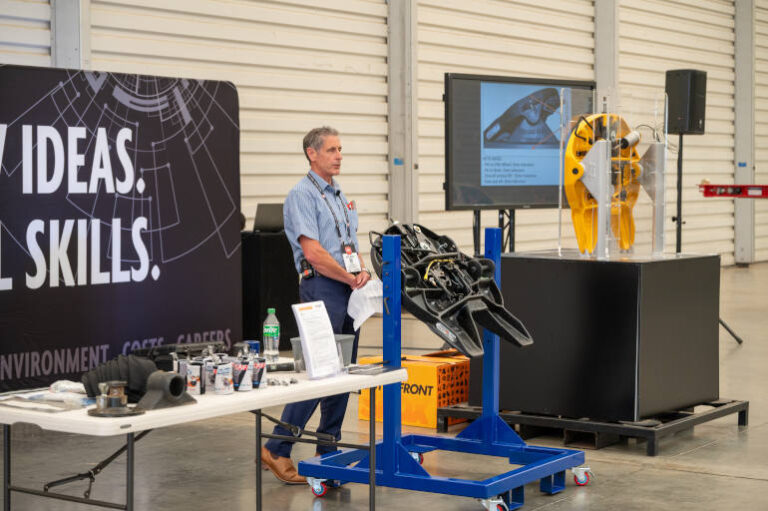
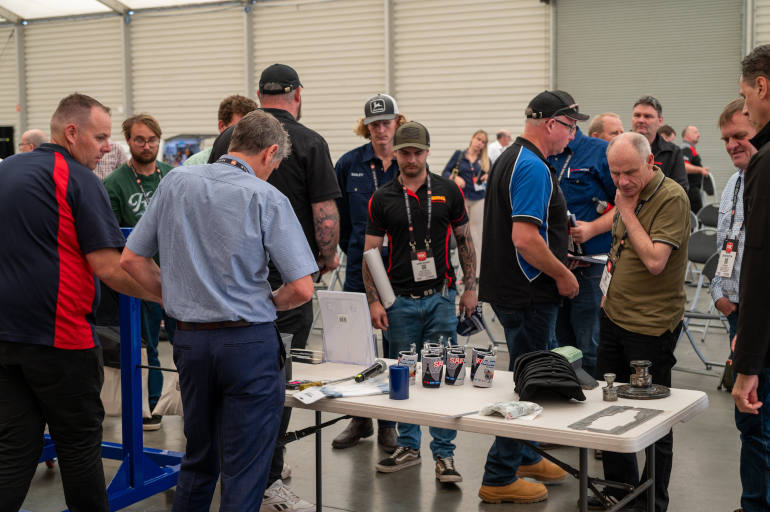
At the Australian Trucking Association’s Technology and Maintenance Conference (TMC) 2025, Ross Molloy, Technical Officer at SAF-HOLLAND, led a detailed technical session exploring the latest developments in fifth wheel coupling technology. The presentation covered practical insights for fleet managers, parts managers, workshop staff, and technicians—emphasising correct adjustment procedures, wear limits, and the importance of maintenance to prevent trailer drops.
Molloy began by noting the evolution of materials and design. “We changed the pocket liners from a steel insert to a plastic insert that seems to be holding up fairly well—in fact, they hold up better than the steel ones,” he said. The updated designs use polyurethane and rubber bushes, with both welded and bolt-on mounting options now available.
Understanding the Fifth Wheel Types
The session distinguished between the 351 (greasy top) and 331 (low-lube) fifth wheels. “I hesitate to say the word greaseless, because no fifth wheel is greaseless,” Molloy clarified. “Even the 331 needs grease around the jaws.”
He also highlighted the G36 range featuring a single swinging jaw and compatibility with integrated vehicle systems like Mercedes and Volvo dash indicators. “It’s a plug-and-play system wired straight into the vehicle’s ECU,” he said, underscoring the growing role of electronic integration in coupling safety.
Correct Adjustment and Wear Limits
A key concern raised by Molloy was that “not many workshops I go to know the correct adjustment procedures.” He outlined that over-tightening jaws accelerates wear and can damage kingpins. “If you can’t pull one of these fifth wheels open with two fingers, there’s probably something wrong underneath,” he warned.
Visual inspection remains essential: “Once the tips of the yoke travel past the tip of that tool by 12 millimetres, it’s time to throw the jaws away.” Molloy cautioned against relying solely on counting threads on the adjustment shaft, noting variations between manufacturers.
For jaw adjustment, the rubber washer on the adjusting shaft plays a critical role. “Ideally, you do not want the kingpin grabbing the jaws too tight. I’d rather see a loose jaw than one that’s too tight,” he said.
Greasing and Maintenance Best Practice
Molloy emphasised that lack of lubrication is one of the most common maintenance failures. “Eight times out of ten, when someone calls and says they can’t release their fifth wheel, there’s no grease on the cam plate,” he said. “Plenty of grease is required. The cam plate, the roller, the jaws, and the yoke tips all need attention.”
The correct adjustment is confirmed when the rubber washer is snug and tight—“unable to be turned,” Molloy explained. Over-adjusting can cause the jaws to bind and create excessive wear, as demonstrated by an example where a kingpin failed after just four months due to poor lubrication and over-adjustment.
Acceptable Wear and Vertical Movement
Addressing questions about wear tolerances, Molloy explained that “a little bit of vertical movement on these is fine.” He clarified, “Most things have a three-millimetre tolerance, including the top plate. If you’ve got four or five millimetres of movement, start looking at the pins and bushes.”
Each component has limits: “Two millimetres vertically and three millimetres horizontally for ball races, three millimetres for pin-to-bush, and up to 12 millimetres of total vertical lift.” He also reminded workshops that pins, bushes, and inserts must be replaced together. “The entire weight of the trailer should be bearing down directly on top of that foot—there should be no load on the pins and bushes,” he said.
Trailer Drop Prevention and Electronic Indicators
One of the session’s most critical messages centred on trailer drop prevention. Molloy warned that even experienced drivers can make mistakes if they rely too heavily on electronics. “Drivers shouldn’t rely on the electronic lock indicator. Get out of the vehicle and check,” he urged.
The ELI (Electronic Lock Indicator) system uses sensors to detect jaw and cam plate position. Red lights flash when the fifth wheel isn’t properly engaged. “It’s not a reason for an operator to assume the fifth wheel is secure. He still needs to get out and do a tug test—it’s never going to replace the basics,” Molloy said.
He added that while systems like ELI or Volvo’s integrated warnings help prevent accidental releases, complacency remains a challenge. “We still see one or two trailer drops a month, mostly on DC sites where people are doing upwards of 150 hookups a day,” he said.
Certification and Compliance
The session also touched on regulatory requirements. Each fifth wheel must have a rating tag with the D-value, and any new or replacement installation requires Blue Plate certification if it differs from the original. “If you’re replacing a fifth wheel with another brand or moving its position, it’s classed as a chassis modification,” Molloy reminded attendees.
Key Takeaways for Workshops and Fleets
For fleet managers and technicians, Molloy’s message was clear: prevention through correct inspection, adjustment, and lubrication is the best way to avoid failures. He encouraged participants to take a USB stick containing service manuals and inspection checklists, adding, “Most workshops pay more attention than they ever have, but many still don’t understand how these systems should be lubricated and adjusted.”
He concluded with practical advice: “Use two fingers to open it. If you can’t, something’s not right. Don’t over-adjust, don’t skip the grease, and never skip the visual check. Trailer drops are avoidable when the basics are done properly.”
For fleets, workshops, and technicians, adopting these inspection and maintenance practices isn’t just about compliance—it’s about safety. As Molloy reminded the audience, the condition of the fifth wheel determines not only coupling reliability but the safety of everyone sharing the road.