

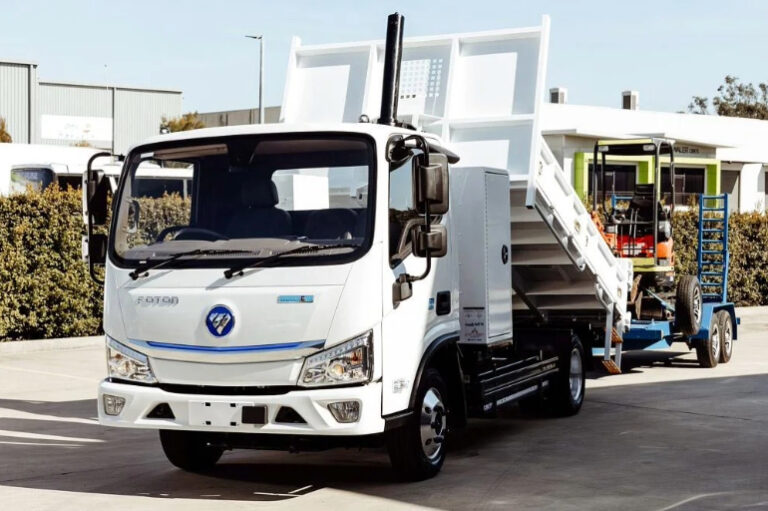
The NSW Government has sharpened its focus on truck electrification with the release of its updated Electric Vehicle Strategy, expanding incentives to support the transition of delivery and service fleets.
For operators of light and medium-duty trucks, the announcement signals a shift from early-stage passenger vehicle adoption to practical heavy vehicle deployment, supported by funding, infrastructure and workforce training.
The strategy is backed by $100 million in funding and identifies electric trucks as a priority area for reducing emissions and operating costs across the transport sector.
Truck electrification moves from pilot to implementation
A key feature of the strategy is the expansion of the EV Fleets Incentive Program to include small and medium-size trucks, providing direct financial support to help organisations electrify their delivery and service fleets.
This is a practical signal that government policy is now targeting the segment where emissions reductions can be delivered quickly—vehicles that operate daily on predictable routes with high utilisation.
For many fleet operators, particularly in urban logistics, utilities and local government, the transition to electric trucks is no longer a future planning exercise. It is becoming an operational decision.
Julie Delvecchio, Chief Executive Officer at the Electric Vehicle Council, described the move as a logical next step in reducing operating costs and emissions.
“Expanding fleet incentives to trucks is one of the smartest moves in this strategy – it’s one of the fastest ways to cut operating costs for businesses while making our streets cleaner and quieter for everyone.”
Infrastructure investment targets operational reliability
Charging infrastructure remains one of the biggest barriers to heavy vehicle electrification, particularly for fleets operating outside metropolitan areas.
The updated strategy places strong emphasis on expanding fast charging infrastructure in regional, remote and suburban locations to support commercial vehicle operations.
To date, the NSW Government has funded more than 3,300 public chargers across over 1,200 sites, creating a foundation for future heavy vehicle deployment.
The Government is also running a two-year trial to enable zero-emission heavy vehicles on state roads, helping to identify operational requirements and regulatory considerations for broader adoption.
For Transport Managers and Workshop Managers, this infrastructure rollout reduces operational risk and supports more confident planning around vehicle replacement cycles.
Workforce capability becomes a critical enabler
Electrifying truck fleets requires more than vehicle procurement. It requires a workforce capable of maintaining high-voltage systems and supporting new maintenance regimes.
The strategy includes investment in training for approximately 2,000 mechanics in regional NSW, recognising that access to skilled technicians is essential for reliable fleet operations.
Minister for Skills, TAFE and Tertiary Education Steve Whan said the training program is designed to support the transition of the heavy vehicle sector.
“This training ensures workers are equipped to safely service and repair electric vehicles, while supporting the growth of a modern, future-focused automotive workforce.”
For heavy vehicle operators, workforce readiness is emerging as one of the most significant constraints on electrification, particularly in regional areas where maintenance resources are already stretched.
Operating cost pressures continue to drive adoption
While emissions reduction targets are an important driver, the business case for electric trucks is increasingly being shaped by operating costs.
According to the NSW Government, switching to an electric vehicle can reduce fuel costs by up to $3,000 per year and lower maintenance costs by around 40 per cent.
For heavy vehicle fleets with high utilisation, these savings scale quickly across multiple vehicles and operating years.
At the same time, the strategy acknowledges the broader economic context facing transport operators, including volatile fuel prices and supply chain pressures.
Premier Chris Minns said the goal is to provide businesses with a practical alternative to rising operating costs.
“We’re making it simpler to go electric, with more chargers, better access and real savings over time.”
What this means for heavy vehicle operators
The updated NSW Electric Vehicle Strategy reflects a shift in policy from awareness to deployment.
For heavy vehicle fleets, the practical implications are clear:
- Government incentives are now directly targeting trucks, not just passenger vehicles
- Infrastructure investment is expanding beyond metropolitan areas
- Workforce capability is being developed to support maintenance and safety requirements
- Regulatory frameworks are evolving to support zero-emission heavy vehicles on public roads
For organisations operating delivery, service and municipal fleets, the next phase of electrification will be defined by operational readiness rather than technology availability.
As fleet management maturity increases, operators will be better positioned to evaluate electric trucks using structured planning processes—aligning vehicle replacement, infrastructure investment and workforce capability to deliver reliable service outcomes while reducing emissions.




