
The City of Parramatta has introduced a new in-workshop brake testing system that is improving safety, compliance and efficiency across its heavy vehicle fleet operations.
Traditionally, heavy vehicle brake testing was conducted on public roads using a decelerometer device. While widely used, this process required technicians to locate suitable roads where tests could be performed safely and legally. For councils operating in busy metropolitan environments, finding appropriate locations that avoid school zones, pedestrian traffic and narrow streets can be difficult.
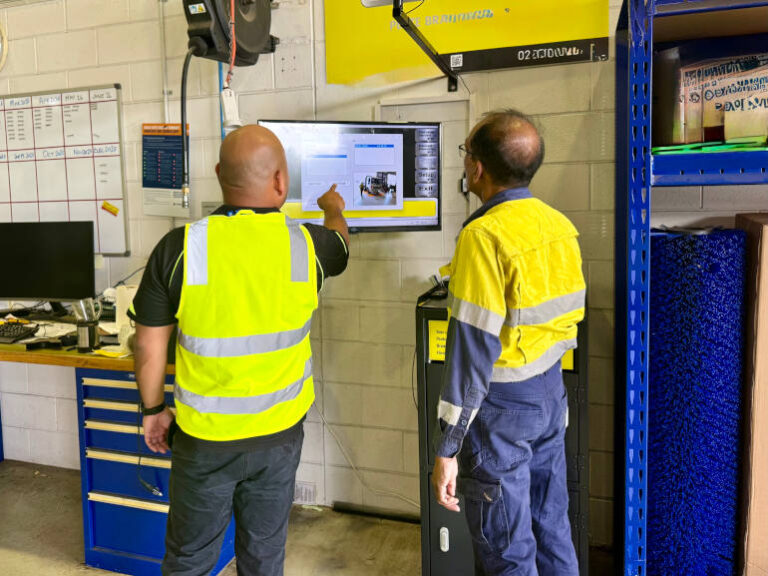
To address these challenges, the City of Parramatta installed a workshop-based brake testing system that allows technicians to assess braking and suspension performance without leaving the maintenance facility. The system completes a full test in less than one minute and automatically produces a digital report that meets National Heavy Vehicle Regulator (NHVR) requirements.
Moving brake testing off public roads
The new approach removes the need for road-based testing and the risks that come with it.
Previously, technicians were required to drive vehicles on public roads to conduct brake performance tests. Environmental conditions such as traffic, road surface and driver variability could affect results, while the process also exposed staff and the community to potential safety risks.
By moving brake testing into the workshop, City of Parramatta has created a safer and more controlled testing environment. Vehicles remain stationary on specialised testing plates while sensors measure braking force and suspension performance.
The system captures results electronically, removing the need for manual data entry and reducing the risk of reporting errors. It also automatically records vehicle identification and test data, strengthening the integrity of maintenance records.
Faster testing improves workshop productivity
One of the most significant benefits for the council has been improved workshop efficiency.
Road-based testing required technicians to leave the facility, locate suitable roads and return to the workshop before maintenance could continue. This created delays and interruptions in planned service work.
With the new system, brake tests are completed as part of normal workshop operations. Technicians can test vehicles quickly and consecutively without leaving the workshop, which helps reduce downtime and return vehicles to service sooner.
The rapid testing process also supports proactive maintenance by allowing brake performance to be checked more frequently and consistently.
Supporting compliance and better fleet data
Compliance with heavy vehicle safety requirements is another key benefit of the system.
The brake tester produces detailed digital reports that align with NHVR heavy vehicle brake testing standards. This provides fleet managers with a reliable record of vehicle performance and maintenance history.
Automated data capture improves record keeping and gives councils greater confidence that testing results accurately reflect vehicle condition.
Over time, this data can also support better maintenance planning by identifying trends in brake performance across the fleet.
Careful implementation ensured smooth adoption
Planning for the project began in November 2025 after the council identified safety and operational challenges with its existing testing methods.
Following market research and supplier engagement, the council selected an Australian-manufactured brake testing system that could integrate smoothly into its workshop processes.
The equipment was delivered and installed in January 2026 with minimal disruption to operations. Supplier technicians provided on-site training for workshop staff, ensuring the system was quickly adopted and operational by February.
A practical example of targeted fleet innovation
The City of Parramatta’s brake testing project demonstrates how targeted investment in technology can deliver meaningful improvements in fleet operations.
By eliminating road-based testing, the council has improved safety outcomes for technicians and the community. At the same time, faster testing and automated reporting are helping increase workshop productivity and strengthen compliance.
For fleet managers responsible for maintaining heavy vehicles, the project highlights the value of modern diagnostic technology that integrates seamlessly into existing maintenance workflows.
As councils and fleet operators continue to focus on safety, compliance and operational efficiency, innovations like in-workshop brake testing show how relatively small changes in process can deliver measurable improvements across the entire fleet maintenance operation.
The case study was an entry in the 2026 IPWEA Fleet Innovation Award.
- Geotab adds mass management to heavy vehicle telematics
 Geotab has expanded its Australian heavy vehicle compliance offering by adding Smart On-Board Mass capability through a certified integration with Airtec Corporation, allowing heavy haulage operators to manage telematics and mass data through a single platform. The certification means Geotab can now support Telematics Monitoring Application schemes both with and without Smart OBM requirements, as
 - Bridge Strikes Start Before the Truck Reaches the BridgeA bridge strike may happen in seconds, but the circumstances that lead to it can develop much earlier in the journey. That is one of the key fleet-management implications to emerge from HoustonKemp Economists’ report, The economic costs of bridge strikes in Australia, prepared for HERE Technologies and the Australian Logistics Council. The report estimates
- Electric Trucks and Vans Join the Spotlight at Everything Electric SydneyThe transition to electric transport is moving beyond passenger cars, and fleet operators will get a closer look at the growing range of electric trucks, vans and commercial vehicles when Everything Electric returns to Sydney in September. The three-day event, held at Sydney Showground from 18–20 September 2026, is expected to attract more than 40,000
- Truck Access, PBS and EV Rules Targeted in Major Reform ReportAustralia’s road freight productivity has stalled for more than a decade, and the Productivity Commission says regulatory reform is needed if the industry is to capture the benefits of safer, more productive and lower-emission heavy vehicles. The Commission’s Impacts of heavy vehicle reform study examines five areas where changes to road access, permits, zero-emission vehicle rules, charging
- Active safety: what fleet buyers should ask for when purchasing trucksWhen buying trucks, it is easy to focus on engine output, payload, cab comfort, service intervals and price. But one of the most important procurement decisions is the active-safety specification. Active safety technologies are designed to prevent a crash or reduce its severity before impact. They use cameras, radar, sensors, braking systems, steering assistance and