

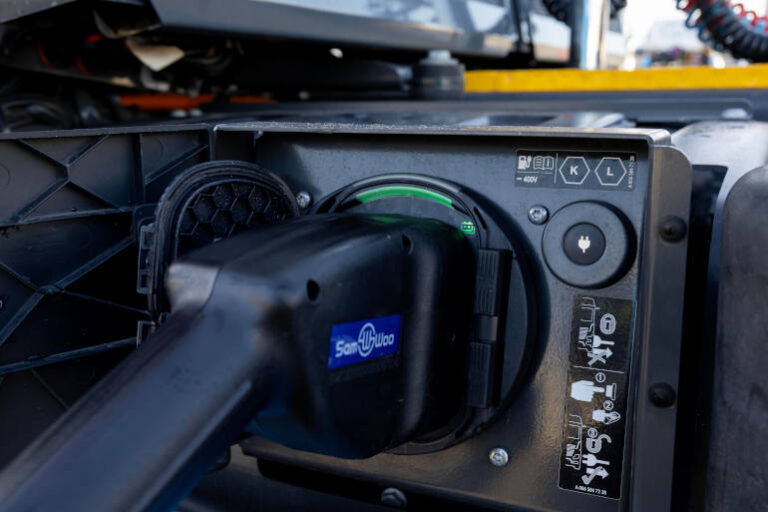
The conversation around fleet electrification is shifting. Technology is no longer the primary barrier — the real challenge now lies in infrastructure, financing, and the business models needed to make electric transport work at scale.
Speaking at the Smart Energy Council Conference and Exhibition in Sydney, Alex Grant, Director at ARENA, said the freight sector is facing structural constraints that are slowing adoption, particularly for smaller operators.
“This is a sector with small margins. This is a sector where 98% of operators are small to medium businesses. This is hard,” Grant said.
For Fleet Managers and Finance Managers, this highlights a critical issue. Even when the operational case for electric vehicles is understood, the upfront costs and complexity of implementation can stall progress.

Financing models are reshaping adoption
To address this challenge, new financing and delivery models are starting to emerge across the market.
Grant pointed to examples where third-party providers are stepping in to remove the capital burden and simplify the transition.
“There are groups who have solutions… you can have a fully vehicle-as-a-service, charging-as-a-service model,” he said.
These models are designed to reduce risk for fleet operators by bundling vehicles, charging infrastructure, and energy management into a single offering. In some cases, providers are also taking on the upfront capital investment, allowing fleets to focus on operations rather than asset ownership.
“Zenobē handling the upfront cost piece, the design of the kit… there are another five or six groups just like Zenobē who are here to make this easy,” Grant said.
For organisations with lower fleet management maturity, these types of solutions can provide a pathway to electrification without needing to build internal expertise from scratch.
Infrastructure constraints are becoming more visible
While depot charging can support early adoption, Grant said it quickly reaches its limits as fleets scale.
“We know that you can electrify depots to a certain point, and after that you run out of capacity… there’s only so much you can do,” he said.
This is driving increased focus on shared and off-site charging infrastructure, particularly for freight routes.
“Off-site charging is going to play a major part in Australia’s electrification of transport,” Grant said.
ARENA analysis suggests that a national network of charging hubs will be required to support heavy vehicle operations.
“You need 165 of them around the country to map to the freight routes,” he said.
For fleet operators, this reinforces the importance of planning beyond the depot. Access to reliable, scalable charging infrastructure will be a key factor in determining how quickly electric trucks can be deployed across different use cases.
Industry collaboration is critical
One of the consistent themes from Grant’s presentation was the need for collaboration across the value chain.
“No group can do it alone,” he said. “Have you taken a true look at your capabilities… and looking to infill around that? It’s much easier.”
Successful projects are increasingly being delivered through partnerships that bring together vehicle suppliers, energy providers, infrastructure developers and financiers.
“They’re all clubs… groups who are charging the actual vehicle operations, the financing, the retailers. It’s about getting clubs together,” Grant said.
For Fleet Managers, this represents a shift away from traditional procurement models towards more integrated solutions. The ability to coordinate multiple stakeholders is becoming just as important as selecting the right vehicle.
The opportunity beyond vehicles
Grant also highlighted emerging opportunities that go beyond simply replacing internal combustion engine vehicles.
Vehicle-to-grid (V2G) technology, for example, has the potential to turn fleets into energy assets rather than just energy users.
“We think this is one of the most exciting opportunities in the energy transition,” he said, referring to V2G.
As fleets electrify, the ability to manage and monetise energy — through smart charging, load management and grid interaction — will become an increasingly important part of the business case.
Moving from barriers to solutions
The shift in focus from vehicles to systems marks a turning point for the industry. The barriers to electrification are now less about whether the technology works, and more about how it is deployed, funded and integrated into existing operations.
For organisations planning their transition, the priority is clear. Improving fleet management maturity — through better data, clearer policies and stronger partnerships — will be essential to navigate this next phase.
The opportunity is significant, but so is the complexity. As Grant’s message made clear, the path forward will depend on collaboration, innovation and new ways of thinking about fleet operations.