


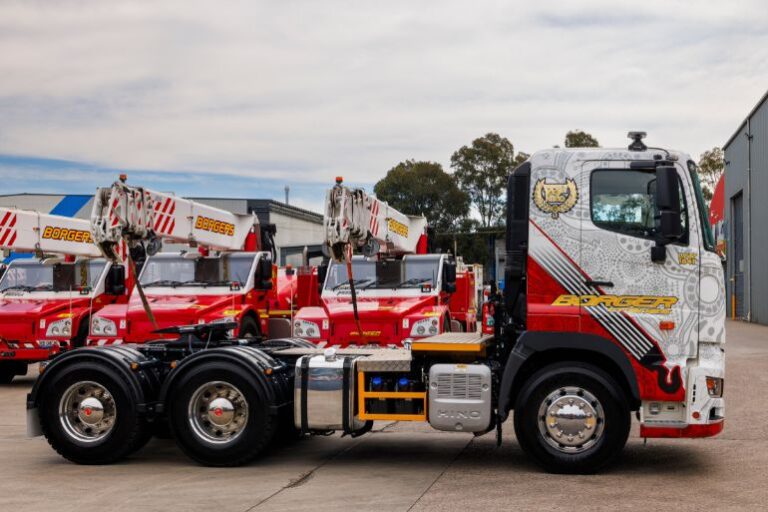
When a truck breaks down, the cost can be much greater than the repair bill. For Borger Cranes, operating a fleet of more than 200 trucks alongside hundreds of cranes means reliability, safety and equipment availability are essential to delivering services to customers. General Manager Shawn Borger explains how the business has developed a fleet management approach built around standardisation, in-house maintenance and long-term investment in equipment.
Fleet management is about more than trucks
Borger Cranes operates one of Australia’s substantial crane fleets, with approximately 330 cranes owned by the business and around 350 under management. Supporting these assets is a fleet of more than 200 trucks, predominantly Hino and Volvo, which perform an essential role in keeping the cranes operational.
The business operates across construction, infrastructure, mining and wind farm projects, providing diversity in its customer base and the equipment required to deliver services.
For General Manager Shawn Borger, understanding the relationship between the cranes and supporting vehicles is fundamental to fleet management.
“Pretty much when we order a crane, we order a truck at the same time. That’s pretty much what we do, one for one.”
Many of the larger slewing cranes require trucks to transport counterweights and other equipment to the job site. Without these supporting vehicles, the cranes cannot perform the work they were purchased to complete.
It’s an example of why fleet management maturity starts with understanding the role each asset plays in delivering services and generating revenue.
A truck might be considered a secondary asset compared with a large crane, but its availability can determine whether the entire operation is productive.
Understanding the true cost of downtime
One of the biggest changes in the Borger Cranes fleet management strategy occurred around 2014, when the business reconsidered its approach to purchasing trucks.
Historically, the company had invested heavily in cranes while using older, lower-cost trucks to transport the supporting equipment.
Shawn says the business eventually recognised that this approach created an operational risk.
“We always had an expensive crane with a cheap truck, but the problem was when the cheap truck doesn’t perform, then it costs a lot of money for the crane to be sitting on site, but all the auxiliary gear on the side of the road.”
The decision to purchase new trucks was therefore about more than reliability or presenting a professional image. It was about protecting the productivity of the entire operation.
A breakdown could leave an expensive crane sitting idle, delay a customer’s project and create additional costs that were significantly greater than the repair bill for the truck.
This is an important lesson for Fleet Managers who are under pressure to reduce operating costs.
Purchasing the cheapest vehicle doesn’t necessarily deliver the lowest whole-of-life cost, particularly when downtime affects other assets, employees and customers.
Borger Cranes began purchasing new trucks and developing closer relationships with manufacturers to ensure vehicles were correctly specified for their applications.
“We actually heavily invest into all our plant and equipment, our trucks, the trailers. We have the best gear for a reason to make sure that we can deliver a good product.”
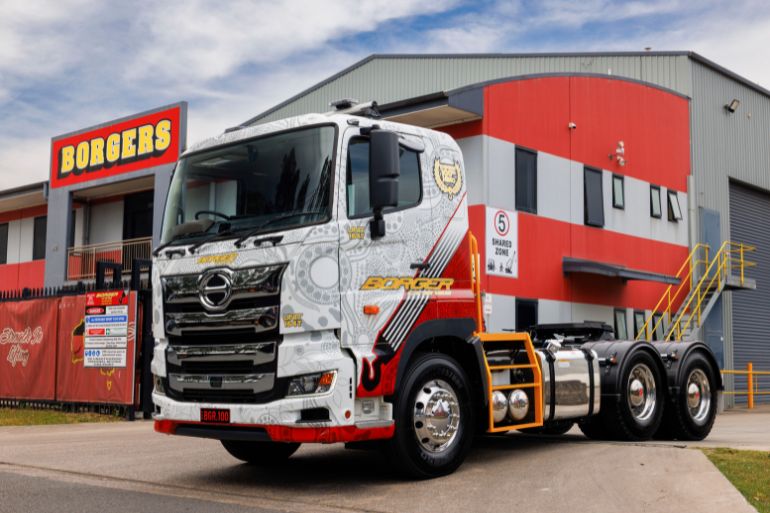
The approach has seen Hino become a significant supplier to the business, with the company reaching the milestone of 100 Hino truck deliveries.
Standardisation supports fleet management maturity
Another important element of the Borger Cranes strategy is fleet standardisation.
With hundreds of assets operating across different locations and industries, the company deliberately limits the number of vehicle brands and configurations used for similar applications.
“We need to keep the same truck for the same application. So our employees are jumping. Doesn’t matter if they jump in this truck or that truck, it still performs the same, and they have the same blinkers, the same gearboxes, the same engines. That’s why we run fleets.”
Standardisation delivers several operational advantages.
Drivers can move between vehicles with familiar controls and operating characteristics. Mechanics develop expertise with common components, while parts inventory and maintenance processes become easier to manage.
It also supports safety by reducing the differences employees encounter when operating unfamiliar equipment.
For Borger Cranes, standardisation extends beyond trucks to the cranes themselves.
Shawn explained that when the company selects a particular crane for an application, it may purchase dozens of the same model to maintain consistency across the fleet.
The business also considers standardisation when replacing older equipment, often transitioning groups of vehicles to a new model rather than introducing numerous different configurations.
This is an example of fleet management maturity being demonstrated through procurement decisions that consider operational requirements, maintenance, safety and long-term support rather than purchase price alone.
Why maintenance stays in-house
While many organisations consider outsourcing maintenance to reduce costs, Borger Cranes has taken a different approach.
The company employs approximately 30 mechanics across Australia’s east coast and maintains extensive internal capabilities, including mechanical servicing, fabrication, tyre repairs, spray painting and bodywork.
The maintenance operation runs 24 hours a day, seven days a week, with day, afternoon and night shifts ensuring mechanical support is available when required.
For Shawn, the decision is primarily about maintaining control over equipment availability.
“The control outweighs the cost.”
He explains that outsourcing can introduce additional delays, particularly when vehicles need to be transported to external workshops or when breakdowns occur outside normal business hours.
“We don’t have to drop a truck over to over to another you know service center and waste all that time.”
The company still uses external service providers in some remote locations, but the preference is to maintain internal capability wherever practical.
This approach is particularly valuable when crane operations are scheduled overnight or involve road closures.
Shawn explained that when streets are closed in Sydney for lifting operations, the business may have a mechanic on standby to respond immediately if equipment develops a problem.
The value of the maintenance team is therefore measured not simply by the cost of completing a service, but by its contribution to operational continuity.
For Fleet Managers assessing maintenance strategies, the example highlights why cost comparisons should include vehicle availability, response times, operational disruption and the consequences of downtime.
Safety starts with leadership
Safety is another area where Borger Cranes demonstrates the importance of management commitment.
Operating large cranes and heavy vehicles in construction environments creates significant risks, making training, equipment condition and employee behaviour essential considerations.
Shawn believes safety must be embedded throughout the organisation rather than treated as a separate compliance activity.
“Between safety in the crane industry, you’ve got to build it in with your culture with your people.”
He says the expectations must come from senior management and be understood by everyone in the business.
“We will demand that you do stop before you have an accident.”
This approach places responsibility on employees to recognise risks and stop work when conditions are unsafe.
It also requires the organisation to provide the training and equipment necessary for employees to perform their work safely.
Borger Cranes operates apprenticeship and traineeship programs alongside its qualified mechanical workforce, supporting the development of technical skills within the business.
The fleet purchasing process also involves consultation with drivers, mechanics, manufacturers and bodybuilders.
Shawn says the company considers driver comfort, safety, mechanical support and whether the vehicle is suitable for the crane it will support.
Even the design of truck bodies receives considerable attention.
For example, the business has developed specialised guides that allow crane counterweights to be positioned and secured using pins, reducing the need for traditional load restraint chains.
These decisions demonstrate how safety considerations can be incorporated into vehicle specifications before an asset enters service.
Replacement cycles based on the application
One of the more unusual characteristics of the Borger Cranes truck fleet is its relatively low annual kilometres.
Unlike a traditional transport operation, where trucks may travel significant distances every day, many Borger Cranes vehicles spend much of their working time parked beside cranes.
A truck might travel an hour to a job site, remain there throughout the lifting operation and then return to the depot.
Shawn says this means vehicles can be four or five years old with only around 80,000 kilometres travelled.
As a result, the business can retain trucks for longer periods while continuing to assess their condition, reliability and suitability.
He suggested some trucks could remain operational for approximately 15 years because of their relatively low kilometres.
However, age and kilometres are not the only considerations.
When the company decides to introduce a new vehicle generation, it considers the benefits of transitioning the broader fleet to maintain consistency for drivers, mechanics and parts management.
This reinforces the importance of developing replacement policies based on the actual operating environment rather than applying the same age or kilometre limits to every fleet asset.
Working with suppliers to get the specification right
The relationship between Borger Cranes and its vehicle manufacturers goes beyond ordering trucks.
Because the company’s vehicles perform specialised tasks, it works closely with manufacturers and bodybuilders to ensure the finished product is fit for purpose.
“Actually, everybody. We we we really do a lot of research in the back end, make sure that the the drivers are comfortable, and feel safe. Make sure that the make sure that the mechanics are trained. Make sure that the application for for the truck suits the crane.”
This collaborative approach helps ensure the vehicle can perform its intended role while meeting the expectations of drivers, maintenance teams and customers.
It also demonstrates how mature fleet management requires input from multiple stakeholders rather than procurement decisions being made in isolation.
Preparing for new technology
While reliability and standardisation remain central to the fleet strategy, Borger Cranes is also monitoring changes in vehicle and crane technology.
Shawn says customers are beginning to ask questions about emissions and alternative powertrains during tender processes.
He believes crane technology is currently moving faster than heavy transport in some applications, particularly with hybrid systems that allow cranes to operate on battery power while completing lifts.
These systems can reduce noise and eliminate engine exhaust emissions during battery-powered lifting operations.
Electric trucks are also being considered as the technology develops, although charging infrastructure remains a challenge.
The business has also introduced Chinese-manufactured cranes alongside established European equipment, with Shawn highlighting the importance of asking questions about reliability, support and long-term resale value.
For fleet operators, these developments reinforce the need to assess new technologies against operational requirements rather than adopting them simply because they are available.
Fleet management that supports business growth
Borger Cranes employs approximately 1,100 people and has a strong focus on retaining skills and experience within the organisation.
Shawn says approximately 80 employees represent the third generation of their families to work for the company.
For a business operating complex equipment across multiple industries, that continuity of knowledge is an important asset.
“We can’t do it without good people. It’s that simple.”
The Borger Cranes story demonstrates that fleet management maturity isn’t necessarily about having the newest technology or the most sophisticated reporting system.
It’s about understanding the operational role of every asset, making informed purchasing decisions, developing consistent processes, investing in employees and ensuring equipment is available when customers need it.
For Fleet Managers looking to demonstrate their value to senior executives, the lessons are clear.
The real contribution of fleet management isn’t simply reducing the cost of vehicles and maintenance. It’s protecting revenue, managing risk, improving productivity and helping the organisation deliver on its commitments.
At Borger Cranes, keeping the trucks moving is an essential part of keeping the cranes working.
This longer website version puts the emphasis on fleet management maturity, downtime as a business cost, standardisation, safety culture and the value of in-house maintenance. It uses Shawn Borger’s interview as the source, with direct quotes retained verbatim rather than rewritten.