

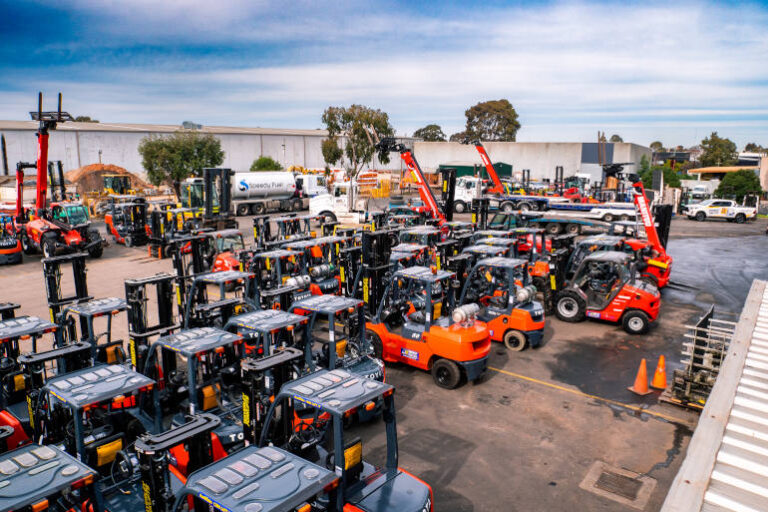
Economic uncertainty is helping support demand for forklift rental across Australia, with businesses increasingly choosing short-term hire rather than committing capital to new equipment.
Charlie Schwerkolt, Managing Director of Waverley Forklifts, told Fleet News Group that the rental market remains strong in 2026 as customers look for flexibility while economic conditions remain tight.
“Things are reasonably good at the moment,” Schwerkolt said. “When the economy is pretty tight, which it is at the moment, people never buy up. They just rent.”
For fleet and equipment managers, the trend reflects a familiar response to uncertainty: rather than adding permanent assets, businesses can increase capacity temporarily and return equipment when demand changes.
“Our rental market is pretty strong in all states of Australia at the moment,” Schwerkolt said.
Seasonal events are also contributing to demand in parts of the country, providing another market for equipment that may only be required for relatively short periods.
Material handling remains essential
Looking towards 2027, Schwerkolt expects the fundamental need for material handling equipment to provide some resilience even if broader economic conditions weaken.
“People need to lift whatever it is. If things slow down, they still need to lift. Maybe not as much,” he said. “So forklifts [are] required everywhere.”
Waverley Forklifts is consequently planning for further growth in 2027, although Schwerkolt says that depends on continuing to deliver for customers and supporting its staff.
Expansion follows activity in North Queensland
The company is also expanding its geographic footprint.
Waverley Forklifts currently operates across Melbourne, Sydney, Brisbane, Adelaide, Perth and Darwin, and has recently opened a branch in Townsville.
Schwerkolt sees North Queensland as a growth opportunity because of the mix of mining, infrastructure, defence and events activity.
“There’s a lot going up in North Queensland. There’s a lot of mining,” he said.
The company has also picked up work associated with the Townsville stadium, with major events providing another source of equipment demand.
“There’s a lot of defence happening up there, so it’s a good place to be,” Schwerkolt said.
Electric forklifts continue to enter fleets
Electrification is another change Schwerkolt is seeing across the forklift market.
Waverley Forklifts operates a fleet of around 7,000 machines, which Schwerkolt says is predominantly Toyota equipment, making the company a major Toyota customer in Australia.
“A lot of electric stuff is going into the fleet, which is great,” he said.
For fleet and procurement teams, the broader market picture is one of customers seeking flexibility. Economic uncertainty may be discouraging some outright equipment purchases, but the work still needs to be done — supporting rental demand while suppliers continue to expand into growing regional markets and introduce more electric equipment.