

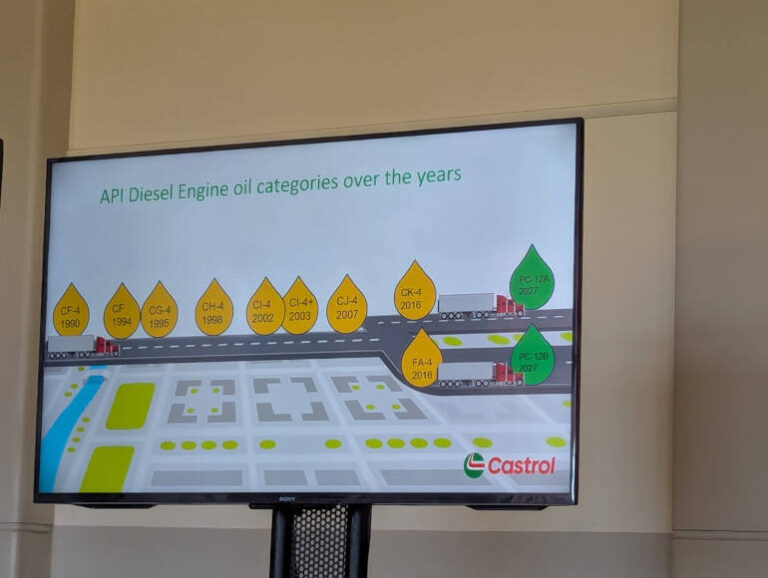
At the Australian Trucking Association’s Technology and Maintenance Conference (TMC) 2025, Castrol’s Senior Expert Technologist, Claudia Sclosa, outlined one of the most significant upcoming changes in engine lubricant standards — the American Petroleum Institute’s (API) Proposed Category 12 (PC-12). Expected to launch on 1 January 2027, PC-12 represents a major advance in heavy-duty diesel engine oil formulation, driven by new emissions and durability demands from the U.S. Environmental Protection Agency (EPA).
Why PC-12 is Being Developed
Sclosa explained that PC-12 is “not a product per se” but a working title for the next generation of API heavy-duty diesel oil standards — the successor to CK-4 and FA-4.
She said, “The world is fast moving towards cleaner air and lower emissions. Governments and regulators are under increased pressure to cut nitrogen oxides (NOx) and greenhouse gas emissions from heavy-duty trucks.”
The EPA and the California Air Resources Board (CARB) are introducing stringent emission regulations for model year 2027 engines, requiring an 80% reduction in NOx emissions compared to current levels. These will also measure real-world emissions, including during low-load and cold-start conditions when aftertreatment systems are less effective.
This means that engine oils must deliver greater durability, higher thermal stability, and enhanced aftertreatment compatibility — all while supporting new engine designs that run hotter, cleaner, and longer.
“PC-12 is about future-proofing our lubricants,” Sclosa said. “It’s making sure they’re ready for the next generation of engines, regulations, and environmental expectations.”
What PC-12 Will Deliver
The API’s new proposed category will be split into two subcategories:
- PC-12A – Backwards-compatible, maintaining durability and protection for existing engine platforms, similar to CK-4.
- PC-12B – Optimised for fuel efficiency and lower emissions, introducing lower viscosity grades such as 0W-20 and 5W-20 to reduce internal friction. However, due to lower high-temperature, high-shear (HTHS) viscosity, these will not be backwards-compatible with older engines.
Sclosa explained: “The introduction of W-20 grades marks a significant change. It’s a balancing act — delivering efficiency gains without compromising durability.”
Key Technical Advances
Compared with the current CK-4 specification, PC-12 sets new benchmarks in several performance areas:
1. Wear Protection and Oxidation Stability
PC-12 oils will need superior oxidation resistance to handle higher operating temperatures. The Volvo T-13 oxidation test will remain in use but with tighter limits, demanding formulations that resist thickening, sludge formation, and corrosion.
“Improving oxidation stability directly supports wear protection,” Sclosa said. “It allows the oil to maintain consistent viscosity and keep moving parts lubricated over longer intervals.”
2. Aftertreatment System Compatibility
To protect sensitive Diesel Particulate Filters (DPFs) and Selective Catalytic Reduction (SCR) systems, PC-12 will impose stricter chemical limits:
- Phosphorus reduced from 0.12% → 0.08%
- Sulphur reduced from 0.4% → 0.3%
- Sulphated Ash reduced from 1.0% → 0.1%
“These tighter limits help prevent ash build-up and catalyst poisoning, ensuring the aftertreatment system remains effective for the full service life,” she said.
3. Oil Durability and Drain Intervals
PC-12 introduces new and updated tests to reflect modern engine hardware and longer service intervals:
- The Cummins ISB test replaces the older Mack T-12 soot test to better represent contemporary conditions.
- A new Detroit Diesel DD13 scuffing test will ensure oils protect against adhesive wear in high-pressure, high-load environments.
- New seal compatibility tests (with hydrogenated nitrile materials) will verify performance over extended service life.
According to Sclosa, these changes will lead to extended oil drain intervals, reducing maintenance costs and vehicle downtime — key benefits for fleet operators.
Comparing CK-4 and PC-12
| Performance Area | CK-4 (2016) | PC-12 (2027) | Improvement |
|---|---|---|---|
| Oxidation Stability | Improved over CJ-4 | Tighter T-13 limits | Longer oil life, better high-temp performance |
| Aftertreatment Protection | Controlled SAPS | Lower P, S, Ash | Greater DPF & SCR protection |
| Viscosity Grades | 15W-40, 10W-30 | Adds 0W-20, 5W-20 | Higher fuel efficiency |
| Wear Protection | Basic Cummins ISM | Adds DD13 scuff test | Stronger anti-wear under high load |
| Compatibility | Backwards-compatible | Split into A (yes) and B (limited) | Flexibility for mixed fleets |
What It Means for Fleets
While the new category won’t be licensed until 2027, Sclosa confirmed development is well underway across the lubricant industry.
“For fleets, this is good news,” she said. “Oils will offer longer life, better engine protection, and improved aftertreatment durability. That means reduced maintenance costs and less time off the road.”
Sclosa also noted that backwards compatibility in PC-12A will simplify adoption: “Fleets won’t have to completely overhaul their inventory — they can use one oil across both new and existing engines.”
Castrol is already testing PC-12-capable formulations ahead of release. “We’re engineering products that deliver superior oxidation stability, advanced wear protection, and extended drain intervals — ready for you in 2027,” she concluded.
API’s PC-12 represents more than an incremental update — it’s a leap forward in lubricant technology, aligning oil performance with the next generation of clean, durable, high-efficiency diesel engines.
As emission standards tighten and operational demands rise, PC-12 will help fleets stay compliant, extend service life, and maximise uptime.