
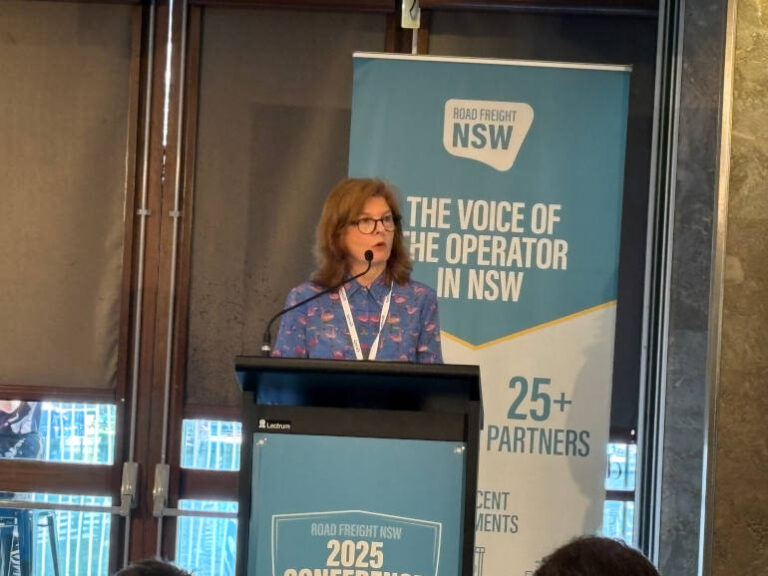
Last month, at the Road Freight NSW 2025 Conference and Awards, Sally Webb, Deputy Secretary of Safety, Policy, Environment and Regulation at Transport for NSW, delivered a wide-ranging address on the challenges and opportunities facing the road freight industry. Her focus was clear: building a safer, more sustainable, and more inclusive industry through strong collaboration between government and operators.
Safety as the First Priority
Webb emphasised that safety remains the central priority for Transport for NSW. Her team leads the state’s multi-modal safety and decarbonisation policy agenda, with road safety front and centre. “One of the most important things that my team works on is making sure that every journey—yours included—is as safe as it can be, whether it’s people or freight moving across our network,” she said.
She acknowledged the increasing pressure on drivers, noting fatigue, limited rest facilities, and unsafe behaviour by light-vehicle drivers as growing concerns. “Your drivers tell us the way light vehicle drivers behave creates risks and real stress, which they then carry for long hours,” she said.
Addressing Workforce Challenges
The freight industry is facing a critical driver shortage, with 28,000 heavy vehicle positions unfilled nationally. Webb highlighted the scale of the challenge: nearly half of drivers are aged over 55, while only 5.4% are under 25. Women remain significantly under-represented, making up just 3% of the heavy vehicle workforce.
To tackle this, Transport for NSW is supporting reforms to simplify driver entry pathways. “Entry pathways are unclear, inconsistent, and frustrating for applicants,” Webb admitted. She pointed to upcoming national reforms that will introduce experience-based progression, structured supervision, and competency-based training—piloted in 2025 and rolled out nationally from 2026.
Webb also called for cultural change within the industry. Clean, secure rest facilities, proper lighting, and a respectful workplace culture, she said, are essential to attracting new drivers, particularly women and younger workers.
Freight Reform and Future Initiatives
Looking beyond licensing, Webb outlined the NSW Freight Policy Reform Program. This includes:
- A new online hub with clear information on driver pathways, licence classes, and training options.
- A targeted workforce attraction program developed in partnership with industry.
- Investment in corridors, hubs, and network upgrades through the Freight Master Plan.
- A new heavy vehicle access policy to encourage safer, more productive vehicles on the network.
- Expanded rest stop facilities and support systems for drivers.
She also underlined the importance of aligning licensing and vocational training, stressing that while licensing ensures safe drivers, vocational training and employer support prepare them for the diversity of roles across the freight industry.
Partnership with Industry
Webb closed her presentation by highlighting the importance of collaboration. “Lasting change demands strong and open government and industry partnership,” she said. She acknowledged the success of initiatives like Transport Women Australia scholarships and NSW operators’ buddy systems for new drivers, noting they provide models for the kind of industry-led innovation that can drive progress.
“Together, we’ll attract new talent, retain experienced drivers, and secure a safer, more sustainable future,” Webb concluded.
- Three risks behind more than a third of major truck incidents
 Inattention, inappropriate speed and inadequate following distance accounted for 38% of major heavy vehicle incidents in 2025, according to new research that gives fleet managers a clear starting point for reviewing their safety priorities. The 2026 National Truck Accident Research Centre (NTARC) Major Incident Investigation Report found human factors contributed to 54.7% of all major incidents analysed.
 - Scania G- and R-Series Take Top Safety HonoursScania’s G-series and R-series have achieved five-star ratings in Euro NCAP’s haulage assessment, recording a 96 per cent score for crash avoidance. The results cover four configurations: G-series and R-series 4×2 prime movers and 6×2 rigid trucks. Both model ranges also received Euro NCAP’s City Safe Award, adding to the five-star results previously achieved by
- From incident to fleet redesign: what City of Gold Coast can teach fleet practitionersA serious workplace incident involving a City of Gold Coast tipper truck provides a powerful example of why fleet safety goes well beyond driver behaviour — and why fleet practitioners have an important role in designing, procuring and managing safer vehicles. The lessons from the incident, and the extensive work undertaken by the City of
- Minor Bridge Strikes Are Creating a Major BillThe most spectacular bridge strikes attract the headlines, but a new economic study suggests Australia’s biggest bridge-strike bill is being generated by much less dramatic incidents. HoustonKemp Economists estimates protection beam and signage strikes accounted for 79 per cent of Australia’s approximately 1,220 bridge-strike incidents in FY2025. Despite being the lowest severity category used in
- Buying Telematics Won’t Make Your Fleet SafeTelematics can tell a fleet manager where vehicles are, how they are being driven and where risks may be developing. But technology alone does not create a safe fleet. That is the view of Andrew Hutson, Director at Geosecure, who says the strongest fleet safety programs are built around organisational culture, leadership and a willingness