

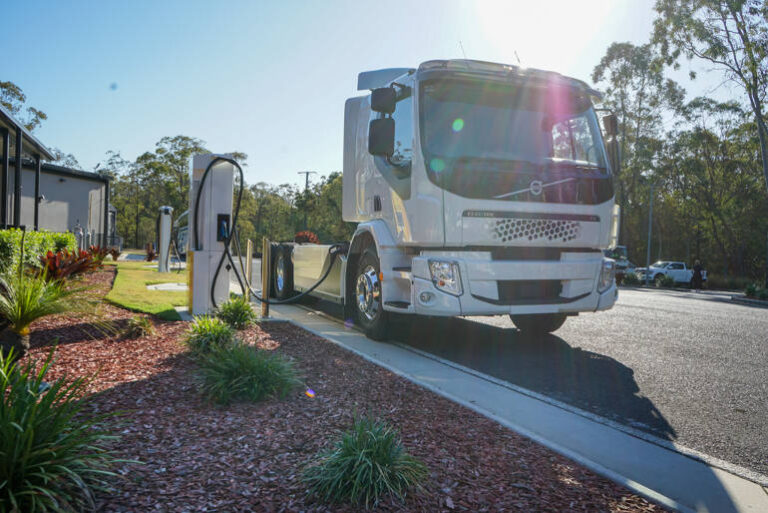
Australia’s road freight industry is the seventh-largest mover of freight in the OECD despite its smaller population and lack of land borders. It contributes 8.6% to national GDP and is responsible for over 80% of freight emissions – around 36 million tonnes of CO₂ annually. With freight volumes expected to grow 77% by 2050, electrifying road freight is essential to meet net-zero targets.
Commissioned by ARENA, the AECOM Electrifying Road Freight report outlines a path to transition the sector to battery electric vehicles (BEVs), identifying use cases, energy demands, infrastructure needs, and policy barriers.
Key Findings
- Urban freight is ready to electrify
- Urban freight, which includes last-mile delivery and short regional trips, is the most viable use case for electrification today.
- With 3.3 million vehicles in operation, mostly light commercial vehicles (LCVs), overnight depot charging is already feasible.
- Intrastate and interstate freight will require staged rollout
- Long-haul operations will need ultra-fast or megawatt charging solutions along highways and at freight hubs.
- A national network of up to 165 charging hubs is proposed to support BEV freight, with staging prioritised by route usage and readiness.
- Energy supply is not the problem — transmission is
- Forecasts suggest there will be enough electricity generation capacity, but transmission and distribution networks will need major upgrades to meet localised charging demand.
- Government coordination is essential
- Federal, state, and local governments must collaborate to refine charging locations, update regulation (e.g., for BEV weight and licensing), and address permitting delays.
- Policy, cost and access are the major barriers
- High upfront vehicle costs, limited model availability (especially in articulated trucks), and insufficient public charging remain key issues.
- Small-to-medium operators — who make up 98% of the industry — will need targeted support to participate in the transition.
Infrastructure Needs
- Charging Locations: Freight depots, rest stops, freight nodes (e.g. ports, terminals), and regional towns.
- Vehicle-Use Case Alignment:
- Urban freight: depot-based charging.
- Intrastate freight: depot and destination charging.
- Interstate freight: on-route megawatt charging hubs.
- Grid Integration:
- Urban areas face space constraints but generally have better existing grid connections.
- Rural and remote areas may need off-grid renewable solutions and battery storage (BESS).
- Isolated communities, especially in NT and WA, pose the greatest infrastructure challenge.
Energy Demand Forecast (2040)
AECOM modelled two scenarios:
- High uptake (100% BEVs in urban, 60% in intrastate, 30% in interstate): ~16 TWh annually.
- Moderate uptake: ~11.5 TWh annually.
This would add 3–4% to Australia’s total electricity demand, with peak loads manageable if investment in renewables and grid upgrades continues.
21 Recommended Actions
AECOM outlines actions across five themes:
1. Demonstration Projects
- Urban shared charging trials in Western Sydney, North Melbourne, and Western Brisbane.
- Regional highway pilots on Sydney–Newcastle, Brisbane–Gold Coast, Melbourne–Ballarat routes.
2. Strategy & Policy
- Develop a National Freight Electrification Strategy with clear targets.
- Review vehicle design, access, and licensing rules to remove BEV barriers.
3. Market Support
- Create a national skills and knowledge portal.
- Engage owner-operators, freight customers, and asset owners.
- Regular knowledge-sharing between industry and government.
4. Funding
- Support local EV manufacturing.
- Fund depot upgrades and small operator transitions.
- Explore renewables for off-grid charging.
5. Infrastructure Delivery
- Stage national network rollout (urban first, then highways, then remote).
- Preserve future charging corridors and align with energy project rollouts.
- Collaborate with DNSPs on location-specific upgrades.
Conclusion
The AECOM report provides a comprehensive roadmap to electrify Australia’s freight sector by 2040. While technical and economic challenges remain, particularly for small operators and remote areas, coordinated national effort could decarbonise one of Australia’s most emission-intensive sectors. The time to act is now — before growth in freight volumes locks in higher emissions for decades to come.
👉 View the full AECOM report for more information.