

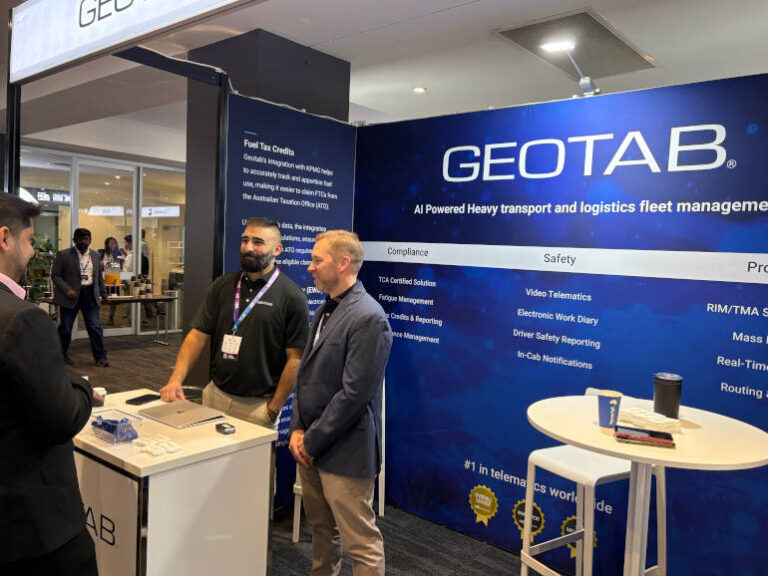
For many transport operators, fuel is one of the largest operating expenses in the business. Yet according to Geotab, many fleets are still failing to maximise one of the industry’s most valuable financial incentives – Fuel Tax Credits (FTC).
While telematics is often associated with safety, compliance and vehicle tracking, Geotab’s heavy transport team says Fuel Tax Credits are frequently the first conversation they have with fleet operators because of the immediate financial benefits available.

Andrew Hintz, AVP, Heavy Transport, APAC Region at Geotab, believes many operators are still leaving significant amounts of money unclaimed.
“FTC would be the number one area that we lead with when we’re in front of a transport operator,” said Hintz.
“The question is always, how are you managing Fuel Tax Credits? How are you maximising that claim to be had?”
According to Hintz, the answer is often surprising.
“Quite often you’ll find transport operators saying that they claim at five per cent or safe harbour or something like that,” he said.
“Well, that’s a fantastic opportunity, because by leaving money on the table, not only going forward but also looking back at that four-year retrospective claim.”
Looking Beyond Off-Road Operations
One of the misconceptions surrounding Fuel Tax Credits is that the greatest opportunities are limited to off-road activities.
However, Hintz said many operators overlook legitimate claims associated with auxiliary equipment that continues to operate while vehicles are travelling on public roads.
“When you start to break down Fuel Tax Credits, it’s in all areas, it’s not just off-road,” he explained.
“If you’re running a heavy truck that’s got air conditioning cooler units, that’s got its own little separate motor, if it’s pulling diesel out of the tank, well, that’s 100 per cent at the full FTC rate.”
The same principle applies to refrigerated transport operations.
“If you’re running refrigerated vehicles, so reefer trailers, that sort of thing, again, 100 per cent at the full FTC rate on-road as well,” said Hintz.
“You just need to be smart about how you can maximise the FTC claims.”
For fleets operating refrigerated trailers, auxiliary equipment and specialised transport applications, those additional claims can quickly add up across an entire fleet.
Telematics Provides the Evidence
While identifying opportunities is one challenge, substantiating claims is another.
Geotab’s telematics platform combines vehicle location data with detailed operational information to provide evidence that can support more accurate FTC calculations.
Alkan Ciftci, Business Development Manager at Geotab, said the company’s partnership with KPMG helps customers navigate what can often be a complex process.
“A lot of those spots are boosted by our partnership with KPMG and FTC automated products,” said Ciftci.
“You are being backed by a large firm who specialise in these claims and can help our customers to really understand the different use cases.”
This becomes particularly important in environments where the distinction between public and private roads is not always obvious.
“Looking at things like customer sites that are off-road construction zones that might be right beside a road, but are close to public use, and getting all your claim for the times where it’s probably within that 20 or 50 metre radius of actually being on road,” he explained.
“Being able to drill down to the meat of geofences and zones, and make sure you claim every cent.”
The Four-Year Opportunity
For operators that have relied on simplified claiming methods for years, the biggest opportunity may not be future savings but recovering money already spent.
Australian businesses can generally review and amend Fuel Tax Credit claims for previous years, creating the potential for substantial retrospective recoveries.
“We use retrospective claims, and there are quite a few public case studies of customers who have made large four-year retrospective claims,” said Ciftci.
In some cases, the financial return can be significant enough to offset the cost of implementing telematics technology.
“That pays for telematics and video safety through the complete implementation,” he said.
Every Cent Counts
With freight operators continuing to face pressure from fuel prices, labour costs and increasing compliance requirements, maximising Fuel Tax Credits represents one of the few opportunities to improve profitability without changing operations.
The challenge is that many businesses simply don’t know how much they may be missing.
uFor Hintz, the message is straightforward.
“By leaving money on the table,” he said, “there’s a fantastic opportunity there.”
For transport operators looking to improve cash flow and reduce operating costs, Fuel Tax Credits may be one of the most overlooked returns on investment available today.