
New Energy Transport is moving quickly to bring electric heavy vehicles onto Australian freight routes, driven by both economics and urgency.
At the Smart Energy Conference in Sydney, Daniel Bleakley, Co-founder and Co-CEO at New Energy Transport, outlined a staged rollout plan designed to accelerate deployment well ahead of traditional infrastructure timelines.
“The crisis hasn’t actually hit us yet… but it’s coming, and we need to act now,” Bleakley said.

Building a strategic foothold
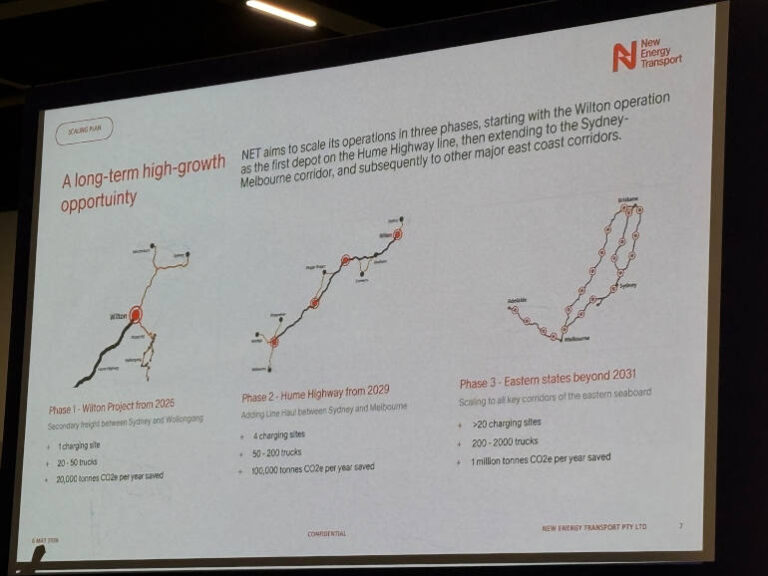
The company’s first major site is being developed near Wilton, south of Sydney, positioned to capture high freight volumes moving between Sydney, Canberra and regional NSW.
“There’s around 4,000 trucks going up and down the Hume Highway every day, and around 5,000 trucks going down Picton Road,” Bleakley said.
The depot will include:
- 5MW grid connection
- 12 high-powered charging bays
- 10MW onsite battery storage
- Megawatt-level charging capability
“We’ll be able to charge one of these trucks in about an hour,” he said.
The site is designed to handle B-doubles and A-doubles, with flexible charging layouts to maximise throughput.
Rapid deployment model
Rather than waiting for full infrastructure build-out, the company is introducing a rapid deployment approach.
“We’re looking at putting in a temporary hard stand… and using skid-mounted rapidly deployable charging units,” Bleakley explained.
This allows early operations to begin within months, not years.
“With the help of Volvo and Windrose… we believe we’re going to be able to get 10 to 20 trucks operational within a few months.”
This approach reflects a shift in thinking—prioritising speed to market over perfect infrastructure.
Scaling the network
The initial operating model is corridor-based, focusing on repeatable freight loops.
“We’ll be able to operate between Sydney and the Illawarra… move food to supermarkets and bring primary produce back into Sydney,” Bleakley said.
With the addition of higher-range vehicles, the network expands.
“The Windrose will do 670 kilometres on a single charge… that enables us to get from Wilton to Canberra and back.”
Future deployment includes extending into regional NSW.
“By the end of the year… we want to reach places like Griffith and Wagga… bringing thousands of tonnes of primary produce into the city.”
Strategic site selection
A key decision is avoiding urban depots.
“We’ve decided not to put any depots in the city… we can target greenfield sites and build them from scratch,” Bleakley said.
This reduces complexity, cost, and planning delays—critical factors for rapid rollout.
Technology readiness
While some OEMs are still developing products, New Energy Transport is moving with available platforms.
“All the reports we’re getting are that the truck is an exceptionally good truck,” Bleakley said of early trials.
He acknowledged the risks of newer entrants but emphasised performance advantages.
“It’s the best that’s out there right now.”
Responding to market pressure
The urgency behind the rollout is tied to fuel price volatility and supply risk. Bleakley warned of significant disruption ahead.
“We’re probably going to see thousands of trucking companies going bust,” he said, referencing potential diesel price spikes.
This creates a narrow window for early adopters to gain a competitive advantage.
Government and industry support
The project is backed by a mix of partners and public sector support.
“We have customers on board… and amazing support from federal, state and local government,” Bleakley said.
However, broader industry adoption will depend on shared infrastructure.
“It’s really important for federal government to pump money into shared-use charging infrastructure… so smaller trucking companies can take advantage.”
From pilot to scale
The Wilton site is only the starting point.
“Our long-term plan is to scale this across the entire eastern seaboard,” Bleakley said.
For fleet operators, the message is clear: the transition is no longer theoretical. The infrastructure, vehicles and business case are aligning—and the companies that move early may reshape the competitive landscape.