
When it comes to delivering roadside support to 3.3 million Members across NSW and the ACT, NRMA knows it can’t afford to compromise on reliability, service quality—or sustainability. That’s why the organisation has chosen to partner with Hino Australia for its expanding fleet of tow trucks, including an innovative new hybrid design that aims to tackle a unique set of challenges.
I spoke with Mark Harvey, Senior Manager of Towing, National Supply & Fleet – Roadside Delivery, and Jai O’Keefe, Fleet Manager at the NRMA, to learn why Hino is their go-to truck brand and how the NRMA is balancing its commitment to reducing emissions with the practical needs of a fit-for-purpose roadside fleet.
Why Hino?
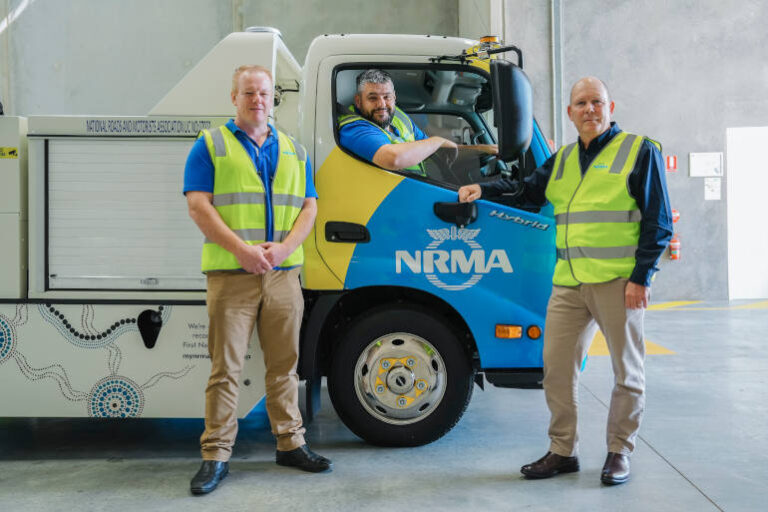
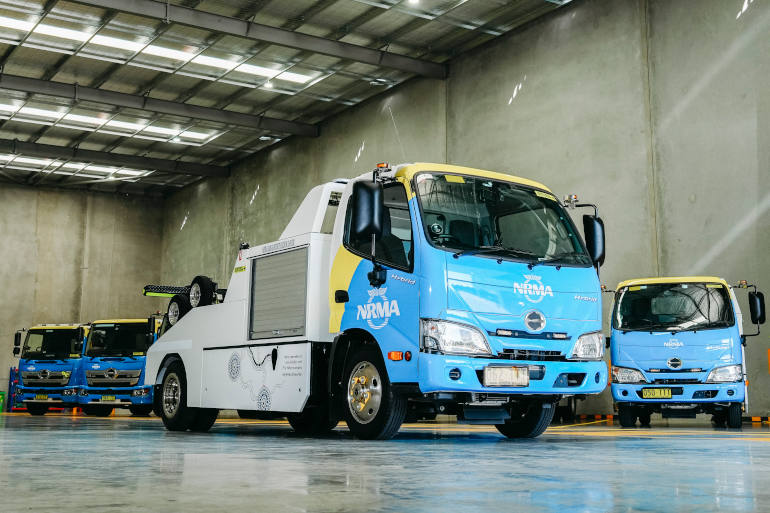
The NRMA’s relationship with Hino goes back years, built on reliability and service support. The organisation’s fleet is largely made up of Hino 500 Series tilt trays, but more recently, they’ve introduced a new vehicle built on the Hino 300 Series hybrid platform electric—one of the first of its kind in Australia.
Jai O’Keefe says the decision to go with Hino for their latest cradle truck project was based on both previous experience and confidence in the brand.
“The Hino 300 Series hybrid electric met our specs – from safety to emissions, dimensions, GVM and GCM. Plus, we’ve had strong support from the Hino dealer network,” he said.
The Problem: Towing in Tight Spaces
The new truck wasn’t just about getting greener—it was about increasing flexibility and functionality to provide better services to NRMA members.
NRMA’s roadside operations are focused on breakdowns, not accident, and their teams often have to extract vehicles from tight underground carparks, narrow lanes, or busy urban areas. Traditionally, that might have involved multiple patrol vans or tilt trays to extract a stuck vehicle, which wasn’t ideal for the Member or for productivity.
“The design of this new cradle truck was about improving that Member experience. Can we get into a tight space and get the vehicle out more efficiently, safely, and as efficiently as possible?” said Mark Harvey.
So the brief was simple—but ambitious. They needed a tow truck that could access tight spaces, provide towing for a broad range of vehicles including 4WD, AWD and EV vehicles, and the potential to offer secondary basic roadside services, all while improving the Member experience and advancing the NRMA’s sustainability goals.
Balancing Sustainability and Functionality
One of the biggest challenges was balancing the NRMA’s corporate emissions reduction targets with operational requirements.
The NRMA has a goal to reduce fleet emissions by 30% by 2030 and hit net zero by 2050. That means every new vehicle purchase is assessed through a sustainability lens.
“We’re already in a position where if we’re replacing a vehicle, it’s EV-first. In the case of the heavy vehicle tow trucks, a full EV option didn’t have the payload or range to suit. The hybrid was the best option available,” said O’Keefe.
While the Hino 300 Series hybrid doesn’t deliver the dramatic emissions reductions of a BEV, it’s a solid step forward. The NRMA reports a measurable improvement in fuel efficiency compared to its larger diesel tilt trays, even after accounting for the additional weight of the cradle body. On top of that, the cradle truck can do more with less—reducing emissions through improved vehicle productivity and efficiency.
Designed for Dual Purpose
What sets this truck apart isn’t just its hybrid drivetrain. It’s the cradle design, modular body, and ability to perform secondary light non-technical tasks—tyre changes, battery swaps, lockouts and fuel top-ups.
NRMA partnered with a body builder to co-design and develop the cradle system and body. One of the standout aspects of the project was the in-house expertise and creativity brought by Moodi El-Ali, NRMA’s Optimisation and Relationship Manager, who has years of hands-on experience in towing. Moodi worked closely with Jai and the body builder on various elements of the design which prioritised flexibility, versatility, safety, storage, and ergonomics—down to the placement of dolly wheels, go-jacks, tools and toolboxes as well as the design of a custom motorcycle carrying solution
The result is a multi-purpose vehicle that can perform a tow or provide a fix, depending on the situation. It boosts first-service resolution resulting in an improved Member experience — particularly in stressful breakdown scenarios.
Safety First
While reducing emissions is a key focus for the NRMA, both Harvey and O’Keefe are adamant that safety came first in the vehicle selection and design process. Hino’s inclusion of advanced safety features like autonomous emergency braking, ABS, and passive systems helped tip the scales in its favour.
That approach flows through to training as well. Technically, no additional licence or training is required to operate a cradle truck if you possess a valid tow certificate. Despite this, the NRMA approach was to provide customised training for every licenced tow operator to reflect the unique handling, safety protocols, and versatility of the new vehicles vs their tilt trays
Smarter, Faster, Better for Everyone
According to Harvey, one of the most impressive results from the new cradle truck design is the improvement in loading and unloading time. On average, it’s 10–15% faster than using a tilt tray. That doesn’t just save time for drivers—improved vehicle productivity translates into greater fleet efficiencies and reduced emissions.
And it doesn’t stop there. The team is already working on phase two, which will see the trucks equipped to perform secondary non-technical tasks (such as tyre changes, battery replacements, lock-outs etc). When tow truck drivers are dispatched to perform a tow, they will have the ability to reassess the Member needs on arrival, and if the vehicle requires some secondary attention (e.g. has a flat tyre), then the tow truck operators will be able to perform these secondary tasks, which in turn mobilises Members sooner, removing the need to have another service attend.
Looking Ahead
The NRMA is realistic about the future. While full electrification of heavy vehicles is the end goal, it’s not yet viable for their needs. But hybrid technology, modular thinking and close supplier partnerships are enabling real, measurable progress.
“This project is a step in the right direction. It shows how you can deliver better service for your customers and reduce your environmental footprint at the same time,” said Harvey.
With room to grow at their new operational hub, the NRMA is building a fleet that’s smarter, safer and more sustainable—one truck at a time.
Contact Simon Walker at NRMA on 0417 259 240 to talk about roadside assistance for your large fleet.
- Modern trucks could help the industry tackle its driver challenge
 The heavy vehicle industry’s driver shortage is not only a recruitment problem. It is also forcing truck manufacturers and fleet operators to reconsider the working environment they provide drivers. Hino Australia President and CEO Richard Emery believes the industry needs to do more over the coming years to encourage people to consider truck driving as
 - Truck Industry Council Names New PresidentRichard Emery, President and CEO of Hino Motor Sales Australia, has been elected President of the Truck Industry Council (TIC), with fleet modernisation and future road user charging among the industry body’s priorities. Emery was elected at TIC’s Annual General Meeting in Canberra, succeeding Andrew Harbison, Managing Director and CEO of Isuzu Trucks Australia Limited.
- UD Names Australia’s Best DriverAnthony Cassar of Coolway Trans has been named Australia’s top UD driver after winning the 2026 UD Trucks Extra Mile Challenge Australia. Cassar, representing Volvo Commercial Vehicles Australia Sydney West, secured the title after three weeks of competition. Drivers were assessed using UD Connect telematics across four areas: anticipation and braking, driveline utilisation, speed adaptation
- Daimler Truck Crowns Top TechniciansDaimler Truck Australia Pacific has named its 2026 Freightliner and Mercedes-Benz Trucks Technicians of the Year, putting a spotlight on the technical capability required to keep increasingly complex heavy vehicles operating reliably. The national finals were held at the Daimler Truck Training Academy in Mulgrave, Victoria, where leading technicians completed technical theory assessments, real-world diagnostic
- Penske Crowns 2026 Master TechniciansPenske Australia & New Zealand has named Luke Andrew and Luke Reid as its 2026 Penske Guild Master Technicians, recognising technical excellence across the company’s on-highway and off-highway operations. Andrew, a leading hand at Penske’s Perth branch, claimed the on-highway title, while Darwin-based Reid took out the off-highway category. The biennial Penske Guild competition brings