

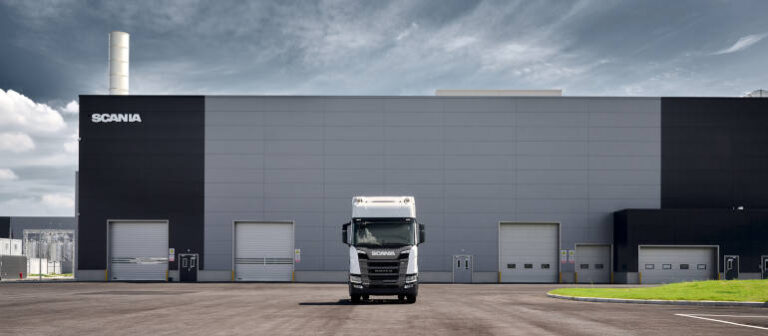
Scania has taken what it describes as a momentous step in its 134-year journey, officially opening its third global industrial hub — and its first in China — marking a significant milestone in the company’s global growth and sustainability strategy.
Located in Rugao, Jiangsu Province, the new facility positions Scania at the centre of the world’s largest truck market. It represents one of the company’s most substantial global investments to date, covering 800,000 square metres with a licensed production capacity of 50,000 vehicles a year. The site will support both domestic demand and selected export markets across Asia and beyond.
The €2 billion investment will create around 3,000 local jobs and underscores Scania’s long-term commitment to China, with the company becoming the first western OEM granted a full production licence for a wholly owned truck plantin the country.
A factory built around sustainability
Scania’s Rugao hub has been designed to operate on renewable energy, including locally produced biogas and certified green electricity. These initiatives contribute directly to Scania’s Scope 1 and 2 decarbonisation targets, setting a new benchmark for sustainable heavy-vehicle manufacturing.
“Sustainability is built into every part of our new factory in Rugao: from energy sourcing to waste management,” said Ruthger de Vries, President of Scania Industrial Operations Asia. “This is not just about producing trucks; it’s about setting a new benchmark for efficient and sustainable industrial operations.”
Strengthening local presence and innovation
Scania has maintained a presence in China’s commercial vehicle market for more than 60 years. The new Rugao hub, along with the company’s R&D centres in Rugao and Shanghai, will enable Scania to co-develop technologies with Chinese partners, accelerate innovation, and improve responsiveness to local market demands.
“China is not only the largest truck market in the world, it’s also a global centre for innovation in transport, connectivity, autonomy, and electrification,” said Christian Levin, President and CEO of Scania and the TRATON Group. “By also producing and innovating locally, we can tap into China’s speed and creativity, strengthen our global capabilities, and accelerate the shift towards sustainable transport.”
Dual product strategy for the Chinese market
The Rugao facility will operate within the TRATON Modular System (TMS), allowing Scania and other TRATON brands to scale and tailor vehicles across markets efficiently. This system also provides flexibility to integrate local technologies that enhance competitiveness in both Chinese and international markets.
Scania’s approach in China will feature two distinct product offerings. The first will deliver Scania’s globally recognised trucks — both tractors and rigids — built to the company’s high standards and supported by a comprehensive service portfolio.
The second offering introduces NEXT ERA, a new product range developed specifically for China’s long-haul and high-volume transport segments. While NEXT ERA shares its DNA with the TRATON Modular System, it is fully integrated into the Chinese digital ecosystem, designed to meet the unique requirements of local customers.
According to Scania, NEXT ERA marks a new chapter in its global product strategy, providing a more standardised yet connected vehicle and service suite. Importantly, the TMS framework also allows technologies piloted in China to be adopted globally in future vehicle generations.
Looking ahead
Deliveries from Rugao production are expected to begin in late 2025, with the NEXT ERA range to launch in the first half of 2026.
With this development, Scania has firmly established itself as a long-term participant in China’s evolving transport sector. The Rugao hub will serve as both a production base and innovation centre, enabling the Swedish manufacturer to contribute to — and benefit from — China’s rapid advancements in sustainable mobility.
For fleet operators worldwide, Scania’s investment highlights how major manufacturers are adapting their production and technology strategies to regional markets, combining global expertise with local innovation to deliver the next generation of heavy-duty transport solutions.