


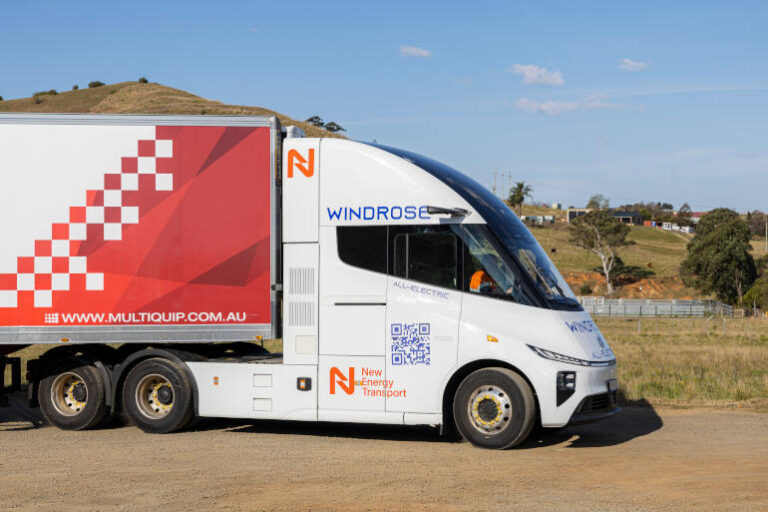
Australia’s Hume Highway has become the focal point for one of the country’s most ambitious freight decarbonisation initiatives — not because it is easy, but because it is hard.
Connecting Sydney and Melbourne, the Hume is the nation’s busiest truck corridor, carrying an estimated 4,800 trucks every day. It has no meaningful rail alternative, supports a wide mix of freight tasks, and operates under tight delivery schedules. If zero-emission trucking can work here, it can work almost anywhere.
That reality sits at the heart of the Hume Zero project, a new industry-led initiative bringing together fleet operators, infrastructure providers, energy specialists and government stakeholders to tackle the commercial and operational barriers holding electric freight back. 2512 Rainer Knobloch – For an i…
Why the Hume matters
Unlike many other freight routes, the Hume is not just a transport corridor — it is also a renewable energy corridor. Large-scale wind and solar projects are already operating, under development or planned along the route, creating the opportunity to link low-cost renewable generation with high-volume freight demand.
Rainer Knobloch, Chief Operating Officer of NewVolt, says this combination is what makes the Hume uniquely important.
“The Hume is the busiest highway in Australia for trucks… and it is a renewable energy corridor. That is the real opportunity we have on that corridor — unlocking the economics using Australian energy.”
The challenge is that freight operations on the Hume are unforgiving. Long distances, strict driver hours, delivery windows and vehicle productivity requirements mean there is little tolerance for disruption or inefficiency.
This is not just a charging problem
One of the key messages behind Hume Zero is that heavy vehicle electrification is not simply a matter of installing chargers at regular intervals.
While modelling suggests around six charging locations would provide sufficient coverage along the corridor, those sites are not about stopping six times per trip. Instead, they create optionality for different routes, return legs, and freight patterns branching off the main highway.
More critically, the limiting factors are operational and economic.
“The reality is the trucks and the duty cycles are more complex. The complexity is around the operational bits — how do you get the techno-economics right and the operations right to make electric freight sellable on the highways?”
For fleets, decisions hinge on total cost, vehicle utilisation, driver hours, residual value risk and contract structures with customers. Even with generous subsidies, those factors do not automatically stack up.
“You can throw all the money you like at truck subsidies… but fleets still have to make the decision to do this. You really need to drive the economics and the simplicity of operations.”
Why Hume Zero is a collective approach
Rather than positioning itself as a single infrastructure rollout, Hume Zero is being framed as a collaborative program. NewVolt is acting as a consortium organiser, working alongside the global Drive to Zero initiative led by CALSTART.
The intent is to bring competing infrastructure providers, fleets, OEMs and governments into the same conversation — including the possibility of roaming agreements between charging networks, a model already used in Europe.
“This isn’t NewVolt trying to own all of this. It’s about creating a collective body to figure this out — infrastructure, energy, operations, and economics — together.”
Government support still plays a role, particularly through organisations such as Australian Renewable Energy Agency, but the project is deliberately focused on reducing reliance on long-term subsidies.
Vehicles are only part of the equation
Trials have already shown that electric trucks can physically operate on the Hume. Vehicles from OEMs including Volvo, Daimler and Windrose have completed runs along the corridor.
The remaining barriers are less about capability and more about timing and efficiency.
There is a narrow “sweet spot” for long-haul electric freight, typically around 10–12 hours total journey time. Push beyond that, and fleets risk tipping into additional driver shifts, higher labour costs and operational complexity.
That is why the Hume Zero project is concentrating on techno-economic modelling before large-scale infrastructure commitments are made.
An energy story as much as a transport story
A recurring theme in the project is reframing zero-emission freight as an energy challenge.
Electricity pricing varies significantly by time of day, while many long-haul trucks travel overnight — when power can be more expensive. Battery energy storage is emerging as a key tool to smooth that mismatch, allowing cheaper daytime renewable energy to be stored and used later.
“Our goal is to get the cheapest possible electrons into trucks. That means looking at generation, storage and charging together — not in isolation.”
As battery storage costs continue to fall, that equation is changing rapidly, influencing when and how charging infrastructure should be deployed.
Why success on the Hume matters
Hume Zero is not about mandating electric trucks or declaring an overnight transition. It is about proving whether zero-emission freight can be commercially viable on Australia’s most demanding corridor.
If it cannot work on the Hume, it will struggle elsewhere. If it can, it provides a blueprint for other freight routes across the country.
“This isn’t going to be solved by one party stepping up and doing everything. Everyone has to lean in — fleets, energy, infrastructure, OEMs and government — if this is going to work.”
Over the next 12 months, Hume Zero is expected to release further details, including consortium partners, modelling outcomes and next steps. For fleet operators watching from the sidelines, the Hume is becoming the place where theory meets reality.
- Why Europe is moving faster on truck emissions and technology
 Europe is accelerating the transition to cleaner and safer commercial vehicles through legislation and policy support, while Australia is moving at a slower pace due to infrastructure gaps and different regulatory priorities. According to Glen Dyer, Managing Director at IVECO Australia, the European market has advanced more quickly in areas such as emissions reduction, alternative
 - How Latin American Fleets Are Lifting Efficiency and ComplianceFor many fleet operators, route planning has traditionally been viewed as a back-office function — a daily exercise in allocating vehicles, assigning customers and setting estimated time windows. But leading transport operators in Latin America are reframing route planning as a frontline safety and efficiency strategy. Recent discussions at Geotab Connect 2026 with fleet leaders
- Euro 6 and Multi-Combination Trucks: The Emissions Lever Hiding in Plain SightAs debate continues around battery electric and hydrogen trucks, Craig Lee, Executive General Manager – On-Highway at Penske Australia & New Zealand, believes Australia may be overlooking a far more immediate emissions opportunity. “If you actually want to make the single biggest emission reduction that you can in Australia,” Lee said, “provide significant incentives to
- Breaking Barriers and Raising Standards in the WorkshopTransit Systems Victoria has appointed Ellearn Savvidis as Workshop Assets Manager at its Footscray depot, highlighting both her career progression and the growing diversity within Australia’s mechanical and public transport sectors. The appointment reflects a broader shift across the industry, where technical expertise, data capability and leadership skills are increasingly combined to manage modern fleets.
- Lift off for new Scania Air-OIs it a bird? Is it a Ute? No, it’s the new Scania Air-O Scania Australia today introduces a new diesel-free, zero-emission last-mile delivery solution that will drive forward the shift to a sustainable transport system and reshape the local logistics industry. Motivated by the sky-high rises in the price of diesel, Scania will begin