
MAN Truck & Bus has announced plans to invest around €300 million in the expansion and modernisation of its European service network by 2030, marking the largest service-network investment in the company’s history.
The investment will focus on expanding workshop capacity, improving regional coverage, and preparing the network to support the growing number of electric trucks entering service across Europe. MAN said the funding will be used to establish new locations, upgrade existing facilities, and improve service quality for customers operating commercial vehicles.
MAN Truck & Bus is one of Europe’s largest commercial vehicle manufacturers, generating annual sales revenue of about €14.1 billion and employing around 32,000 people worldwide. The company produces trucks, buses, vans and engines with both conventional and zero-emission powertrains, along with a range of transport services.
Currently, the company operates a large European service and sales footprint that includes around 1,200 MAN-owned and partner locations. Across the network, more than 2,000 service centres and cooperation partners provide support for operators, backed by the MAN Mobile24 breakdown and mobility service that operates around the clock.
According to the company, the latest investment will focus heavily on improving customer proximity to service facilities. One of the key objectives is to ensure that the majority of operators have significantly shorter travel times to workshops.
Friedrich Baumann, Executive Board Member for Sales and Customer Solutions at MAN Truck & Bus, said the service network plays a critical role in the company’s competitive positioning.
“A strong brand needs a strong service network. We have that – and we are now making it even stronger. Alongside our sales team, our workshops are our public face for our customers,” said Baumann.
“Our strong network is a competitive advantage. We want to expand it further. That is why we are investing heavily here over the next few years, because the combination of product, service, and good quality will become even more important in the coming years.”
Under the expansion plan, MAN aims for almost 80 percent of customers in key markets to be located within 30 minutes of a service location. Countries targeted as priorities include Germany, Austria, Switzerland, France, Great Britain, Italy, Spain, Poland and Turkey.
To achieve this coverage, the company plans to open an average of seven new service branches each year in these markets.
Another major focus of the investment program is preparing the service network for the transition to zero-emission transport. MAN expects that by 2026 around two-thirds of its locations will be ready to support electric vehicles.
Approximately one third of the €300 million investment will be directed toward e-mobility and digitalisation initiatives. These include training around 8,000 employees across Europe—from sales teams to high-voltage technicians—to work with electric trucks and associated systems.
MAN has already established several dedicated battery repair centres across Europe, including locations in Germany, Spain, Belgium, Austria and Italy. The company plans to expand this network further so that all European markets are supported by 2030.
The company is also working with energy provider E.ON to install public charging infrastructure for electric trucks at service locations. The collaboration could see up to 400 charging points installed across as many as 170 sites in Europe.
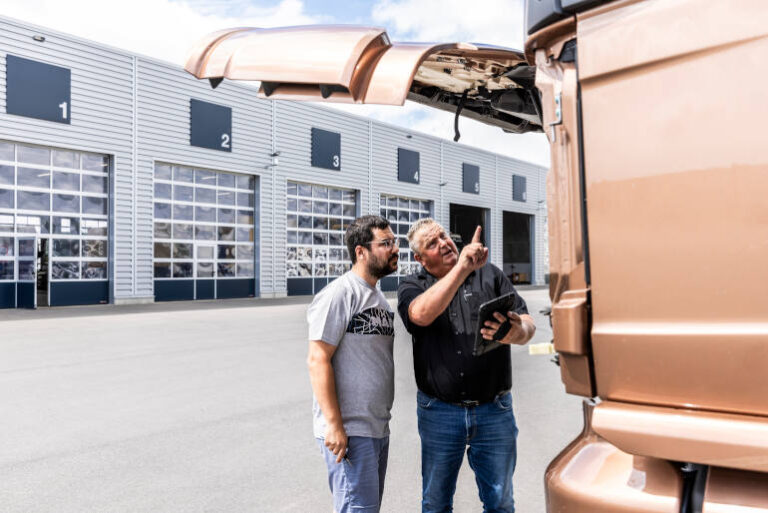
In addition to electrification initiatives, the investment program will fund digitalisation of workshop processes. Service advisors and technicians are already using tablet devices to manage service orders and documentation digitally, with further use of apps and artificial intelligence planned to improve efficiency and transparency for customers.
For commercial vehicle operators, MAN says the focus remains on maximising vehicle uptime.
“The commercial vehicle business is significantly more complex and service-intensive than the passenger car business,” Baumann said.
“The daily availability of vehicles is essential for our customers’ businesses.”
- Geotab adds mass management to heavy vehicle telematics
 Geotab has expanded its Australian heavy vehicle compliance offering by adding Smart On-Board Mass capability through a certified integration with Airtec Corporation, allowing heavy haulage operators to manage telematics and mass data through a single platform. The certification means Geotab can now support Telematics Monitoring Application schemes both with and without Smart OBM requirements, as
 - Bridge Strikes Start Before the Truck Reaches the BridgeA bridge strike may happen in seconds, but the circumstances that lead to it can develop much earlier in the journey. That is one of the key fleet-management implications to emerge from HoustonKemp Economists’ report, The economic costs of bridge strikes in Australia, prepared for HERE Technologies and the Australian Logistics Council. The report estimates
- Electric Trucks and Vans Join the Spotlight at Everything Electric SydneyThe transition to electric transport is moving beyond passenger cars, and fleet operators will get a closer look at the growing range of electric trucks, vans and commercial vehicles when Everything Electric returns to Sydney in September. The three-day event, held at Sydney Showground from 18–20 September 2026, is expected to attract more than 40,000
- Truck Access, PBS and EV Rules Targeted in Major Reform ReportAustralia’s road freight productivity has stalled for more than a decade, and the Productivity Commission says regulatory reform is needed if the industry is to capture the benefits of safer, more productive and lower-emission heavy vehicles. The Commission’s Impacts of heavy vehicle reform study examines five areas where changes to road access, permits, zero-emission vehicle rules, charging
- Active safety: what fleet buyers should ask for when purchasing trucksWhen buying trucks, it is easy to focus on engine output, payload, cab comfort, service intervals and price. But one of the most important procurement decisions is the active-safety specification. Active safety technologies are designed to prevent a crash or reduce its severity before impact. They use cameras, radar, sensors, braking systems, steering assistance and