

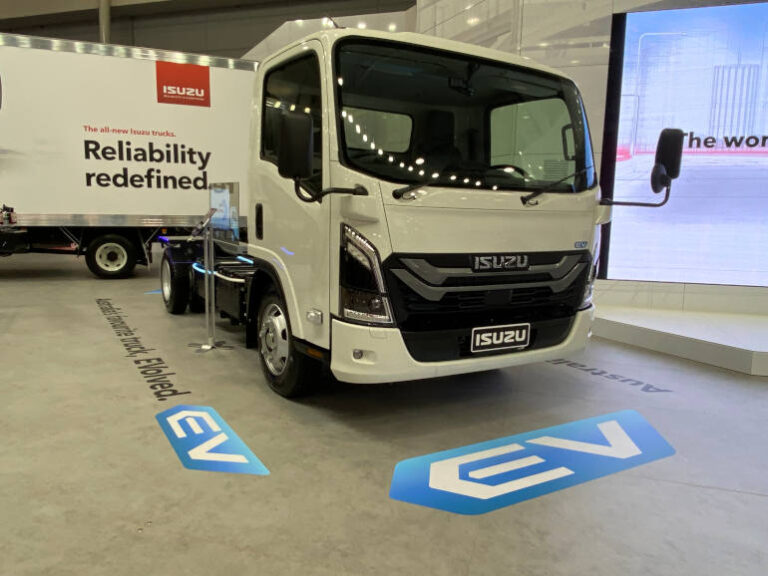
At the 2025 Brisbane Truck Show, Isuzu Trucks didn’t just unveil their most comprehensive product refresh in decades—they also outlined a clear path toward a lower-emissions future, built around electric trucks, hydrogen, and renewable fuels.
In a media briefing prior to the show’s opening day, Andrew Harbison, Director and Chief Operating Officer at Isuzu Trucks Australia, told Fleet News Group the next four years will be critical for the brand’s zero-emission rollout.
“We’ve been trialling our battery electric trucks in Australia for over 12 months,” Harbison said. “I’d love to say we’ll see them on sale in the next 12 months, but that’s probably ambitious. Certainly within four years.”
A Multi-Technology Roadmap
Leading the product strategy is Matt Sakhaie, Isuzu’s Chief of Product, who explained the company’s global decarbonisation plan is based on a “multi-energy” approach.
“Electrification is the most well-known method, and we’re actively testing battery electric trucks for last-mile and back-to-base applications,” Sakhaie said. “But beyond that, we’re also progressing with fuel cell vehicles and alternative renewable fuels like HVO (Hydrotreated Vegetable Oil).”
Isuzu’s partnership with Honda is a cornerstone of their hydrogen strategy. The two companies have developed and are trialling hydrogen fuel cell trucks at both ends of the weight spectrum in Japan—light-duty trucks for urban delivery, and the heavy-duty Giga range.
Sakhaie confirmed that these trials are already delivering valuable real-world feedback that will shape future product offerings, including in Australia.
Ready, When the Market Is
While the technology is ready or nearing maturity, both executives agree that market conditions need to catch up—particularly when it comes to charging and refuelling infrastructure.
“An EV truck is a relatively simple vehicle,” said Harbison. “The real challenge is what surrounds it. Right now, you can’t plug a truck into most public chargers. Infrastructure remains a significant barrier.”
That’s also true of hydrogen and HVO. Although Harbison notes that HVO-powered buses are already quietly running around Isuzu’s Japanese facilities, commercial rollout is constrained by cost and availability.
“Japan’s got a finger in each pie,” he added. “When you visit the engineers, you see it in use on-site. The same goes for hydrogen—it works, but getting it to where it’s needed is still the hurdle.”
Designed for Future Fuels
Isuzu’s new MY25 range is future-ready, not just in drivetrain but in platform. According to Sakhaie, the trucks benefit from a “flexible commercial data architecture” that supports ongoing updates in powertrain and safety systems.
“What we’re building today is not just a product—it’s a foundation,” he said. “Whether it’s battery electric, hydrogen, or renewable diesel, we’re making sure our platforms can adapt as the market evolves.”
This includes efforts in Australia to gather customer feedback through ongoing local trials, and to prepare the dealer and service network for the changes ahead.
Clean Engines, Here and Now
While fully zero-emission trucks are still a few years off, Isuzu’s latest diesel powertrains are already raising the bar for emissions performance. Many new models feature Euro VI-compliant engines, paired with efficient SCR and DPD systems to minimise NOx and particulate matter.
Even here, the shift is significant. The latest 4JZ1 and 6UZ1 engines use flatter torque curves for better drivability, and improved aftertreatment hardware—including smaller AdBlue tanks due to more efficient combustion strategies.
“The Euro VI engines we’ve introduced are a major step forward,” said Sakhaie. “They reduce emissions without sacrificing payload or performance.”
A Realistic View of Progress
Unlike some truck brands chasing headline-grabbing timelines, Isuzu is clear-eyed about the path ahead.
“We’re not rushing product to market for the sake of a press release,” Harbison said. “We want to ensure that when we go to customers with a zero-emission truck, we can support it—technically, commercially, and logistically.”
Isuzu’s approach is grounded in its position as Australia’s market leader. The brand has dominated truck sales for over 30 years, and according to Harbison, the MY25 range and the decarbonisation strategy will help keep it that way.
“This product range is setting us up for the next generation of success in Australia,” he said. “We truly believe we’re redefining trucking with this launch—and that includes the cleaner, more sustainable future ahead.”
What’s Next?
Isuzu’s roadmap for emissions reduction is already unfolding. Expect to see more announcements on electric and alternative fuel models throughout 2026 and 2027. In the meantime, Australian fleets can take advantage of the new Euro VI diesel range—available from mid-2025—knowing that a more sustainable Isuzu is just around the corner.
As Harbison summed it up: “It’s all happening, and it’s happening now.”