
MAN Truck & Bus has announced plans to invest around €300 million in the expansion and modernisation of its European service network by 2030, marking the largest service-network investment in the company’s history.
The investment will focus on expanding workshop capacity, improving regional coverage, and preparing the network to support the growing number of electric trucks entering service across Europe. MAN said the funding will be used to establish new locations, upgrade existing facilities, and improve service quality for customers operating commercial vehicles.
MAN Truck & Bus is one of Europe’s largest commercial vehicle manufacturers, generating annual sales revenue of about €14.1 billion and employing around 32,000 people worldwide. The company produces trucks, buses, vans and engines with both conventional and zero-emission powertrains, along with a range of transport services.
Currently, the company operates a large European service and sales footprint that includes around 1,200 MAN-owned and partner locations. Across the network, more than 2,000 service centres and cooperation partners provide support for operators, backed by the MAN Mobile24 breakdown and mobility service that operates around the clock.
According to the company, the latest investment will focus heavily on improving customer proximity to service facilities. One of the key objectives is to ensure that the majority of operators have significantly shorter travel times to workshops.
Friedrich Baumann, Executive Board Member for Sales and Customer Solutions at MAN Truck & Bus, said the service network plays a critical role in the company’s competitive positioning.
“A strong brand needs a strong service network. We have that – and we are now making it even stronger. Alongside our sales team, our workshops are our public face for our customers,” said Baumann.
“Our strong network is a competitive advantage. We want to expand it further. That is why we are investing heavily here over the next few years, because the combination of product, service, and good quality will become even more important in the coming years.”
Under the expansion plan, MAN aims for almost 80 percent of customers in key markets to be located within 30 minutes of a service location. Countries targeted as priorities include Germany, Austria, Switzerland, France, Great Britain, Italy, Spain, Poland and Turkey.
To achieve this coverage, the company plans to open an average of seven new service branches each year in these markets.
Another major focus of the investment program is preparing the service network for the transition to zero-emission transport. MAN expects that by 2026 around two-thirds of its locations will be ready to support electric vehicles.
Approximately one third of the €300 million investment will be directed toward e-mobility and digitalisation initiatives. These include training around 8,000 employees across Europe—from sales teams to high-voltage technicians—to work with electric trucks and associated systems.
MAN has already established several dedicated battery repair centres across Europe, including locations in Germany, Spain, Belgium, Austria and Italy. The company plans to expand this network further so that all European markets are supported by 2030.
The company is also working with energy provider E.ON to install public charging infrastructure for electric trucks at service locations. The collaboration could see up to 400 charging points installed across as many as 170 sites in Europe.
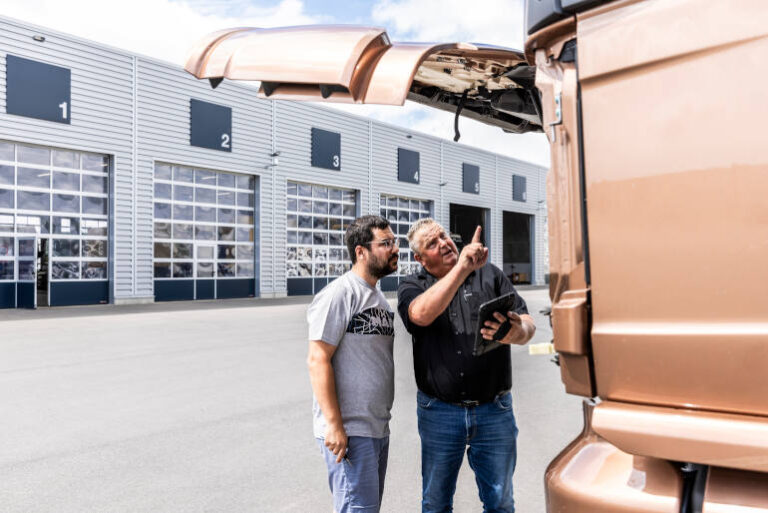
In addition to electrification initiatives, the investment program will fund digitalisation of workshop processes. Service advisors and technicians are already using tablet devices to manage service orders and documentation digitally, with further use of apps and artificial intelligence planned to improve efficiency and transparency for customers.
For commercial vehicle operators, MAN says the focus remains on maximising vehicle uptime.
“The commercial vehicle business is significantly more complex and service-intensive than the passenger car business,” Baumann said.
“The daily availability of vehicles is essential for our customers’ businesses.”
- NewVolt breaks ground on Melbourne fast-charging network for electric trucks
 Construction has commenced on a new fast-charging network designed specifically for heavy vehicles, marking a significant step in the development of Australia’s electric truck infrastructure. Energy and infrastructure company NewVolt confirmed it is building Stage 1 of the NewVolt Network — a three-hub, open-access fast-charging network located across Melbourne’s major freight precincts. The announcement coincides
 - Government fuel relief plan welcomed as industry warns of mounting pressureAustralia’s peak trucking bodies have welcomed the Federal Government’s decision to fast-track changes to allow fuel costs to be passed through the supply chain, but warn that more immediate support is needed to prevent business failures across the transport sector. The move follows a dramatic surge in diesel prices, which industry leaders say has placed
- Komatsu Technicians Go Trackside With F1 Team in MelbourneTwo Komatsu field service technicians swapped remote mine sites for the intensity of global motorsport, gaining rare behind-the-scenes access to the Atlassian Williams Formula One Team during the 2026 Australian Grand Prix in Melbourne. Western Australian technicians Caitlyn Hayes and Brayden Rodda were selected through Komatsu’s employee recognition program, earning a place inside one of
- Specialised Waste Truck Tackles the Harsh ConditionsREMONDIS Australia has deployed a highly specialised waste collection truck designed to operate in one of the most demanding environments in the country — the World Heritage listed K’gari (Fraser Island) off the Queensland coast. The custom-built vehicle, an IVECO Astra 8×8 front-lift truck fitted with a Superior Pak body, has recently entered service collecting
- Market Correction Exposes Structural Fault Lines in Heavy TransportAfter several years of record demand and supply chain disruption, Australia’s heavy truck market is now firmly in correction mode. According to Craig Lee, Executive General Manager – On-Highway at Penske Australia & New Zealand, the downturn is more than cyclical — it has exposed deeper structural issues within the freight sector. “The heavy truck