

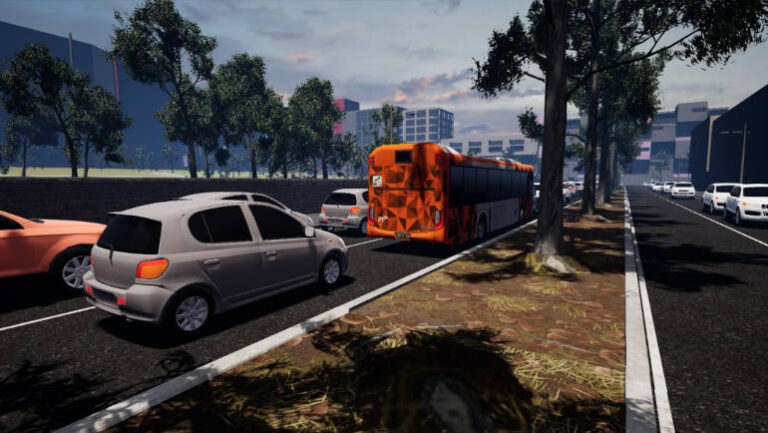
Australian simulation technology company MOTUM has completed a heavy vehicle driver training platform that allows operators to practise challenging manoeuvres and hazardous situations in a controlled virtual environment.
The platform supports vehicle configurations ranging from rigid trucks and semi-trailers to B-doubles, livestock combinations and oversized vehicles. It also captures performance data, giving instructors a consistent way to assess drivers and identify where further training is needed.
Developed through Round 9 of the Heavy Vehicle Safety Initiative (HVSI), the project received funding administered by the National Heavy Vehicle Regulator on behalf of the Australian Government.
MOTUM has now secured support through HVSI Round 10 to extend the technology into bus driver training.
Practising situations that are difficult to recreate
For heavy vehicle fleets, a key application is the ability to repeat scenarios that would be unsafe, expensive or impractical to reproduce on public roads.
Drivers can practise negotiating difficult corners and roundabouts, maintaining safe braking distances, controlling load transfer and responding to distractions or hazardous behaviour from other road users.
Training environments include urban, suburban, rural, freeway and industrial settings. Alongside common truck combinations, the platform includes cement trucks, bulk carriers and vehicle carriers.
MOTUM founder and Managing Director Steve Hoinville said accommodating different fleet requirements was central to the development.
“Heavy vehicle training is not one-size-fits-all,” Mr Hoinville said.
“Operators use different vehicles, routes and training standards, so flexibility was essential. The platform can support everything from fundamental vehicle control and low-speed manoeuvring to emergency situations and advanced hazard response.”
Turning driver training into measurable performance
The completed platform combines digital vehicle modelling, realistic virtual environments, artificial intelligence-driven traffic, motion technology and real-time telemetry.
It records speed, braking, steering, following distance, vehicle stability, collisions and near misses. Instructors can use this information to assess performance consistently and identify areas for improvement.
For fleet managers, that creates an opportunity to make training more targeted. A driver’s performance through a particular corner, braking exercise or hazard scenario can inform the next lesson, while repeatable conditions provide a basis for assessing progress.
“The Round 9 funding allowed us to build on our existing MOTUM World technology and develop a genuinely Australian simulation platform for heavy vehicle driver training,” Mr Hoinville said.
Bus operations become the next focus
Development is now underway on the MOTUM World Simulated Bus Driver Training Program.
The project will address the specific demands of bus operations, including navigating busy urban and regional environments, carrying passengers and interacting with pedestrians, cyclists and other road users.
MOTUM is expanding its digital vehicle models, operating environments, lesson structures and performance measures to support the program.
“We have successfully delivered and validated that platform, and this next round gives us the opportunity to apply what we have learned to another critical area of the transport industry,” Mr Hoinville said.
“Once complete, bus drivers will be able to repeatedly practise challenging situations in a safe and controlled environment, without placing the driver, passengers, vehicles or other road users at risk.”
For truck and bus fleet managers, the practical value lies in connecting realistic exercises with measurable feedback, helping drivers build skills before facing those situations on the road.