

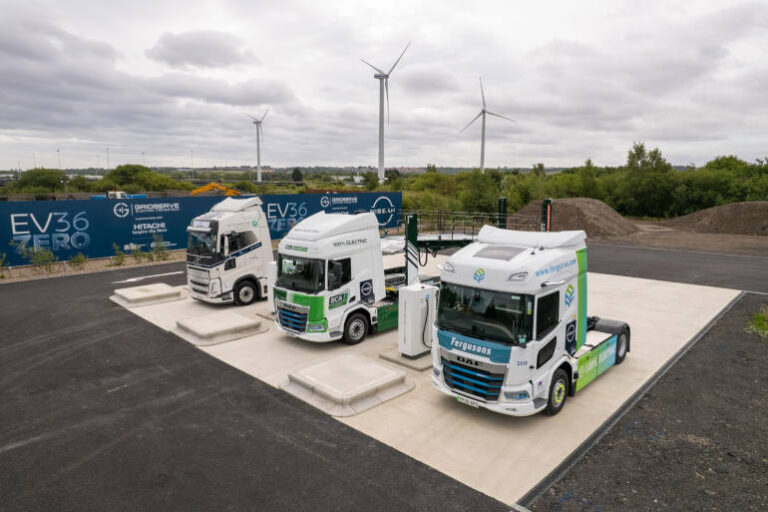
In a landmark move for sustainable freight logistics, Nissan has officially opened a £1.4 million electric truck charging station at its Sunderland manufacturing plant—marking a UK-first for the automotive industry and showcasing how depot charging can decarbonise end-to-end supply chains.
Developed in partnership with hauliers Fergusons, Yusen, and BCA, and led by charging infrastructure leader GRIDSERVE, the new facility is part of the broader Electric Freightway initiative. Funded by the UK Government through Innovate UK, the project supports the electrification of heavy transport and builds momentum behind the shift to zero-emission logistics.
“This is a big step forward in Nissan’s EV360 vision, which brings together electric vehicles, zero carbon energy and battery manufacturing,” said Michael Simpson, Vice President Supply Chain Management, Nissan AMIEO. “We’re proud of what we have achieved, and we’re exploring further opportunities to allow other hauliers to use the charging station as well as looking at other opportunities to maximise its full potential.”
Electrifying the Supply Chain
The new facility is the first private shared eHGV charging station of its kind in the UK and can simultaneously charge up to 10 electric heavy goods vehicles (eHGVs) at 360kW. It will initially service a fleet of 25 eHGVs delivering to and from Nissan Sunderland, covering more than 2.4 million kilometres annually while cutting around 1,500 tonnes of CO₂ each year.
The charging station is a physical manifestation of Nissan’s EV36Zero initiative—a vision that integrates electric vehicle production, renewable energy, and battery manufacturing into a unified ecosystem for sustainable manufacturing. For logistics operations, this initiative not only supports Nissan’s net-zero ambitions but also creates a real-world case study of scalable, decarbonised transport logistics.
The project also supports 60 electric truck deliveries to the plant every day and is strategically designed to scale as more transport partners transition to electric.
Government and Industry Collaboration
The project is one of several funded under the UK Government’s £200 million Zero Emission HGV and Infrastructure Demonstrator programme. Speaking at the launch, UK Minister for the Future of Roads, Lilian Greenwood, praised the project’s contribution to job creation and emissions reduction.
“We’re working closely with the road freight sector to slash transport emissions, and our £200m zero emission HGV programme is helping businesses across the country to power the electrification of its fleets,” Greenwood said. “It’s great to see Nissan taking advantage of our scheme which is supporting high paid jobs and putting money in the pockets of working people.”
Daniel Kunkel, CEO of GRIDSERVE, reinforced the importance of collaboration: “The decarbonisation of transport logistics is much stronger and reaches far wider when done in partnership. Depot charging is critical for the electrification of HGVs, going hand in hand with future public infrastructure developments.”
As the lead organisation behind Electric Freightway, GRIDSERVE is coordinating with multiple stakeholders to deploy both private and public charging networks to support long-haul electric freight operations.
What This Means for Fleet and Sustainability Managers
For Fleet Managers and Sustainability Managers planning zero-emission transport strategies, Nissan’s project highlights several key lessons:
- Depot charging is viable and scalable: The Sunderland facility demonstrates how charging infrastructure can be effectively deployed at key logistics nodes.
- Collaboration is essential: Bringing together OEMs, transport operators, and infrastructure providers can accelerate deployment and reduce emissions quickly.
- Data-driven planning supports outcomes: With over 2.4 million kilometres projected annually and 1,500 tonnes of CO₂ saved, the project offers a solid baseline for emissions accounting.
The charging hub’s shared model also points to a more inclusive approach, allowing multiple logistics partners to transition simultaneously—rather than each investing in separate infrastructure.
From Sunderland to Global Operations
This project is not an isolated effort but part of Nissan’s global Ambition 2030 strategy. With a goal to be carbon neutral across the lifecycle of its products and operations by 2050, initiatives like the Sunderland eHGV depot are vital stepping stones.
Nissan’s AMIEO region (Africa, Middle East, India, Europe, and Oceania), which employs over 19,000 people and covers 140 markets, will likely see similar innovations as sustainability becomes a central competitive advantage in global supply chains.
Fleet News Group Takeaway
This deployment shows that depot-based charging infrastructure is not only feasible for electric trucks but also enhances operational efficiency. For Australian Fleet Managers and decision-makers exploring electric truck trials, this example from the UK offers both technical insights and a policy-backed business case for adoption. More importantly, it reinforces the role that shared infrastructure and collaborative models will play in the future of freight electrification.