

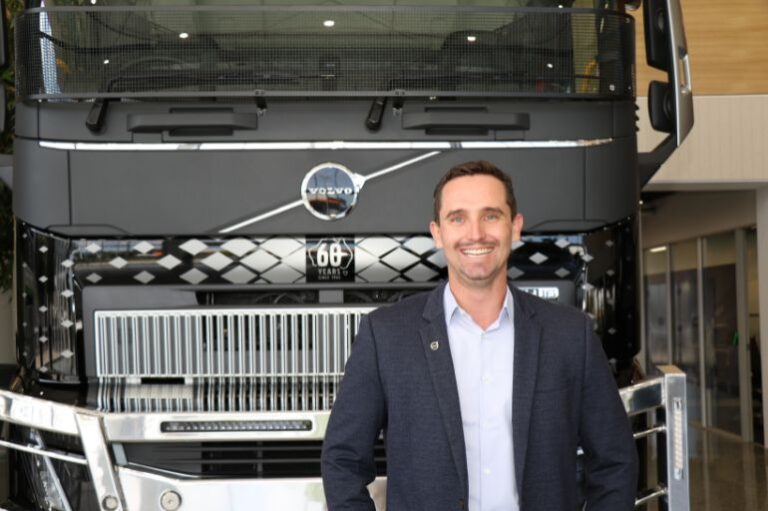
When Michael Bridge talks about trucks, it’s clear this isn’t a new chapter – it’s a continuation of a long career built around dealerships, customers and heavy vehicles.
Bridge started in his new role as Director – National Fleet in November 2025, a position created to reflect how much national fleet relationships have changed in recent years.
“I’ve been in the trucking industry for over 15-odd years, directly around trucks,” Bridge said. “Before that, my family had a caravan dealership, so I’ve been around a dealership environment my whole life. Customer service and sales is something I’ve never really known anything different from.”
That grounding led him into the truck industry through a UD dealership, followed by a progression through cadetship, sales, sales management and operations roles across multiple OEM brands in south-east Queensland.
Four-and-a-half years ago, that experience brought him to Volvo Group Australia, where he joined the national fleet team as a Key Account Manager.
“The key account manager is really the face of the brand to our large national fleet customers,” Bridge said. “That’s not just sales – it’s the total solution. It’s the national escalation, selling the truck, and all the soft features that go with it.”
Why the role exists
The Director – National Fleet role is new, and Bridge says it’s a direct response to growth – both in Volvo Group Australia’s business and in what fleet customers now expect from their OEM partners.
“Our business is getting bigger. The customers are wanting more from us, and we’re wanting to give them more,” he said. “That’s where the Director of National Fleet role really came about – to provide extra support to the key account managers and, ultimately, to our customers as well.”
The national fleet team currently includes seven Key Account Managers, with scope to grow as the structure settles.
A key change over recent years has been the move to multi-branded account management across Volvo, Mack and UD.
“Our key account managers are multi-branded,” Bridge said. “Customers don’t want to deal with three different people. They want one point of contact who can look at the application and say: this one suits a Volvo, that one suits a Mack, and this one suits a UD.”
Fleet customers are asking different questions
Bridge says one of the biggest shifts he’s seen is the type of conversations fleets are now having with their truck suppliers.
“There used to be more focus on just selling metal and volume,” he said. “Now there’s a lot more around total cost of ownership, safety, remarketing, connectivity and how systems work across different brands.”
That change hasn’t happened by accident.
“Our customers’ customers are asking the questions,” Bridge said. “That’s pushing fleets to learn more, and it’s pushing us to be more proactive so we can help our customers stay ahead.”
As a result, fleets are engaging Volvo Group Australia earlier and more deeply in decision-making.
“They’re reaching out to us and asking: what else should our business be doing?” Bridge said. “How can we partner together to trial new engines, different ratios, or mix the fleet differently across applications?”
Electric trucks: momentum is building
Volvo has been one of the early movers in electric trucks, and Bridge believes the next few years will see adoption accelerate as more use cases are proven.
“We’ve been very successful, and as other OEMs start joining that space, the market will grow quite fast,” he said. “There is a market there – but you’ve got to find the right application for the truck. Once the business case works, it can work really well.”
He says much of the momentum is being driven by customer expectations rather than regulation alone.
“A lot of it is customer-on-customer led,” Bridge said. “Their customers are asking them, ‘We have sustainability goals – how can we partner together to put the right truck in the right place?’”
Looking beyond battery electric
While battery-electric trucks dominate the headlines, Bridge says fleets are also exploring other pathways to lower emissions.
“There’s a very positive message around HVO as it becomes more common and the price reduces,” he said. “It’s not always just electric that can deliver sustainability benefits – it might be HVO or another fuel source.”
Some customers are even looking at collaborative approaches.
“We’ve had customers ask which other fleets they could potentially partner with in bulk to help drive efficiency,” Bridge said.
What’s coming next
Asked what the next five to ten years might look like, Bridge points to steady refinement rather than sudden disruption.
“There’s always something in the product plan,” he said. “We’ll continue to refine what we already have, especially around internal combustion engines, safety systems and fuel efficiency.”
Battery technology is also reshaping how fleets think about electric trucks.
“We’re seeing customers realise they don’t need the biggest battery possible,” Bridge said. “Battery technology has caught up so much that a smaller configuration can still meet the task, and that’s changing the conversation.”
For Bridge, the new role is ultimately about bringing all those conversations together.
“Our job is to pull the different parts of the business together and make sure we’re supporting our customers in the right way,” he said. “That’s really what this role is about.”