
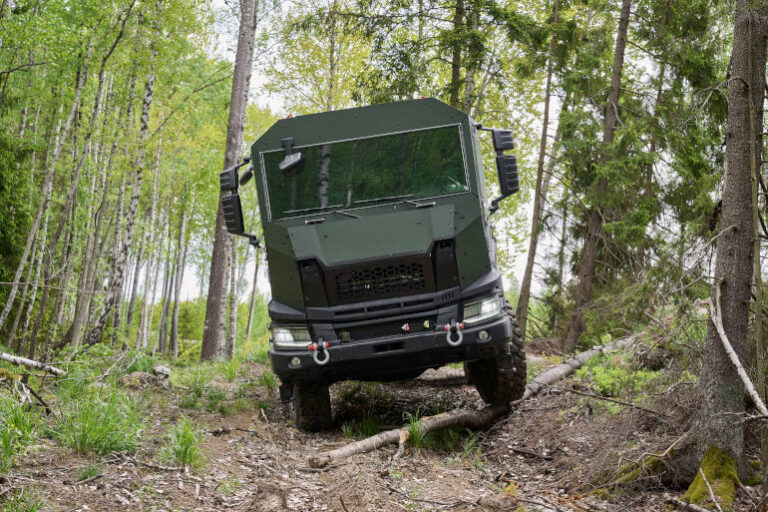
Scania has used Eurosatory 2026 in Paris to reveal a new modular protected cab, expanding its defence truck offering and reinforcing the role of standardised fleet platforms in mission-critical transport.
The protected cab has been developed for defence logistics, where vehicles need to combine crew protection, mobility, operational availability and long service life. It is designed to operate within Scania’s existing modular system, rather than requiring defence customers to adopt a separate vehicle platform.
For defence fleets, that distinction matters. A protected vehicle is not only judged by its ability to operate in demanding conditions. It also needs to be maintained, supported, repaired and kept available over many years of service.
Scania’s approach is to integrate protection into its existing vehicle architecture, allowing customers to retain common driver environments, shared components, familiar service processes and established parts support.
The protected cab includes ballistic and blast protection features and can be configured to meet different mission profiles. Scania says the product is fully compliant with STANAG 4569 Level 1–3.

The cab will be available across 4×4, 6×6 and 8×8 configurations, giving defence customers flexibility to specify vehicles for different roles while maintaining commonality across the fleet.
This means the same basic vehicle architecture can support training, operational readiness and deployment requirements. It also allows vehicles to be adapted for mission-specific systems, equipment and bodywork.
Stefano Fedel, Head of Scania Commercial, said defence logistics and transport resilience were becoming increasingly important for armed forces and societies.
“With the protected cab, Scania combines protection and operational capability with the modularity, reliability and support systems already proven across our global transport ecosystem,” said Fedel.
The cab environment has been designed to support driver alertness, control and manoeuvrability in complex operating conditions. Scania says the solution preserves visibility, ergonomics and the familiar Scania driver environment while adding the protection required for more demanding defence applications.
For fleet managers, the broader message is about operational availability. Protected vehicles can create additional complexity through specialised components, unique maintenance requirements and limited parts availability. By keeping the protected cab inside its modular production and support system, Scania is aiming to reduce that complexity.
Sara Forsberg, CTO and Head of Scania R&D, said the protected cab was developed according to the same principles that guide Scania’s broader product strategy.
“The new modular protected cab is not a separate platform outside the Scania system. It is developed according to the same principles that define Scania’s approach to modularity, uptime and operational efficiency,” said Forsberg.
“That gives customers a scalable and adaptable solution with strong long-term support.”
The cab is manufactured in Sweden and integrated into Scania’s regular production flow, with final vehicle assembly taking place alongside other defence truck variants at Scania production facilities.
That production model is intended to support lifecycle efficiency. Defence customers can benefit from common interfaces, shared spare parts, established maintenance structures and Scania’s global service network.
Scania has supplied defence-related vehicles and solutions for more than a century and currently provides trucks, engines and related solutions to several NATO countries and allied nations.
The introduction of the protected cab comes at a time when defence logistics, transport resilience and fleet availability are receiving greater attention. Modern defence fleets need vehicles that can be deployed in demanding environments while remaining serviceable and cost-effective across long operating lives.
By combining protection with modularity, Scania is positioning the new cab as more than a vehicle upgrade. It is a fleet management solution designed to support operational readiness, reduce lifecycle complexity and improve long-term availability for defence customers.