

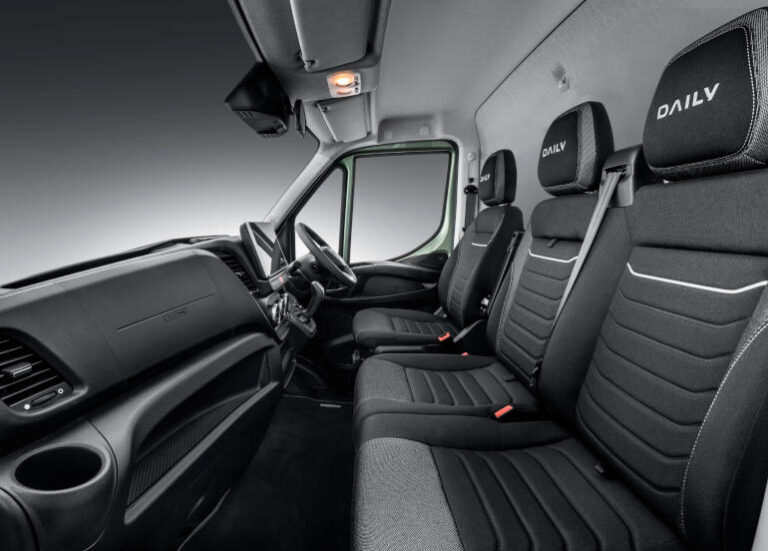
For a professional driver, the seat is the workplace.
It is where they spend long hours managing traffic, loading docks, customers, road conditions, vehicle controls and tight delivery schedules. Yet when fleets specify a new truck, the driver’s seat can still be treated as a minor option rather than a key safety and productivity decision.
A premium driver’s seat is not just about making a truck feel more luxurious. It can help reduce fatigue, improve posture, limit exposure to vibration and make the cab a more practical and enjoyable place to work.
For fleets competing to attract and retain drivers, that matters.

Comfort starts with support
The best seats are designed to support the driver’s body in a neutral position.
That means the lower back is supported, the thighs are properly supported without pressure behind the knees, the shoulders can relax and the driver can reach the pedals, steering wheel and controls without stretching or twisting.
A basic air-suspension seat may provide height and weight adjustment. A premium seat goes further with features such as:
- Multi-way lumbar support
- Adjustable cushion length
- Seat-base tilt and rake adjustment
- Adjustable side bolsters
- Backrest rake adjustment
- Multi-position armrests
- Adjustable head restraint
- Wider fore-aft and height adjustment range
These features matter because truck fleets are rarely operated by one driver of one body shape. Shared vehicles need seats that can be adjusted quickly and accurately for drivers of different heights, weights and seating preferences.
A driver who can achieve a better seating position is less likely to sit awkwardly, lean forward, overreach for the wheel or constantly shift position during the day.
Better suspension reduces road shock
One of the main differences between a standard seat and a premium seat is the suspension system.
A conventional air-suspension seat uses an air bladder and damper to absorb movement from the road and cab floor. This is a major improvement over basic fixed seats, but the quality of damping and adjustment can vary significantly.
Premium seats can include:
- Automatic weight adjustment
- Improved damping control
- Longer suspension travel
- Better response to sharp impacts
- More stable support over uneven roads
- Electronically controlled or active suspension systems
The objective is to reduce how much vibration and shock reaches the driver’s body.
This is particularly important for drivers operating on regional roads, poor urban streets, construction sites, unsealed roads, quarry sites or long-haul routes. Repeated vibration may not feel severe in one moment, but over a full shift it contributes to physical fatigue and discomfort.
A seat that better manages vibration can help drivers arrive at the end of the day feeling less beaten up by the road.
Premium seats support safer driving
Fatigue is not only about sleep. Physical discomfort can also affect concentration.
A driver who is constantly adjusting their position, dealing with a sore back or bracing against rough-road movement is using energy that should be focused on driving.
A more supportive seat can help by:
- Reducing pressure points
- Improving lower-back support
- Limiting unnecessary body movement
- Helping drivers maintain a stable position over rough roads
- Reducing shoulder and neck strain
- Supporting better visibility through more effective driving posture
A stable seating position also helps the driver use steering, braking and mirrors more effectively. If the seat is too low, too high, poorly adjusted or lacking support, it can affect pedal reach, line of sight and control of the vehicle.
The safety benefit is not that a premium seat prevents every incident. It is that it creates a better physical environment for the driver to remain alert, comfortable and in control.
Heating and ventilation are practical features
Seat heating and ventilation can sound like luxury features, but in the right application they are practical workplace tools.
Heating can make early morning starts more comfortable in cold regions. Ventilation can help reduce heat build-up and discomfort in warm climates or when drivers are entering and exiting the cab repeatedly.
For Australian conditions, ventilated seat cushions and backrests can be particularly valuable in trucks with long operating hours, limited access to shade or high levels of physical activity during the day.
Climate-controlled seats can help drivers stay more comfortable without relying entirely on the cab air-conditioning system.
Side bolsters and armrests reduce strain
Side bolsters are designed to keep the driver stable in the seat during cornering, roundabout manoeuvres and uneven-road travel.
They can be useful in vocational trucks, tippers, construction vehicles and regional freight operations where the truck may experience more lateral movement than a highway prime mover.
Armrests can also reduce shoulder and upper-body fatigue, particularly during long highway runs. The best designs are adjustable and can be folded away when drivers need easy entry and exit.
These features need to be specified carefully. A seat with overly aggressive bolsters may be uncomfortable for drivers who frequently climb in and out of the cab. A truck used for multi-drop delivery may need a different seat profile to a linehaul prime mover.
The cab must work with the seat
The seat is only one part of the driver environment.
A premium seat delivers its full value when it works with:
- Adjustable steering wheel and steering column
- Well-positioned pedals
- Good cab suspension
- Low noise levels
- Effective heating and air-conditioning
- Clear visibility
- Mirrors and cameras positioned correctly
- Easy cab access
- Storage that does not interfere with the driver’s movement
A driver should be able to set the seat first, then adjust the steering wheel and mirrors around that position.
If drivers are forced to compromise because the wheel, pedals or mirrors do not adjust far enough, the benefits of a premium seat can be reduced.
A driver retention issue as well as a safety issue
Truck fleets are competing for experienced drivers.
A comfortable cab may not be the only reason a driver chooses to stay with an employer, but it contributes to the overall quality of the job. Drivers notice the difference between a truck that has been specified around their needs and one that has been built to the lowest possible cost.
A premium seat sends a practical message that the fleet considers the driver’s wellbeing and working conditions.
That can be particularly important in industries where drivers spend long days in the cab, work remotely, operate on difficult roads or use the same truck for several years.
What fleets should ask for
When specifying a new truck, fleets should ask the manufacturer or dealer:
- Does the seat have automatic weight adjustment?
- What lumbar adjustments are available?
- Can the cushion length and seat-base tilt be adjusted?
- Is there enough fore-aft and height travel for a broad range of drivers?
- Are adjustable side bolsters available?
- Is seat heating or ventilation available?
- What type of damping system is used?
- Is electronically controlled or active suspension offered?
- Is the seat suitable for the truck’s road and duty cycle?
- Can drivers trial the seat before the fleet commits to a large order?
For many fleets, the best-value option will be a premium air-suspension seat with automatic weight adjustment, strong lumbar support, cushion extension, seat-base tilt and improved damping.
For long-haul, remote-area, construction and high-vibration work, the case for electronically controlled or active suspension becomes stronger.
The premium seat should not be viewed as an optional extra. It is part of the driver’s workplace, part of the fleet’s fatigue-management approach and part of building a truck that drivers want to operate.