

Australia’s heavy transport industry will need to bring together safety, data, energy, infrastructure, regulation and workforce planning if it is to successfully navigate the changes expected before the end of the decade.
That was one of the central messages from TechDRIVE Connect Brisbane, which brought transport operators, regulators, manufacturers and technology providers together to examine how emerging technologies can deliver practical outcomes in real-world transport operations.
Hosted by WHG, the event covered safety management, connected transport, artificial intelligence, alternative fuels, autonomous vehicles, regulation and workforce pressures.
Rather than identifying one technology that will reshape road transport, discussions repeatedly returned to the importance of integration — particularly how vehicles, technology, infrastructure, energy and people will need to work together.
Safety moves beyond policies
Heavy vehicle safety and compliance were prominent early in the program, with Gavin Hill from Austroads/Transport Certification Australia and Paul Daly from the National Heavy Vehicle Regulator discussing Heavy Vehicle National Law reform, Safety Management Systems, EWD 2.0 and the growing importance of trusted data.
A key issue was the need for operators to move beyond simply having safety policies and procedures.
Fleets are increasingly expected to demonstrate how risks are identified, managed and monitored in everyday operations, with evidence showing that safety systems and controls are actually working.
Technology and assured data are becoming an important part of that process, giving operators greater visibility across vehicles and operations while supporting compliance, access and productivity decisions.
The Safety Beyond Compliance panel expanded the discussion to fatigue, mental wellbeing, AI, privacy and leadership.
One of its strongest messages was that technology does not automatically produce better safety outcomes.
Drivers and operational teams need to understand why systems are being introduced, how the information they collect will be used and how those systems are intended to support safer decisions.
The discussion also highlighted the opportunity to use data to identify risk earlier, rather than relying solely on responses after an incident has occurred.
No single replacement for diesel
For truck operators, the energy transition was another major theme.
Sandra Lau from Viva Energy Australia and Tim Camilleri from Volvo Group Australia examined the practical challenges of moving beyond conventional diesel.
Rather than expecting one powertrain to suit every transport task, the discussion pointed towards a mix of battery-electric vehicles, hydrogen, renewable fuels and increasingly efficient conventional technologies.
The appropriate solution will depend heavily on individual operating conditions, including depot infrastructure, routes, duty cycles, commercial contracts and access to energy.
Camilleri also discussed Volvo Group Australia’s work with battery-electric heavy vehicles and local manufacturing, while emphasising the need for greater collaboration and scale across the industry.
The message for fleet operators was that changing the truck is only one piece of the transition. New powertrains also require the right charging or refuelling infrastructure, energy supply, operational model and commercial conditions around them.
Preparing heavy transport for 2030
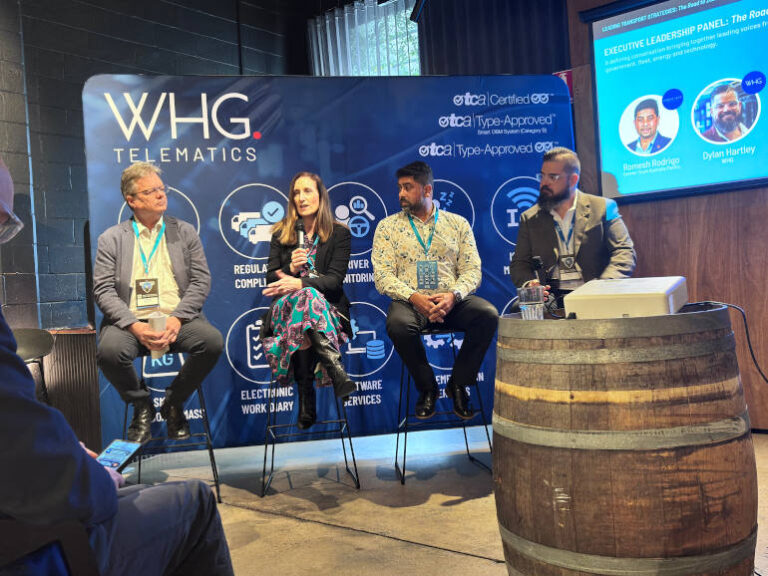
An executive panel featuring representatives from Daimler Truck Australia Pacific, FBT Transwest, ITS Australia and WHG explored what Australian transport businesses should be preparing for as 2030 approaches.
Topics included artificial intelligence, autonomous vehicles, connectivity, fleet investment and workforce pressures.
Daimler Truck Australia Pacific’s Romesh Rodrigo highlighted logistics optimisation, route planning, automation and infrastructure as areas that will become increasingly important alongside lower-emission trucks and alternative fuels.
Technology is also expected to change the skills required across driving, maintenance, logistics and fleet management rather than simply remove people from transport operations.
The broader view emerging from the panel was that the industry’s transformation will come through the interaction of technology, people and infrastructure rather than one major technological breakthrough.
WHG expands transport technology offering
TechDRIVE Brisbane was also used by WHG to announce several new products and services.
The company unveiled AssetIQ 730, an Australian-designed trailer and mobile asset management solution developed as a migration pathway for ageing solar-powered tracking technology while providing fleets with longer-term visibility of trailers and mobile equipment.
WHG also provided an update on FleetPREDICT, including the integration of Garmin connected wearables with OOGI AI camera technology. The combination is intended to bring driver, wearable and vehicle data together to support a more proactive approach to fatigue management.
WHG CEO – Australia Dylan Hartley said one of the most important outcomes from the Brisbane event was the willingness of different parts of the industry to work through the challenges together.
“What stood out in Brisbane was the level of genuine collaboration across the industry,” Hartley said.
“Operators, regulators, manufacturers and technology providers are all dealing with different parts of the same challenge.”
He said the future of transport would not be built around a single answer.
“The real opportunity is to bring those perspectives together, understand what works in real operations and find ways to deploy technology and new ideas that are practical, trusted and can scale.”