

For decades, higher horsepower has been seen as insurance in heavy fleets — a safeguard against steep climbs, slow trip times and heavy combinations. But as Australia’s major freight corridors have been rebuilt, that logic is increasingly being challenged.
According to Jono Wrightson, Business Manager – Detroit at Penske Australia and New Zealand, modern road design has quietly reduced the need for ever-larger engines in many mainstream applications.
Roads have changed — engine thinking hasn’t always followed
Australia’s key highways now look very different to what fleets were operating on 20 or 30 years ago. Major climbs have been eased, lanes duplicated and traffic flow improved.
“If you look at the old Pacific Highway versus the new Pacific Highway now, like, it’s a very different ball game,” Wrightson said.
Dual carriageways and bypasses mean trucks are spending less time hauling heavy loads up long grades — traditionally the scenario that justified high horsepower ratings.
“All those dual carriageways… they take pretty much all the hills out of the road,” he said.
Despite these changes, Wrightson said engine specification decisions often haven’t kept pace with the infrastructure fleets are now operating on.
Fit-for-purpose starts with the application
One of Wrightson’s key points was that trucks are no longer generalists. Most heavy vehicles are designed, built and set up for a specific task — and the engine should reflect that.
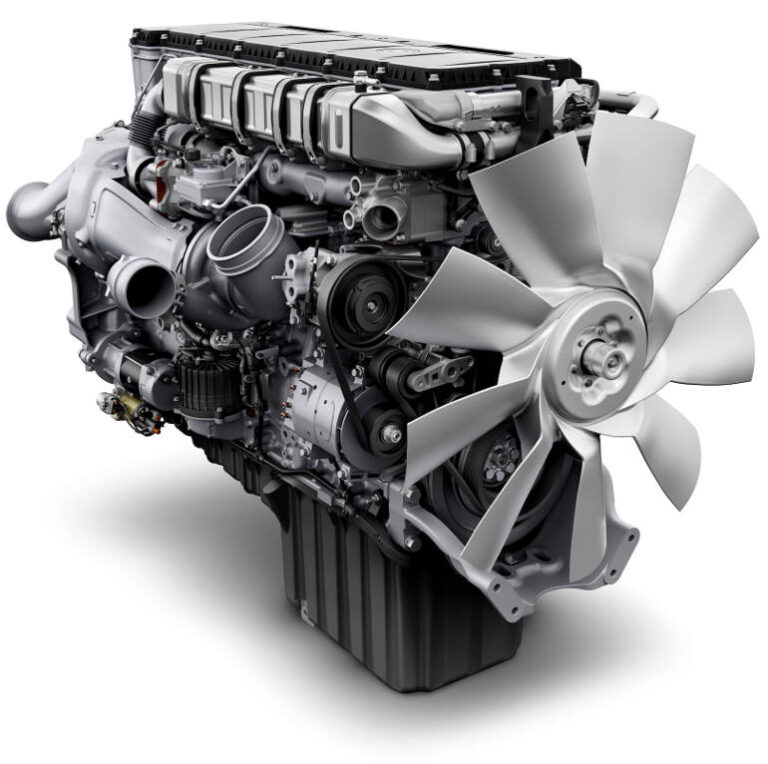
“The 13-litre can quite easily do the job of what the 15 or 16-litre people look for these days,” he said.
In linehaul and B-double operations along Australia’s east coast, that shift is becoming more obvious.
“The little 13 does a good job in all sorts of roles — B-doubles, around-town vocational work, all sorts of things,” Wrightson said.
Where vehicles are built for a single application — whether it’s linehaul, PBS combinations or vocational work — overspecifying horsepower can add cost without delivering real-world benefit.
The horsepower habit
Wrightson acknowledged that some of the demand for higher power is driven by habit rather than need.
“It comes down to the driver, and if the driver thinks they can get to the other end quicker,” he said. “More power sounds like it’s more better.”
But modern road geometry, speed limits and compliance requirements mean trip times are often dictated by factors other than horsepower.
“If you are going to cart more, you’re going to end up burning more fuel,” Wrightson said. “The more horsepower you have, the more fuel you’re going to have to burn to make that horsepower.”
When bigger engines do make sense
Wrightson was careful to stress that higher-output engines still have an important role — particularly in heavier PBS combinations and demanding operating environments.
However, he questioned whether those specifications are being applied too broadly.
“If you go back 20 years ago, we were pulling road trains with a lot less power than we’ve got now,” he said. “500 used to be the max power number for a road train, and now people won’t look at it if it’s less than 600.”
The trade-off, he said, is unavoidable.
“If you are going to cart more, you’re going to end up burning more fuel,” he said.
Matching engine size to modern networks
For Fleet Managers and Procurement Managers, Wrightson believes the conversation needs to shift from headline horsepower to application fit.
Modern highways, automated transmissions and proprietary drivetrains mean smaller engines are often operating closer to their efficiency sweet spot than their larger counterparts.
“Point one or point two of a kilometre per litre will add up over the year,” Wrightson said.
As Australia’s road network continues to improve, the hidden cost of chasing horsepower may no longer be at the bottom of a hill — but in fuel budgets, emissions reporting and whole-of-life cost calculations.
For fleets prepared to align engine size with how and where a truck actually operates, fit-for-purpose is increasingly proving to be the smarter performance metric.