

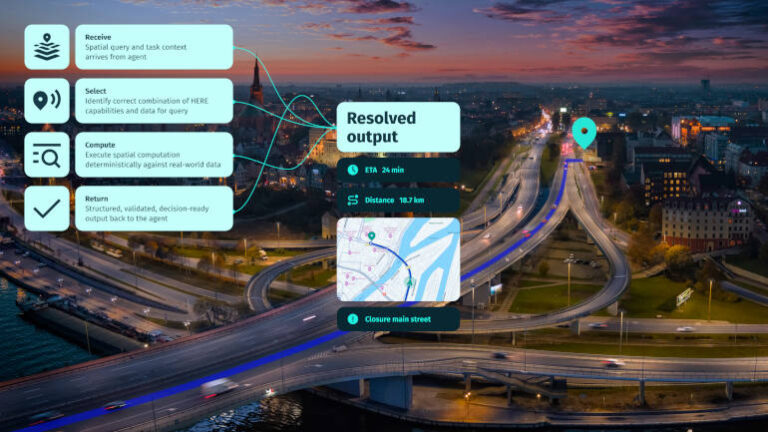
HERE Technologies has unveiled a new geospatial AI solution called HERE Location Reasoning, designed to improve how artificial intelligence systems make real-world, location-based decisions.
The company says the new platform addresses one of the growing challenges for AI and agentic systems as they move beyond answering questions and begin executing tasks in dynamic environments.

According to HERE, traditional large language models (LLMs) struggle with spatial reasoning because they are not built to reliably process constantly changing road, traffic and geographic conditions. The result can be inconsistent routing decisions, operational inefficiencies and higher costs.
HERE Location Reasoning is designed to act as a dedicated execution layer for spatial decision-making by combining HERE’s mapping data, live traffic information and road network intelligence with AI systems at runtime.
The platform converts location-based requests into structured execution flows that automatically select the appropriate HERE map and location services to deliver what the company describes as “consistent, decision-ready answers.”
The announcement highlights several practical fleet and transport applications where accurate spatial reasoning becomes critical.
Examples include identifying EV charging stations within a required time window during a route, finding suitable rest stops without major detours, assessing whether a truck can safely complete a turn based on road restrictions, and calculating compliant routes using live traffic and vehicle constraints.
The company also points to fleet dispatch operations and field service scheduling as areas where AI systems increasingly require deterministic location intelligence rather than probability-based estimates.
Christopher Handley, Senior Vice President of Product Management at HERE Technologies, said many AI systems are reaching limitations when dealing with real-world operational decisions.
“AI can describe the world, but it cannot reliably compute how the world works. HERE Location Reasoning will change that,” said Handley.
“As organizations move beyond basic, open data-driven queries to complex, real-world decisions, they are hitting a clear limit: AI models lack the data fidelity and capability to resolve spatial problems efficiently and cost effectively.”
Handley said the platform is intended to provide “the missing execution layer” that enables AI systems to compute spatial outcomes consistently and accurately.
HERE claims the system is designed to improve both operational performance and cost efficiency by reducing unnecessary API requests, lowering token usage and optimising execution times for location-heavy workflows.
Among the features highlighted in the announcement are deterministic results, low-latency performance, integration of live traffic and road network conditions, and a privacy-focused approach that does not retain personal data, user identity or query history.
The platform is built on HERE’s global mapping infrastructure, which the company says includes more than 68 million kilometres of mapped roads across over 200 countries and territories. HERE also claims its location services are currently used in more than 238 million vehicles globally.
The launch reflects the increasing focus on geospatial grounding as AI systems become more deeply integrated into transport, logistics and fleet operations.
For heavy vehicle operators and logistics providers, accurate real-time location reasoning could help improve route optimisation, compliance management, dispatch efficiency and operational visibility, particularly as fleets become more connected and increasingly reliant on automation and live data integration.
HERE said Location Reasoning is currently available through select customer and partner engagements as the company expands its AI-focused location services offering.