
For Fleet Managers and Procurement Managers, securing a new truck today is no longer just about when a chassis rolls off the production line. Delivery timelines are increasingly shaped by what happens after the chassis is built — particularly the time it takes to complete body builds and final fit-out.
At a media briefing late in 2025, Richard Emery, President and CEO of Hino Motor Sales Australia, provided rare clarity on where the current bottlenecks sit and why trucks with confirmed orders are still missing year-end delivery targets.
The misconception: chassis supply equals delivery
One of the most common assumptions in fleet procurement is that once a truck chassis is available, delivery is imminent. Emery challenged that thinking.
He explained that there are already enough trucks in the market with customer names on them, but many are not being delivered within the expected timeframe.
“There’s enough trucks in the market with customers’ names on them… I just don’t think they’re going to get delivered by the end of the year,” Emery said.
The issue, he stressed, is not always production volume — it’s what happens next.
Where the delay really sits: body build and fit-out
Once a cab-chassis leaves the factory, it typically enters a second, often lengthy, phase of the delivery process: body building.
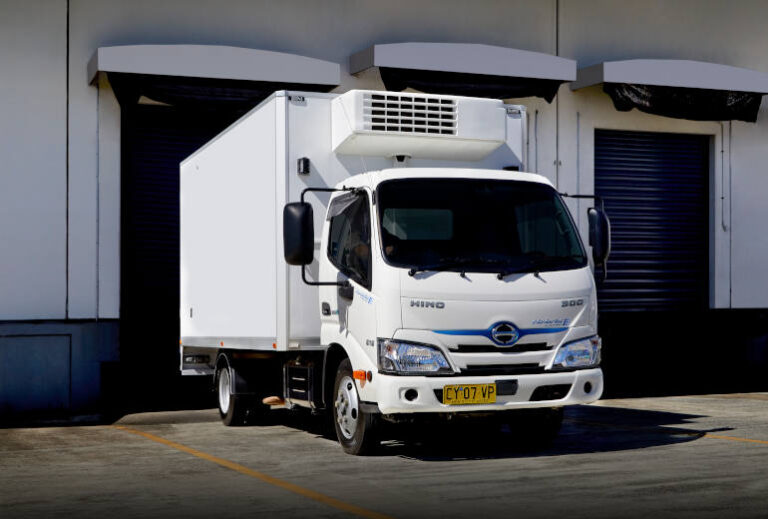
Fleet vehicles rarely arrive as complete, off-the-shelf units. Trays, tippers, cranes, waste bodies, refrigerated units, service bodies and specialist equipment all add time and complexity.
Emery was clear that this stage is now a major constraint.
“Vehicles are still slow to move through delivery channels,” he said, linking that directly to body building and fit-out timelines.
In some cases, trucks built in one calendar year are not delivered until the next — not because production stopped, but because they are waiting on bodies.
Why some ‘sold’ trucks slip into the next year
This dynamic also explains why sales figures and delivery numbers can diverge.
Emery noted that some Euro 5 trucks will still be delivered into 2026 only because they are delayed in body build, despite production having effectively ended.
“So we will deliver a few [trucks] into next year because they’re waiting on body builds,” he said.
For fleets, this can create confusion around replacement timing, registration forecasts and budget planning — particularly when projects are aligned to financial years.
A compounding effect for fleets
Longer body build timelines have a knock-on effect across fleet operations:
- Replacement cycles stretch, forcing fleets to keep older vehicles on the road longer
- Maintenance costs increase as life-expired assets are retained
- Operational planning becomes harder, especially for contract-based work
- Capital expenditure timing drifts, complicating budget approvals
While none of these pressures are new, Emery’s comments confirm they are now systemic rather than exceptional.
Not brand-specific — an industry reality
Importantly, Emery did not position this as a Hino-specific issue. The comments reflect a broader industry challenge affecting multiple OEMs and body builders as demand normalises after several intense years.
The shift to Euro 6 emissions standards, combined with bespoke fleet specifications and a backlog of deferred replacements, means delivery timelines remain extended even as chassis availability improves.
What fleet buyers should do differently
Based on the realities outlined in the briefing, fleet buyers should consider adjusting their planning assumptions:
- Separate chassis availability from delivery timing — they are no longer the same milestone
- Engage body builders earlier in the procurement process
- Build longer lead times into replacement schedules, particularly for specialised bodies
- Avoid end-of-year assumptions around delivery without confirmed body build slots
As Emery’s comments highlight, delivery timelines are now defined by the slowest part of the chain — and increasingly, that is not the factory.
The takeaway for 2026
Fleet delivery timelines are unlikely to snap back quickly in 2026. While production supply is stabilising, downstream constraints remain a critical factor.
For fleets that recognise this early and plan accordingly, the risk of disruption can be reduced. For those that assume a return to pre-COVID delivery norms, delays may come as an unwelcome surprise.
The message from the industry is clear: a truck isn’t delivered when it’s built — it’s delivered when the body is finished. And right now, that distinction matters more than ever.
- Hino 500 Series Means Business
 Hino is putting Australian operating experience at the centre of its 2027 medium-duty 500 Series, highlighting an established driveline alongside standard safety technology and connected fleet support. Since the platform’s introduction in 2019, the 500 Series has worked across applications ranging from freight and construction to council services and towing. For fleet managers assessing replacement
 - Three risks behind more than a third of major truck incidentsInattention, inappropriate speed and inadequate following distance accounted for 38% of major heavy vehicle incidents in 2025, according to new research that gives fleet managers a clear starting point for reviewing their safety priorities. The 2026 National Truck Accident Research Centre (NTARC) Major Incident Investigation Report found human factors contributed to 54.7% of all major incidents analysed.
- MAN TGS wins 2026 Fleet Truck of the Year – Heavy DutyThe MAN TGS has been named the 2026 Fleet Truck of the Year – Heavy Duty, taking the top spot in the Fleet News Group Best Value Analysis with an overall score of 7.730 out of 10. The MAN finished ahead of the Hino 700 Series, which scored 7.600, and the Volvo FH16, which recorded 7.495, making the Heavy Duty category one of
- IVECO Daily wins 2026 Fleet Truck of the Year – Light DutyThe IVECO Daily Cab Chassis 50C has been named the 2026 Fleet Truck of the Year – Light Duty, finishing on top of the Fleet News Group Best Value Analysis with an overall score of 6.010 out of 10. The Daily finished ahead of the Isuzu NPR , which scored 5.741, and the Hino 300 Series, which recorded 5.030. While all three finalists
- Modern trucks could help the industry tackle its driver challengeThe heavy vehicle industry’s driver shortage is not only a recruitment problem. It is also forcing truck manufacturers and fleet operators to reconsider the working environment they provide drivers. Hino Australia President and CEO Richard Emery believes the industry needs to do more over the coming years to encourage people to consider truck driving as