
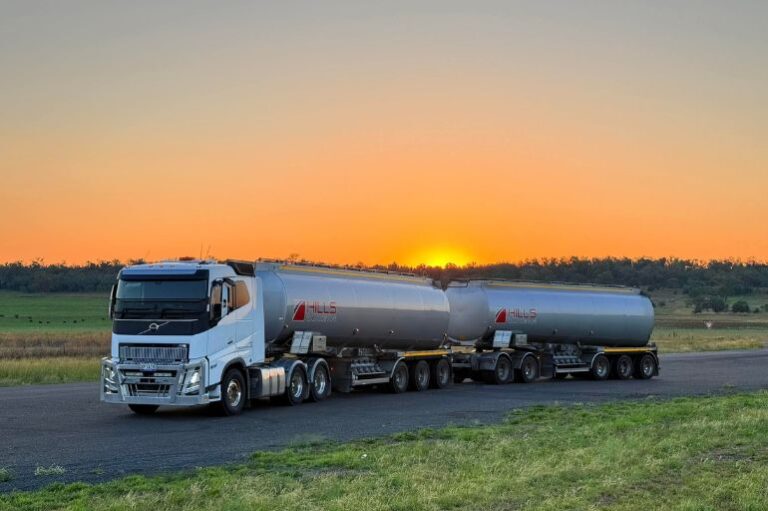
At Geotab Connect 2026, one of the more practical conversations came from the team at Hills Tankers, a long-established Australian fuel transport operator now exploring how AI-enabled telematics can support safety, compliance and reliability across a demanding national operation.
Speaking during the event, Shaun Cavanough, Chief Safety and Compliance Officer at Hills Tankers, described a business that has grown steadily over more than four decades while operating in one of the most tightly regulated and risk-sensitive sectors in road transport.
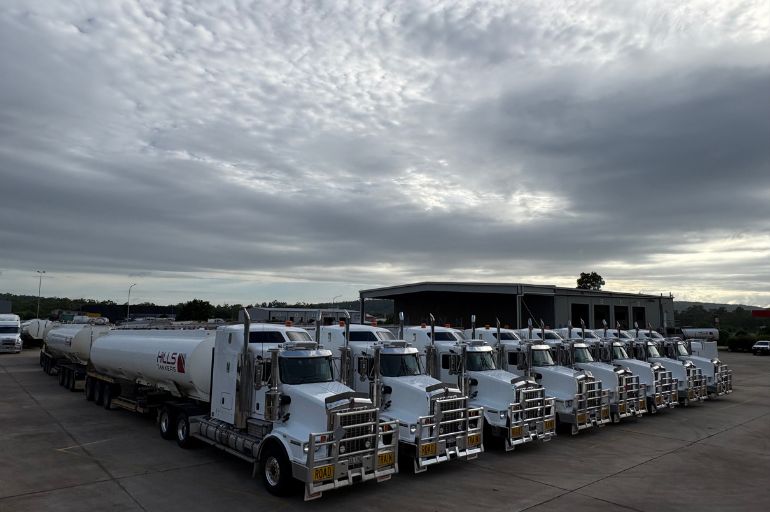
The company operates a fleet of around 115 trucks, ranging from quad road trains servicing regional and remote locations to single units working in metropolitan areas. Its network spans major centres including Newcastle, Sydney, Melbourne, Brisbane, Adelaide, Townsville, Toowoomba and Mackay.
Fuel transport remains the core of the business, with additional work involving bulk liquids such as coolants, chemicals and finished oils.

Managing Risk in a High-Consequence Operation
For operators like Hills Tankers, the consequences of downtime extend well beyond maintenance costs. Deliveries often support critical infrastructure such as airports, mines and defence facilities, where reliability is essential to maintaining operations.
Cavanough explained that even a single breakdown can have cascading effects across customers, drivers and logistics teams.
“You’re letting down your customers, you’re letting down your drivers, you’re letting down your operations staff,” he said. “A lot of our stuff is five or six hours before the site’s going to stock out.”
In urban areas, breakdowns can present immediate safety risks, particularly when vehicles are carrying dangerous goods. In remote regions, the challenge shifts to logistics and cost, with recovery operations sometimes taking several days.
“Something breaks down in a remote location, that driver could be a week before they are home,” Cavanough said, describing the reality of long-distance fuel distribution.
These operational pressures are driving renewed interest in technologies that can identify faults earlier and reduce the likelihood of unplanned downtime.
From Manual Monitoring to Exception-Based Management
Hills Tankers has previously used telematics, but the evaluation of newer AI-enabled platforms reflects a broader shift in the transport sector from manual monitoring to automated, exception-based workflows.
Cavanough said the company trialled the new system on a small number of vehicles as part of a staged rollout with Geotab reseller Leading Edge Innovations and has since implemented across the entire fleet.
One of the immediate differences has been the ability to focus attention only on incidents that require action, rather than reviewing large volumes of routine data.
“With our previous system, it’s all manual based. We go through videos, we go through telematics manually,” Cavanough said. “With Geotab, it shows you the exceptions.”
The change is particularly relevant for a business managing hundreds of drivers across multiple locations, where administrative workload can quickly become a bottleneck.
“The AI technology is pretty amazing in it. It’s going to cut our workload down,” he said.
Customers Are Driving Technology Requirements
Another factor influencing technology adoption is customer expectations. In the dangerous goods sector, many contracts now require specific safety and monitoring capabilities as part of standard operating procedures.
Cavanough noted that forward- and driver-facing cameras, GPS tracking and defined driving behaviour thresholds are increasingly mandated by customers.
“All our main customers demand forward and driver facing, plus GPS,” he said.
In some cases, individual customers require customised safety settings, adding complexity to fleet management but reinforcing the importance of flexible technology platforms.
The Shift from Mechanical Failures to Electronic Faults
One of the more consistent themes from operators at Geotab Connect was the changing nature of vehicle maintenance. Modern trucks are increasingly defined by electronics and sensors rather than traditional mechanical components.
Cavanough said this transition has altered how breakdowns occur — and how they need to be managed.
“Technology on trucks these days is complex, the problems are not mechanical,” he said. “It’s sensors or electrics when something goes wrong.”
The ability to detect these issues before a vehicle leaves the depot or while it is still operating safely on the road is seen as a key opportunity to improve reliability and reduce operational risk.
“If we can pick that up before we can send a technician out, it might be a technician goes out, or a tow truck goes out,” he said.
Learning from Global Fleet Operators
For Cavanough, attending Geotab Connect provided an opportunity to benchmark Australian operations against much larger fleets operating in North America.
The scale of those fleets — often numbering in the tens of thousands of vehicles — reinforced the potential benefits of adopting proven technology and management practices.
“The size of the fleets in the US are amazing,” he said. “Talk to people with 10,000 plus trucks. So if it works for them, it should work in Australia.”
Networking with other operators was identified as one of the most valuable aspects of the event, particularly in understanding how data and automation can support continuous improvement in safety and efficiency.
Early Days, but a Clear Direction
While the trial is still in its early stages, the direction of travel is clear. For Hills Tankers, technology adoption is less about replacing existing systems and more about reducing risk in an increasingly complex operating environment.
Predictive maintenance, automated monitoring and data-driven decision-making are becoming practical tools rather than theoretical concepts — particularly for fleets operating in high-consequence sectors such as fuel transport.
As Cavanough noted, there are no shortcuts when managing dangerous goods.
But there are opportunities to make the job safer, more reliable and more efficient through better use of data.