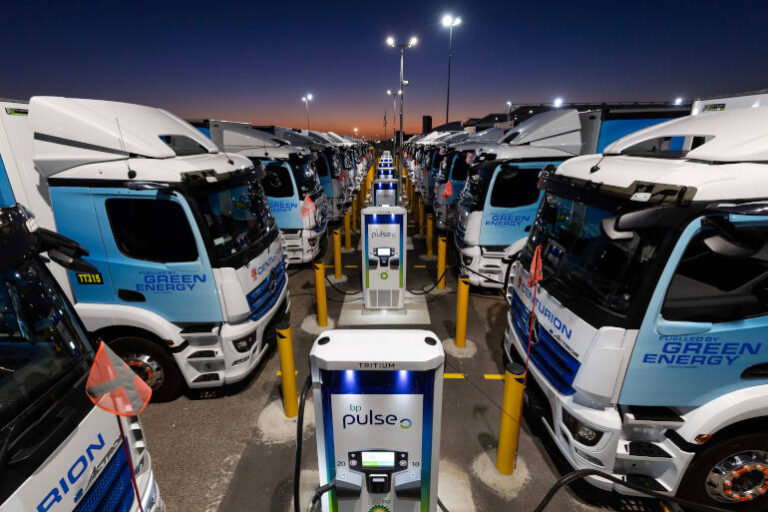
Government subsidies have played an important role in kick-starting interest in electric trucks across Australia. Funding for vehicle trials and charging infrastructure has helped bring early projects to life and demonstrated that zero-emission freight is technically possible.
But as industry experience grows, a harder truth is emerging: subsidies alone are not enough to drive widespread adoption.
Despite increasing policy support and manufacturer investment, many fleets are still sitting on the sidelines. According to industry leaders, the reasons have less to do with technology — and far more to do with economics, operations and risk.
Fleets still have to say yes
Rainer Knobloch, Chief Operating Officer of NewVolt, says one of the early assumptions in the sector was that financial support would naturally translate into fleet uptake.
“You can throw all the money you like at truck subsidies, but fleets still have to make the decision to do this. And there are a lot of reasons why they might not.”
That decision is far more complex than simply comparing a diesel truck price with an electric alternative. Fleets must consider how a new vehicle fits into existing operations, customer contracts, driver availability and long-term asset strategies.
In many cases, electric trucks represent a step change in risk rather than a like-for-like replacement.
Capital risk and residual value uncertainty
One of the most significant barriers remains upfront capital cost — but the bigger concern for many fleets is what happens at the end of the vehicle’s life.
“It’s not just the upfront price. A lot of the challenge is around residual value assumptions,” Knobloch said.
Uncertainty around battery degradation, secondary markets and remarketing values makes it difficult for fleets — and financiers — to confidently model whole-of-life costs. While diesel residuals are well understood, electric trucks are still writing their first chapters.
This uncertainty is particularly acute for fleets operating under short-term transport contracts, where vehicles may need to be replaced or redeployed every two to three years.
Operational complexity outweighs incentives
For many fleets, the biggest hurdle is not financial support but operational disruption.
Electric trucks introduce new variables into tightly optimised freight systems: charging windows, route planning, driver changeovers and energy pricing. Even where duty cycles appear suitable on paper, real-world operations often expose hidden complexity.
“The trucks and the duty cycles are more complex than people think. The complexity is around how you get the operations right and make electric freight sellable.”
Long-haul and high-utilisation vehicles, in particular, leave little margin for error. A charging delay or route change can quickly cascade into missed delivery windows or additional labour costs.
Capability gaps inside fleets
Larger fleets with sustainability or innovation teams are often better placed to explore electrification. They have the internal resources to model routes, analyse costs and engage with multiple stakeholders.
Mid-sized and smaller fleets, however, frequently lack that capacity.
“Some fleets have people whose full-time job is to figure this out. Others don’t have that at all. They’re still learning how to model their own costs.”
Without a clear understanding of current cents-per-kilometre, energy usage and utilisation, it becomes difficult to assess whether an electric truck will improve or worsen performance — regardless of available subsidies.
Subsidies don’t simplify decisions
While public funding can reduce upfront costs, it does not remove the need for fleets to commit to long-term operational change.
“Even with all the infrastructure money in the world, fleets still need to decide how this fits into their business.”
That includes decisions about depot charging versus third-party charging, changes to shift patterns, training requirements, and how costs are passed through to customers.
For many transport operators, particularly those servicing price-sensitive customers, the risk of higher operating costs or reduced flexibility outweighs the benefits of early adoption.
Infrastructure and energy still matter
Subsidies also do little to address broader system constraints, including grid access, electricity pricing and charging availability.
Electric freight economics are highly sensitive to energy costs, which vary by location and time of day. Many trucks operate overnight, when electricity can be more expensive, undermining the benefit of cheaper renewable generation during daylight hours.
Battery energy storage and smarter charging strategies are emerging as solutions, but they add another layer of complexity to fleet decision-making.
Why collaboration matters more than cash
One of the lessons emerging from projects such as Hume Zero is that adoption requires coordinated effort across fleets, infrastructure providers, energy companies and government.
Rather than relying solely on incentives, the focus is shifting toward reducing risk, improving operational certainty and sharing knowledge across the industry. Global programs such as Drive to Zero, led by CALSTART, are built around this collaborative model.
The aim is not to force fleets to change, but to make the decision easier and more commercially viable.
Moving beyond the subsidy mindset
Subsidies have helped open the door to electric freight in Australia, but they are not the deciding factor for most fleets.
The real work lies in simplifying operations, reducing risk, building confidence in residual values and helping fleets understand their own cost structures.
“This isn’t going to be solved by one party stepping in and fixing everything,” Knobloch said. “Everyone has to lean in.”
Until those fundamentals are addressed, subsidies will remain a helpful support — but not the catalyst for mass adoption.
Fleet News Group has been a trusted source of news and information for the fleet and transport industries since 2011. Our global audience provides services and products to their local communities by moving people and goods from one place to another. We celebrate their contributions to our society by sharing their stories.