

In an exclusive interview at Geotab Connect 2025 in Orlando, Florida, Sean Killen, Vice President of Global Markets at Geotab, shared his observations on the Australian trucking industry, highlighting its unique challenges, technological adoption, and where he sees it heading in the coming years.
Regulations and Technology Lag
Australia’s trucking industry operates under some of the most stringent compliance requirements in the world, which has shaped the slow adoption of global telematics solutions.
“Australia doesn’t care if what the US does. I’m Australia. I want what Australia wants. Because I’m Australia, I can do what I want,’” Killen said, highlighting the country’s independent regulatory stance.
This insistence on unique national regulations has made it difficult for international telematics providers to enter the Australian heavy-vehicle market.
“It’s hard to make sure you comply with everything that Australia requires, because it’s a very advanced country… a lot of companies haven’t gone in because of that. Because it’s hard, it’s hard to learn everything you have to know about Australian compliance.”
Geotab, however, has invested heavily in developing a compliant heavy-truck solution for Australia, a process that took 18 months of dedicated R&D.
“We finally, in the next month, should have a big announcement that we’re fully compliant in Australian heavy truck,” he revealed.
A Traditional Industry Facing Modern Pressures
Unlike other markets, Australian trucking remains heavily owner-operated, with many businesses passed down through generations.
“The Australian trucking industry will very much have to modernise in the next 10 years to more of a digital platform, because the margins are so tight. The big groups have already done it. The small, local, entrepreneurial guys will have to do it too.”
Killen noted that at truck events like the Brisbane Truck Show, the industry’s traditional nature is on full display.
“If you go to the Brisbane Truck Show right now and you walk around, it is like old school. And those guys got into that lifestyle because they wanted the freedom of that life. And they love it.”
Introducing new technology into this deeply traditional sector has been a challenge.
“To introduce technology is a little scary. But the progressive companies—like your Toll and Linfox and some of the smaller transport companies that are running at very tight margins—they must innovate and be advanced.”
The Generational Shift Will Drive Change
Killen believes that change is inevitable, as younger generations inherit trucking businesses.
“One of my favorite things about the Australian trucking market is they are super proud to own those companies… but the margins are tight, and the kids know that they’re gonna have to innovate.”
He described the generational dynamic at industry events, where families attend together.
“You’ll see dad, son, and teenager walking around together, and dad’s still driving. Grandpa owns the company, and he’s the CEO, and then the kid is just waiting till he’s allowed to drive.”
Unlike in the United States, where many families encourage their children to leave trucking, Australians tend to keep their businesses within the family.
“In the US, a lot of them have been absorbed into big companies, so there’s no ownership anymore. In Australia, it’s like, ‘Grandpa owns the company, dad’s the CEO, and I’m the next CEO.’ And they’re going to keep it in the family.”
Heavy Reliance on Trucks vs. Rail
Another defining feature of Australia’s transport industry is the lack of rail infrastructure, which makes long-haul trucking essential.
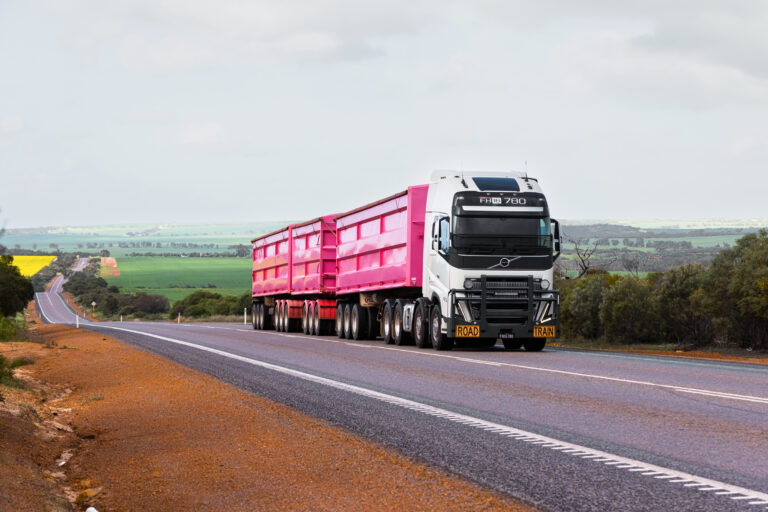
“In Australia, that’s done by a truck, right? You got those four trailer big, crazy ones,” Killen said, referring to road trains used for freight transport across vast distances.
“I think those are the most fascinating vehicles I’ve ever seen, that somebody can drive that and make a turn with that… it’s insane.”
Unlike in North America, where freight rail networks reduce truck reliance, Australia’s trucking industry carries much of the country’s supply chain burden.
“You don’t see it anywhere else… I don’t see that in Brazil or Mexico. There’s no quads anywhere else.”
The Road Ahead: Digital Innovation
Killen is confident that, while change will take time, Australia’s trucking industry will eventually shift towards digital platforms and AI-driven telematics.
“The small, local, entrepreneurial guys will have to do it too… but 80% of the Australian trucking industry is owner-operated with like, five vehicles, 10 vehicles at the most.”
As the next generation of trucking entrepreneurs takes over, digital transformation will become essential for survival.
Killen’s insights paint a picture of an industry rooted in tradition but facing undeniable change. With growing regulatory pressures, increasing safety demands, and the need for efficiency, Australian trucking is on the verge of a telematics revolution.
- Hino 300 Series Euro 6 review: the best changes are behind the wheel
 Hino’s Euro 6 300 Series looks familiar, but a drive through traffic, along the freeway and into winding mountain roads reveals a truck with a noticeably different character. The combination of stronger torque delivery and an updated six-speed automatic makes the light-duty Hino an enjoyable working companion. Across several loaded models, the standout was how
- IVECO Daily and MAN TGS take truck honours in All Things FleetThe IVECO Daily and MAN TGS lead the truck coverage in the November issue of All Things Fleet, out now. The issue profiles the 2026 Fleet News Group Truck of the Year winners and looks at how longer-range electric trucks could change the jobs available to battery-powered heavy vehicles. What put the winning trucks ahead The
- Customers want greener trucks – but aren’t prepared to pay moreTransport operators are being encouraged to invest in lower-emission trucks, but the commercial reality is that many freight customers remain focused on price rather than sustainability. Speaking at MOVE Australia 2026 in Sydney, Sarah Halpin, CEO of GMK Logistics, highlighted the challenges facing transport businesses as they balance rising operating costs, customer expectations and the
- Australian fleet operators overwhelmed by technology as 71% call for unified systemAustralian fleet operators are struggling with technology overload, with 59% saying they have too many tools to manage and 48% reporting they are “drowning in data”, according to new research from Microlise. The findings, from Microlise’s Australian Fleet Cost & Productivity Benchmark 2026, reveal a disconnect between technology investment and operational efficiency. 71% of respondents would
- UPS makes major move into Australian healthcare transportGlobal logistics giant UPS is set to strengthen its position in the Australian and New Zealand healthcare transport market after announcing an agreement to acquire specialist logistics provider Smartways Logistics. The acquisition will expand UPS Healthcare’s time-critical transport capabilities across Australia and New Zealand, providing greater access to specialist services supporting the movement of pharmaceuticals,