
Australia has the technology and engineering expertise to improve heavy vehicle productivity and reduce transport emissions, but inconsistent regulations between states are holding back progress.
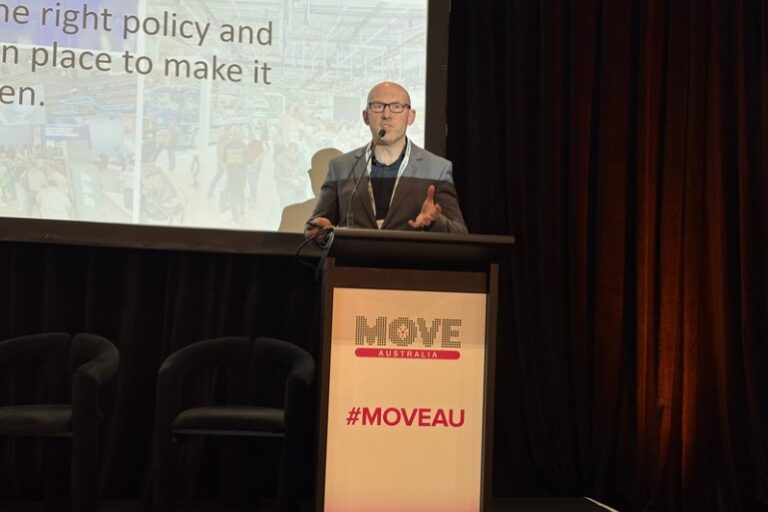
That’s the message from Adam Ritzinger, Chief Technical Officer at Heavy Vehicle Industry Australia (HVIA), who used his presentation at MOVE Australia 2026 to highlight the regulatory barriers preventing the industry from taking full advantage of new vehicle technologies.
Having recently attended the IAA Transportation exhibition in Germany, Ritzinger said Australia and Europe were facing similar challenges as the industry works towards lower emissions and greater freight efficiency.
“We have the technology, we absolutely have the skills and the expertise to meet this decarbonisation challenge head on and transform productivity. But what we need are the policy settings in place to make it happen,” he said.

A national industry with different rules
One of the clearest examples is Australia’s Performance Based Standards (PBS) scheme, which allows innovative heavy vehicle combinations to operate outside conventional mass and dimension limits when they meet prescribed safety and infrastructure performance requirements.
Ritzinger praised PBS as an Australian success story, pointing to combinations such as four-axle trucks with six-axle dog trailers, 30-metre A-doubles and high-productivity combinations operating in Western Australia.
However, he argued that the benefits are being constrained by inconsistent road access arrangements.
Using a truck and dog combination as an example, Ritzinger explained that operators could face a choice of 19 networks under PBS compared with 40 networks outside the scheme.
Different state requirements for vehicle length, mass, axle configurations and freight applications have created a complicated operating environment.
“Imagine if you bought a new car, but the rules changed when you hit the New South Wales border between here and Victoria. That would be unheard of. But that’s what transport companies deal with every day,” Ritzinger said.
He acknowledged the productivity improvements delivered by PBS but said the system could be strengthened through greater national consistency.
The proposed National Automated Access System could help simplify access arrangements, although Ritzinger indicated that its effectiveness would depend on how it was implemented.
Electric trucks face another access challenge
The transition to low and zero-emission heavy vehicles is exposing further limitations in existing regulations.
Battery-electric trucks often carry additional weight because of their batteries, potentially affecting payload capacity and compliance with axle mass limits.
For fleet operators, this creates uncertainty when evaluating electric vehicles against conventional diesel alternatives.
Ritzinger highlighted NSW initiatives allowing higher axle loads for low and zero-emission heavy vehicles as an example of the policy changes needed to support adoption.
However, he argued that these arrangements should be permanent and consistent across Australia.
“We can give the vehicles the increased axle loads that they need, and we can give them axle certainty. But we need more of that, and we absolutely need it to be consistent across all the states,” he said.
Without national consistency, operators investing in new technology could still encounter different operating restrictions when crossing state borders.
Policy needs to support the transition
Ritzinger also acknowledged that fleet operators continue to face commercial and operational questions about low and zero-emission trucks.
Total cost of ownership, return on investment, charging infrastructure, payload equivalence and network access remain important considerations.
While vehicle technology is advancing, he argued that governments need to help the industry overcome the barriers associated with early adoption.
HVIA is calling for a National Heavy Vehicle Net Zero Roadmap, stronger PBS arrangements, nationally consistent access rules and targeted support for low and zero-emission vehicles.
That support could include direct funding, incentives, research and development assistance and infrastructure investment.
Importantly, Ritzinger argued that financial assistance would not need to continue indefinitely.
“Because eventually the vehicles will make sense on on their own, the economics will make sense on their own. But right now, we need to help us get over that initial adoption curve,” he said.
Productivity must remain a priority
For fleet managers, the implications extend beyond emissions reduction.
Heavy vehicle purchasing decisions are based on payload, productivity, operating costs, route access and asset utilisation. Regulatory uncertainty can undermine the business case for investing in more efficient equipment.
Ritzinger’s central argument was that Australia should be able to improve freight productivity while introducing cleaner technologies, rather than forcing operators to choose between the two.
“We need to improve and strengthen the PBS system by harmonising the states and removing those access roadblocks,” he said.
He also delivered a clear warning about the importance of protecting the productivity gains already achieved.
“Let’s not sacrifice productivity for access.”
The message for policymakers is that the technology is available, Australian manufacturers and operators have demonstrated their ability to innovate, and the next step is creating a regulatory environment that allows those innovations to deliver benefits nationally.
For fleet operators, greater consistency could mean fewer access complications, more certainty when investing in new vehicles and better opportunities to improve productivity while reducing emissions.