

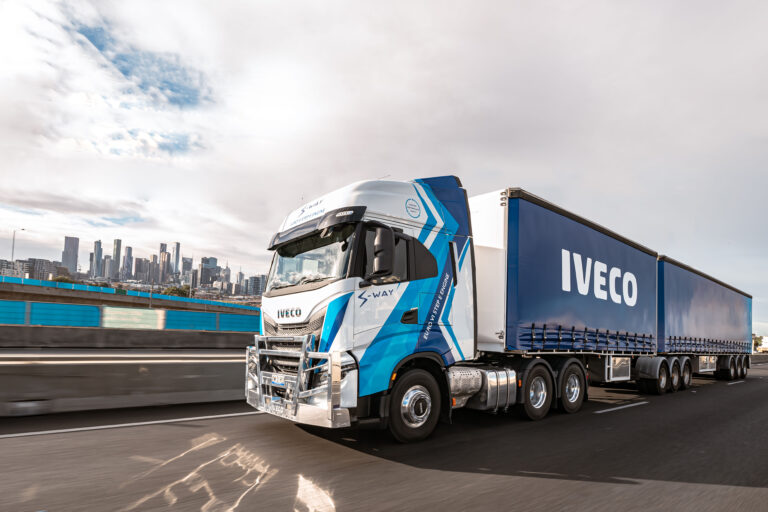
Australia’s freight and logistics sector may see a modest improvement in vehicle demand during 2026, but transport operators are still facing significant financial pressure, according to IVECO Australia Managing Director Glen Dyer.
While some international markets have described current conditions as a freight recession, Dyer believes the Australian market is likely to stabilise rather than contract further, with a small uplift expected in certain segments of the truck and van market.
“I think at the moment what we’re forecasting for ourselves is that the market is going to pick up a little bit, particularly in light vehicles and heavy vehicles, not hugely, but a bit,” Dyer said.
He expects the medium-duty truck segment to remain relatively stable, while light commercial vehicles and heavy trucks could see slight growth as operators begin replacing ageing assets.
Despite this modest improvement in demand, Dyer warned that transport businesses will continue to face significant economic challenges.
“I think the biggest pain point is there’s going to be continued pressure on operators,” he said.
Cost pressures across fuel, labour and vehicle operations have created a difficult environment for freight companies, many of which operate on tight margins.
Fleet renewal driving demand
One factor supporting demand for new trucks and vans is the ageing of existing fleets.
Dyer said many operators delayed vehicle replacement decisions during the recent downturn, choosing instead to extend the life of their current vehicles. However, that strategy is beginning to reach its limits as maintenance costs increase and reliability becomes a concern.
“I think you get to a stage where at some point you have to renew fleet,” he said.
IVECO has observed this trend particularly among fleet customers that rely on vehicles as critical business assets.
“We’ve seen some customers, particularly in the fleet space, have really sweated their assets to the point where they’re looking at them going they’re starting to become uneconomical because of the cost to keep them operating,” Dyer said.
For many operators, vehicle replacement decisions are therefore shifting from discretionary spending to operational necessity.
This delayed replacement cycle is expected to support a gradual recovery in vehicle sales during 2026, even if broader economic conditions remain uncertain.
Leisure sector still subdued
Within the light commercial vehicle segment, some sectors are still recovering from earlier market fluctuations.
IVECO supplies a significant number of vehicles to the leisure vehicle industry, which experienced a strong surge in demand during the COVID period before slowing in recent years.
“We do a lot in the leisure industry, which has seen a correction over the last few years,” Dyer said.
He expects that part of the market to remain relatively flat compared with the unusually strong demand levels seen during the pandemic.
However, outside the leisure segment, the broader fleet market is showing signs that replacement activity may begin to increase.
Fleet buyers becoming more analytical
Another trend shaping the market is the increasing sophistication of fleet buyers when evaluating vehicle purchases.
Dyer said fleet customers are increasingly focused on whole-of-life costs rather than simply the purchase price of the vehicle.
“Fleets are more sophisticated,” he said.
When quoting for fleet business, he said operators typically examine a wide range of cost factors.
“It is all around the price, the gap to the end value, the warranty, the repair maintenance contract, fuel efficiency — everything is extremely important,” Dyer said.
For Fleet Managers, greater certainty around operating costs allows them to better forecast expenses and manage profitability.
“The more fixed costs, the more known costs, obviously the more they can forecast and predict future earnings,” he said.
Gradual recovery rather than rapid rebound
While the commercial vehicle market may see improvement in 2026, Dyer emphasised that any recovery is likely to be gradual rather than dramatic.
Many operators are still managing tight margins, and economic uncertainty continues to influence purchasing decisions.
For manufacturers such as IVECO, the outlook therefore reflects a cautious balance between improving demand and ongoing industry pressure.
Overall, the combination of ageing fleets and operational necessity may drive a modest increase in truck and van sales, even as transport businesses continue navigating one of the most challenging operating environments in recent years.