

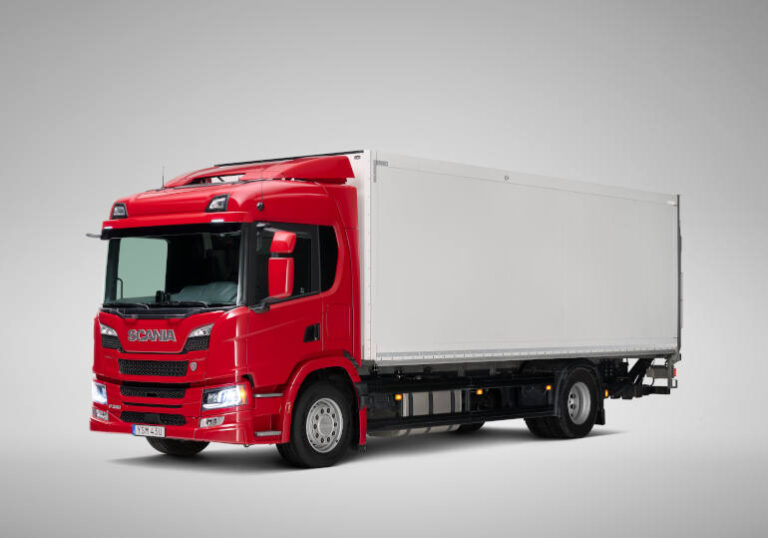
Scania’s P-series distribution cab has achieved the highest possible safety rating in the European New Car Assessment Programme (Euro NCAP) Safer Trucks programme, reinforcing the growing focus on urban safety performance for heavy vehicles.
The five-star rating applies to the P4x2 distribution variant tested by Euro NCAP and also extends to the P6x2 utility configuration, as well as Scania’s L4x2 distribution models. The result builds on a recent five-star rating for the company’s L6x2 utility truck, highlighting consistent performance across its urban and regional vehicle range.
Focus on urban safety performance
Euro NCAP’s Safer Trucks programme places particular emphasis on systems designed to reduce collisions in city environments, where interactions with vulnerable road users such as pedestrians and cyclists are more frequent.
In addition to the overall five-star result, the P-cab recorded the highest mark in the organisation’s “CitySafe” category, which evaluates safety features intended to prevent accidents in urban settings.
The assessment highlighted the effectiveness of Scania’s updated crash avoidance technologies. These systems achieved an overall score of 93 per cent, covering functions such as frontal collision mitigation, lane departure prevention and protection for vulnerable road users during turning manoeuvres. The Vulnerable Road User Brake Side (VRUBS) system recorded a perfect 100 per cent score in testing.
The vehicle’s design also contributed to the rating. The cab’s elevated seating position provides improved forward visibility, while features such as the low cab position and corner-eye camera enhance the driver’s view of pedestrians and cyclists around the vehicle.
Validation of safety investment
Lars Gustafsson, Head of Trucks at Scania, said the result reflects the company’s ongoing investment in safety technology and its response to changing expectations from cities and transport customers.
Lars Gustafsson, Head of Trucks at Scania, said:
“To see that our P-cab follow suit and receives the same high rating as our L-cab refuse truck did earlier by Euro NCAP shows that safety is something we put our pride in. It is also proof that we deliver on the increasingly high expectations from cities, customers, transport buyers and road users, in line with our values.”
Euro NCAP also acknowledged the broader significance of the result for urban transport safety.
Matthew Avery, Director for Strategic Development at Euro NCAP, said:
“It is great to see Scania leading the way in safety by producing safer trucks for the city environment and in so doing protecting Europe’s more vulnerable road users – a real achievement.”
Direct vision and driver ergonomics remain priorities
Alongside the P-cab result, Scania’s L-cab distribution vehicle was also recognised for its safety performance, particularly in relation to direct vision from the driver’s position.
The L-cab is designed specifically for urban distribution work, where frequent stops, tight manoeuvres and close proximity to pedestrians place additional demands on vehicle ergonomics and visibility. Features such as the Scania City Door are intended to improve accessibility and safety when operating in confined urban environments.
Gustafsson noted that the consistent results across both cab types demonstrate the benefits of Scania’s modular vehicle platform, which maintains common layouts and controls across different configurations.
Lars Gustafsson, Head of Trucks at Scania, said:
“Our trucks deliver on our promise to not only have great comfort, but also safety that is on par with the highest standards of the Euro NCAP. Safe trucks are vital given the importance transport has in society. The safety of road users is something we always keep in mind while we develop new transport solutions.”
Implications for fleet operators and urban transport
For fleet operators, particularly those operating in metropolitan distribution, waste collection and construction sectors, safety ratings from independent testing bodies are increasingly influencing procurement decisions.
Urban freight movements continue to grow as e-commerce and population density increase, placing greater scrutiny on vehicle safety systems that reduce collision risk and support compliance with evolving city safety requirements. Independent assessments such as Euro NCAP’s Safer Trucks programme provide a benchmark for comparing vehicles beyond traditional performance metrics.
The latest results suggest that active safety technology, direct vision design and driver-assistance systems are becoming central considerations in vehicle selection for urban fleets, alongside productivity, reliability and whole-of-life cost.
As cities and regulators continue to prioritise road safety outcomes, the role of independently verified safety performance is likely to remain a key factor in shaping heavy vehicle design and fleet purchasing strategies.